Emily Harstone is the author of many popular books, including The Authors Publish Guide to Manuscript Submissions, Submit, Publish, Repeat, and The 2026 Guide to Manuscript Publishers. She regularly teaches three acclaimed courses on writing and publishing at The Writer’s Workshop at Authors Publish. You can follow her on Facebook here.
Please note that if a publisher doesn’t have a specific submission window they can close at any time, and publishers that use Submittable can close at any point because of submission caps (although these publishers generally reopen to submissions at the end of the month).
If a publisher has closed to submissions unexpectedly, please send us an email at support@authorspublish.com.
Please read the full review, which we link to in the publish name, and carefully consider fit before submitting work. I can not stress enough that you should only submit to presses that are a good fit for your work, and that you should carefully read and follow submissions guidelines before submitting that work. Over the past year we had several presses ask to be de-listed because they were deluged by submissions, even after moving to this format. Still more presses have had to temporarily close to submissions because of an influx of inappropriate submissions.
Major Street Publishing
Major Street Publishing is a leading business book imprint, that has been around for 15 years. They are now a part of Moore Street Media. Even though all their submission guidelines are on the same page, each of the Moore Street Media imprints is distinctly different, which is why we are reviewing them separately. Moore Street Media and all of their imprints are based in Australia.
Plumleaf Press
Plumleaf Press is a small press based in Oakville Ontario. They started publishing work in 2015. Their books are represented by Ampersand Inc, and are distributed by the University of Toronto Press, which is good. They were founded by editor Maggie Goh. This is how she describes the name: “The name Plumleaf Press combines my father’s surname, Lee (李), which means plum, and my mother’s surname, Ye ( 葉), which means leaf. In Chinese tradition, the plum, which blossoms even in the deepest winter, is a symbol of tenacity and integrity. A green leaf signals renewal and hope”.
ARP Publishing
In 1966 Arbeiter Ring Publishing was founded initially as a workers’ collective. They started by publishing a few Marxist-leaning and left leaning books each year. Over time they have come to operate as ARP Books although their official name is Arbeiter Ring Publishing Ltd. They currently say this is their mandate: “To publish a dynamic combination of non-fiction, literary fiction, essay, poetry, and other writing that cannot be constrained by genre categories while encouraging innovative new writing.” They are based out of Winnipeg, Manitoba. You can learn more about their history and vision here. You can see what they have recently published if you scroll down here.
Arndell
Launched in August 2024 by Australian author T L Swan, Keeperton is a new press with good distribution. You can learn more about its launch here. They describe their publication by saying, “Keeperton is a publisher that takes immense pride in our commitment to prioritising authors at every step of the publishing journey. We understand that each author has a unique voice and story waiting to be heard, and we are dedicated to ensuring that they are at the heart of everything we do.” You can read their full About Us here, but Arndell is their signature imprint, and so far, all the books they’ve published are under the Arndell imprint, which only publishes Romance. They are also open for submissions of Crime & Thrillers, and Children’s Fiction, and of Romantic Fiction for their Keeperton imprint, which I’ve also reviewed.
Shadow Mountain
Shadow Mountain is an imprint of Deseret Books. Both publishers have their roots in The Church of Jesus Christ of Latter-day Saints, but Deseret Books focuses more on producing faith-based content. Shadow Mountain publishes primarily fiction and they have published a number of New York Times bestselling books. They are very firm about publishing “clean books only”. However the authors need not be members of The Church of Jesus Christ of Latter-day Saints. They have limited reading periods every year, and one of them is the 1st-7th of September.
Crooked Lane
Crooked Lane was founded in 2014 as a press specializing in crime books. They have an experienced staff and have managed to publish some well known authors already. They publish a range of mysteries that lean towards the cozy, and they are not opposed to publishing a series of books. You can see their catalog here. They have recently started publishing horror fiction also, and are open to submissions in that genre as well.
Pen & Sword Books
Pen & Sword Books is an established and respected publisher of nonfiction. They are based in the UK. They are also the majority shareholder for Script Publisher Services, which is a major distributor. Pen & Sword Books has excellent distribution, primarily in the UK. They are best known for publishing specialist military history books, under their Pen & Sword imprint, but publish a range of nonfiction books under other imprints as well. You can see their full list of imprints here.
Harlequin Medical Romance
Harlequin Medical Romance is looking to publish manuscripts of 50,000 words set in the medical world. They say they are seeking “Intense, uplifting and relatable romances set in the medical world. Experience the rollercoaster of emotions, ambitions and desires of today’s medical professionals.”
Dreamsphere Books
Dreamsphere Books publishes fantasy, science fiction, horror, thriller, and mystery books. They focus on publishing genre work, but are not interested in YA romance or adult romance as other imprints, Deep Hearts YA and Deep Desire focus on these genres. Dreamsphere is an imprint of Story Perfect Books which you can learn more about here. It’s a small, family-run company based in Canada, and one of the editors does self-publish his work through one of the imprints. You can learn more about the Dreamsphere here, including the staff.
Wild Heart Books
This small press focuses on publishing “historical romance novels set prior to 1950 and woven with the truth of God’s love”. You can see their staff page here. They were founded by an established Christian historical romance writer. They really focus on their niche, and seem to be successful within that context. A number of their books have over 70 ratings on Amazon. Their covers are well-designed and genre-appropriate.
]]>
That’s the danger.
You write one shiny little line and suddenly your brain behaves like a Labrador retrieving tennis balls. Again. Again. Throw another metaphor into the yard. Make it wink. Make it acrobatic. Somebody compare heartbreak to expired yogurt in a motel fridge. Fantastic. Pulitzer incoming.
Meanwhile the actual story is lying unconscious behind the building. I know this because I’ve written entire paragraphs that functioned like decorative scarves thrown over emotional plumbing problems. Very stylish. Absolutely leaking underneath.
Cleverness is addictive partly because it creates the illusion of authority. A sentence arrives wearing sunglasses indoors and everybody assumes the writer knows what they’re doing. Readers laugh. Readers underline things. Workshop people make appreciative little humming noises like somebody served expensive cheese.
But occasionally you reread the scene later and realize nothing happened except linguistic gymnastics performed above an emotional sinkhole.
That realization feels terrible. Like discovering your houseplant is plastic after watering it for eight months.
The issue isn’t wit itself. Wit can sharpen pain beautifully. Humor often carries emotional truth more effectively than solemnity does. Some griefs become visible only sideways. A joke can expose loneliness faster than six pages of literary fog rolling across symbolic furniture.
But there’s a difference between voice and performance.
Voice reveals.
Performance distracts.
You can feel the difference physically while reading. Voice pulls you closer to the nervous system underneath the prose. Performance keeps reminding you somebody intelligent is operating machinery nearby.
One feels intimate.
The other feels like attending a magician’s birthday party against your will.
And look, writers who grow up praised for being “smart” are especially doomed here. Every sentence becomes a chance to prove verbal agility. You start writing like a raccoon stealing silverware. Ooo shiny object. Another one. Stack them higher.
The problem usually starts with fear. Plain sentences terrify insecure writers because plainness removes hiding places. If a simple sentence lands emotionally, the feeling stands naked in the room. No smoke machine. No jazz hands. Just truth sitting there chewing ice loudly.
That kind of exposure makes people panic.
So instead the prose starts doing backflips.
Characters don’t cry anymore. Their sadness becomes “an orchestra of abandoned shopping carts rattling through the cathedral of late capitalism” or whatever sleep-deprived nonsense the writer cooked at 1:40 a.m.
Brother. He’s just sad.
And sometimes the cleverness actively sabotages emotional timing. Somebody says something devastating, then immediately follows it with a witty observation because the writer got nervous about sincerity lingering too long. This happens constantly. Comedy as emotional hit-and-run.
You’ll see it in dialogue especially. Characters become stand-up comedians during moments where actual humans would probably stare at a wall struggling to inhale correctly.
Everybody in fiction suddenly has the verbal precision of an exhausted philosophy professor who also moonlights as a Twitter account.
Real people are clumsier than that. Emotion interrupts elegance. Fear scrambles syntax. A person mid-heartbreak usually does not produce six consecutive quotable lines polished like artisanal countertops.
They say weird stuff.
They repeat themselves.
They ask where their charger went while their marriage disintegrates near the microwave.
That awkwardness matters because sincerity has texture. It sweats. It hesitates. Clever writing sometimes sterilizes scenes until they smell faintly of expensive candles instead of human panic.
And honestly, readers can sense insecurity inside over-performed prose. You can feel the writer tugging your sleeve every six seconds.
Look what I did there.
Did you catch that metaphor.
Please admire my sentence architecture.
It starts resembling emotional tap dancing.
Which is unfortunate because the strongest sentences often don’t announce themselves at all. They arrive quietly. Cleanly. No fireworks duct-taped to the syntax. They trust the feeling enough to stand still. That kind of confidence takes years.
Maybe because writers eventually realize readers are not starving for brilliance nearly as much as they’re starving for recognition. They want language that notices something true about being alive. A clever sentence can accomplish that sometimes. Absolutely.
But if the sentence exists mainly to display the writer’s intellectual abs, people feel it. Deep in their animal bones. The prose becomes all mirror. No window. And eventually even beautiful smoke starts smelling like something’s burning underneath.
Bio: Sabyasachi Roy is an academic writer, poet, artist, and photographer. His poetry has appeared in The Broken Spine, Stand, Poetry Salzburg Review, Dicey Brown, The Potomac, and more. He contributes craft essays to Authors Publish and has a cover image in Sanctuary Asia. His oil paintings have been published in The Hooghly Review. You can follow his writing on Substack here.
]]>I recently attended a book talk by a local author whose hometown-inspired novels made me wonder: what is it about regional fiction that attracts such a loyal and enthusiastic readership? Literary regionalism has been popular since at least the nineteenth century, and the appeal of “local color” has since exploded in contemporary fiction, from small-town cozy mysteries and romances to insular horror settings. Regional fiction is rich ground for writers, who don’t need to travel far afield for inspiration when it can be found right in their own backyard. Small-town doesn’t mean small appeal: consider, for example, the success of the atmospheric, New England settings of Stephen King’s horror novels or the tourism economy that has arisen around the quaint communities of Louise Penny’s Three Pines mysteries, based on Quebec’s Eastern Townships. These fictional locales are grounded in the authors’ lived experience and local knowledge, resources that writers in any genre can draw on to make their stories feel grounded and ensure that, for the reader, they hit close to home.
What is Regional Fiction?
Don’t be fooled: the regional novel is not just about setting. Yes, this type of fiction often takes place in rural locales, drawing on earlier Romantic penchants for the pastoral or provincial, but it has evolved into almost a kind of anthropological lens, focusing not just on place but also on people and culture—dialect and slang, local customs, landmarks and cultural sites, and social organization. There is a lot of diversity in this mode; focusing on one region, such as the American South, might bring up anything from Mark Twain’s Reconstruction-era novels to the post-WWII short stories of Flannery O’Connor to Toni Morrison’s Southern Gothic masterpiece, Beloved. The distinguishing factor of regional fiction is its recognizable and highly developed sense of place.
Landmarks and Customs
Fantasy novels often include maps of their complex kingdoms and realms; however, regional fiction’s precise geography also requires careful spatial planning. Author Caleb Wygal, for example, includes a map of key locations in Myrtle Beach as bonus content in the fifth-anniversary edition of a novel set in the real-life South Carolina vacation spot. Building a story around specific locations adds realistic detail and engages readers with the fictional world by making it accessible, not just visually but physically. Walking tours of the real-life locales that inspire regional fictions, for example, benefit local communities by drawing tourism and engage readers by providing off-page opportunities for fans to follow in characters’ footsteps and further explore their favorite stories.
Besides landmarks, which might include natural features, historical architecture, or distinctive mom-and-pop shops, local settings are excellent places to stage unique cultural events. The community parade, fair, festival, or block party can be the catalyst for any number of conflicts, epiphanies, resolutions, or even heartfelt romantic meet-cutes (Christmas market, anyone?). Ancient and arcane rituals and traditions, complete with mummer’s masks, often feature in folk horror; on the other hand, the town potluck or village fête is an excellent device to bring together a cast of characters all in one place for a dramatic dénouement.
Slang and Dialect
One of the elements that makes regional fiction so relatable and authentic is the genre’s deliberate attempt to capture the way that ordinary people communicate. Many authors think about how to write realistic dialogue. Observing familiar local patterns is one way to improve the consistency and realism of character speech. By incorporating candid regionalisms, authors can create conversations and expressions that feel natural. Mark Twain was famous for his use of vernacular in his literary fiction because his characters’ colloquialisms cut through formalities and convention to resonate with everyday audiences. Besides adding to a story’s realism, regionalisms in character speech provide a shorthand for sprinkling in details about a character’s background and personality. Are there socio-economic factors that inform how a character expresses themselves, for example? Obscure slang might also offer opportunities for misunderstanding, misdirection, or flashes of comic relief.
Character and Situation
Characterization goes hand-in-hand with language. Regionalism taps into not only how people speak but also how they behave in particular settings. What family feuds and community cliques create tension in the neighborhood? Which social hierarchies dominate the landscape—a magnate with commercial interests, an old-money family resistant to change, local law enforcement agents with an axe to grind? Authors can take advantage of opportunities for observational research, recording interesting incidents or personalities that they encounter day-to-day, in order to gain inspiration for character traits and social conflicts that have a true-to-life quality. While it might seem counterintuitive, honing in on the local and specific will have widespread appeal: similar characters and situations are universal, and, as Agatha Christie’s small-town sleuth Miss Marple once said, “Human nature is much the same everywhere, and, of course, one has opportunities of observing it at closer quarters in a village.”
Bio: Emily Cline is a writer-researcher interested in literary history, especially topics touching on genre fiction. Her writing has been published in Mental Floss and various academic journals.
]]>Books are unusual products. And even if the monetary cost isn’t large, the reader is paying big time in trust and time commitment. When you think about it this way, it is easy to understand why readers would want some signal that the investment will be worthwhile.
A survey is one of those signals I think is extremely underutilized.
My story and context
In 2022, before I published my book of poetry, I set out to understand something important: How do people choose the books they read and buy? So I designed a short, focused survey of just 10 questions and sent it out to my old friends and future college mates. To my surprise, more than 50 people responded and many gave detailed responses. Two years later, when my book actually hit the shelves, so many of those people either bought the book or suggested it to their circles without my nudging, and continue to do so.
This is the result of delight in seeing someone live their dream and being a part of the journey from the beginning. People are much likely to support things that they contributed to in some way, even if it was small.
This is why you should bring people into your publishing and creative plans with a low-pressure survey. It is free, helps you start the conversation, leaves an algorithmic footprint, and has so many other understated benefits!
It makes you comfortable talking about your creative work
Ideas feel strong inside our own heads. A survey is a simple way of signaling to your brain: the audience matters.
In my experience, artists, writers, and first-time authors feel awkward asking people to read their stuff, let alone buy an entire book. Surveying is a low-pressure way to begin discussing themes connected to your creative work.
If you use it well, this would be a simple launch-pad to practicing explaining your ideas, sharing creative intentions, and talking about your inspiration — all without the pressure of selling.
Marketing reality: books don’t succeed from one social media post
Books are long-form content. They require more commitment than liking a post or watching a short video. And if the very first interaction someone has with your work is a purchase link, they are less likely to buy.
But if they have already seen…
- your thinking
- your questions
- your creative direction
- your seriousness
…then the purchase feels like a natural next step instead of a cold ask.
When people feel they are part of a community, especially if they have been around since your ‘early days’, they are inclined to support and champion your cause.
It helps identify friction points early
Sometimes small barriers prevent purchase of objectively brilliant work. In my own experience of surveying and subsequent publication, I realized that the general population, even frequent readers:
- don’t know what occasion to buy poetry for
- assume poetry is too difficult for them to understand (this sentiment is surprisingly widespread)
- don’t know how to judge a poetry book (hence go for the big names only)
- feel it is pretentious to engage in ‘poetry’
That’s specific to poetry, but you get my point. Small angles of awareness like these can help you avoid obstacles to selling your book.
Your book is competing for attention, not just literary appreciation
If you are a bibliophile like me, you probably grossly overestimate the amount of ‘reading’ that an average person gets around doing in real life.
But, for the average reader:
- reading competes with many other forms of attention
- reading requires uninterrupted time
- reading is mood-dependent
- reading is often aspirational (“I want to read more”) but not always frequent
- reading is sometimes seasonal (holidays, travel, life transitions)
People may genuinely appreciate and want to read your work. They may also be balancing work, doom scrolling on social media, managing unannounced fatigue, other hobbies and heaven knows what else. Understanding this prevents you from misinterpreting slow uptake as rejection. Sometimes it is not about you or your creative potential at all.
(chart screenshots from my survey)
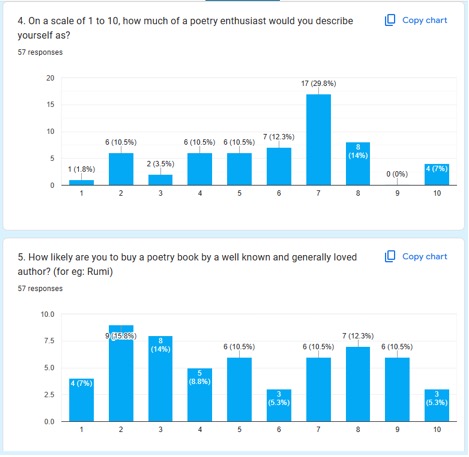
Doorway to learn how readers describe their preferences in their own words
Friends and peers would give you the exact terms used by people who only read occasionally i.e., everyday language, like:
- “I buy books when someone I trust recommends them.”
- “I prefer short reads because I don’t have time.”
- “I like books I can gift.”
-
“I save poetry for when I want to feel something specific.”
Take this information and use it to shape your book blurb/descriptions, marketing/positioning copy, and social media communication. You’d come across as an author who understands readers – not just shouts at them from a high horse.
How to survey
People tend to respond when surveys are low effort, friction-free and do not trample over their personal privacy. Keep confidentiality, ease, skippability at top of your priority. I like using Google Forms as it exports the result into Google sheets and gives results in clear charts.
Steps to create a Google Form survey:
- Start: Use a standard template or create a blank form on forms.google.com.
- Add content:
- Title and description: Click on “Untitled form” to give your survey a name and add a description for context (keep it conversational for building rapport).
- Add questions: Click the “+ ” button to add new questions, choosing types like Multiple choice, Paragraph, or Dropdown.
- Customize: Use the palette icon to change the theme, header image, and colors. (No worries if you keep it simple.)
- Configure settings:
- Required questions: Toggle the “Required” switch to make important questions mandatory. (Don’t keep too many of these; I’d suggest to not make open-ended questions mandatory, give people choices to select instead; aim to reduce friction.)
- Collect emails: Go to Settings to limit responses to one per person or collect email addresses. (It might deter people from giving you a response at all, so consider making this non-mandatory.)
- Collecting names: (People become conscious when they feel watched; consider making this non-mandatory or encourage anonymous naming.)
- Number of pages: Keep to a minimum. I suggest a crisp page. You never want to make a reader overwhelmed just filling your Google form.
- Send and analyze:
- Preview: Click the eye icon to see what respondents will experience.
- Share: Click the “Send” button at the top right to share via email, link, or embed the form.
- Review responses: View answers under the “Responses” tab, where you can see summary charts.
Takeaways for authors
When you are looking to break into the world of commercially successful publishing, it helps if you know how people, in general, talk about reading; and one way to understand this is by talking to the average reader.
A survey can break your assumptions, throw light on your potential blind spots and force you to face the squeamish feeling that comes when asking people to pay for your work (aka sales).
It also builds an ongoing conversation between you and potential readers – instead of you randomly showing up and asking people to buy a long form like a BOOK. Having a digital trail of process and thought does wonders for credibility and community.
Even if the survey responses do not directly shape any of your content, the gesture itself communicates respect. People appreciate being considered.
Finally, a survey is useful early content because it:
- helps the project feel real
- reduces uncertainty about the publishing landscape
- invites interaction (good for the algorithm)
- encourages people to participate
- signals seriousness of intent (for future work)
- builds early connection with readers
- creates curiosity (“what are they working on?”)
- creates momentum before launch
- creates a memory marker (“oh yes, this person has been working on something for a while”)
What authors should not take from this
Surveying, however, does not mean: write what people demand / follow trends blindly / optimize creativity into blandness. It simply means understand the landscape you are entering. Surveying your own circle does not give statistically perfect market data. What it does give is: direction, language, confidence, and awareness of reader behaviour.
Parting note
Take heart in the fact that reading enthusiasm ≠ reading frequency. People appreciate books, respect authors, enjoy literature, value thoughtful writing, but often read less than how much they’d like to. Your creation has merit, whether or not someone reads/ buys it.
But if you aim at generating money from your writing, you have to understand this basic fact: you are a seller. This is a marketplace. The readers are potential customers. The laws of business and commerce apply impersonally.
Bio: Rajvi Mittal is a multi-passionate author and artist from India. She has self-published a poetry chapbook titled “Reborn: Darkness is the Seed of Light” and writes a LinkedIn newsletter ‘SnowFlames Weekly’. Her writing has been published in McSweeney’s Internet Tendency, Entrepreneur Magazine and other online blogs. Her photography & artwork is forthcoming in Blood+Honey, and Flash Frog Lit Magazine. She made a career transition from a corporate consultant to support her health and is now a freelance artist. Her merch is available at her Etsy shop, Phoenix Rising Creations.
]]>Writing requires effort. When it becomes work, we reason that if we’re going to put in so much effort, we might as well get paid for it. While that doesn’t happen to everyone, it’s still a thought that’s present in the background. Writing just for fun suddenly isn’t possible, because it could be work instead. Or it’s just work, because after writing professionally all day, the brain’s too tired to do writing that’s unrelated, that’s just for our own joy.
Which is why writers need hobbies other than writing. When we switch to doing something different, something that demands different skills from us—or demands not much skill at all, such as coloring in drawings—we’re increasing our chances of finding creative solutions.
During writing or editing, our brain is focused, concentrating all its efforts on the task at hand. But just like other parts of the body, our brains need rest. The brain actually never stops working, but when we take a break to just take a walk or do something routine like folding laundry, it gets a breather. This is when it puts things on the back burner, where the problems we’re trying to tackle when focused—a plot hole, a tricky bit of dialogue, the best place to introduce our antagonist—simmer slowly, taking their time to come to a boil. In other words, it’s when we move away from a problem that we hit upon some solution.
And to do that we need something that we can do just for fun. Something that’s not attached to productivity, to capital. Which is what hobbies are all about.
Knitting, drawing, cycling, scrapbooking, playing the guitar—they’re not just hobbies, but also opportunities to observe the world anew (such as through collecting a variety of leaves by drawing them in detail), to develop discipline and learn field-specific knowledge (such as all the different types of knots and knits), to understand how those in other professions think or work (such as when trying to compose a new tune on your guitar).
And this variety in our learning, which comes not from reading and writing but from doing, from living, allows us to add more richness to our writing. The world reveals itself to us in new ways. We’re able to think from the perspectives of people—and, therefore, characters—who are not us. The more varied our knowledge, the greater the number of permutations and combinations of knowledge our brain can create to increase our creativity. By keeping ourselves limited to words, we limit the quality and depth of those words.
But even if our newfound love for say, crocheting or gardening doesn’t lead us to directly improve our writing by enabling us to create different characters and plots, hobbies are still worthwhile: they nurture our physical and mental well-being. We need to get up from our desks not just for the sake of our brains but also for our bodies. We need to stretch and bend and move and jump whenever (and however much) we can.
The subjects we write about can drain us, even if they were imaginary, such as fairy-elf border conflicts, and not just set in the real world, such as the huge losses caused by unseasonal rains for small farmers. Writing can be and is a form of service, but in order to serve well, we also need to take care of ourselves. And in a day when most of our time may be devoted to doing our work and providing care to our families, hobbies offer a chance to wind down (and this can be done collectively, too, such as through knitting clubs).
Most of all, though, we need hobbies because as loyal as we may be to the writing life, we also need something else to love. Otherwise, the work may lead us to falling out of love with writing. Effort will always be needed, and sometimes even long, painful, draining hours.
But if we’re always distant, always focused on productivity, and output, and numbers, be they word counts or payment-per-word, we may risk becoming averse to writing. The negative feelings of work that we have to push ourselves to do get associated with the thing that used to bring joy to us. When that happens, there might come a day when suddenly, we don’t want to write anymore. Or we’re saving every word, reluctant to throw anything away, worrying ourselves about getting everything right, perfect.
This can lead to perfectionism, to aversion, and even to quitting. Even if that quitting lasts months rather than a lifetime, that’s still a long time away from something that we usually cannot live without. I’ve been there and it was painful—returning to the page even more so. But I returned because I loved writing and I found that I could do it if I remembered that I was not just a writer. I was a person who writes, a person who loves writing, but also a person who loves practicing the guitar, knitting little projects, scrapbooking, cooking, and going on walks. When the writing feels difficult, I put down my pen and pick up the guitar or some needles. When I miss words, I go back to the page again.
But to come back to writing, I need to leave first—and I can do that because I’ve found other things to love.
Bio: Ratika Deshpande is a writer from India. Her work has appeared in Authors Publish, Reactor Magazine, the Brevity Blog, and other platforms.
]]>If one takes too realistic a look at the figures, then it can be argued that the number of authors who’ve been able to have such an impact on the world is quite small, especially when compared to the millions of books that are published across the world each year. So, statistically, we’re going to need huge odds in our favor to be in the company of authors like Carson or Perez. It might even convince us to give up any hope that writing can change things.
But the truth is that our writing has more power than we assume. It’s impossible to change the world—it’s just too big—but it’s not impossible to have no impact. We have some power in the immediate areas around us—our families, our friends, our neighborhoods and local communities are all places where our participation can make a difference. And if not even those, then we have power over ourselves. Over who we are and what we think.
When we write, with or without the expectation of making a difference with our words, there’s no guarantee that we will change others. But there is a guarantee that at least one person will be transformed by that writing—our own selves.
If we work with the pressure of using our words to bring about changes in the world around us, we may never get started. We will reject ideas that don’t, on the surface, seem “important.” You might want to write about a woman who steals stars from the night sky, but you might end up writing articles on the climate crisis. While both are valid and both are important to you personally—we’re multidimensional, passionate—you might think the latter are more important, more “necessary.”
But no form of writing is more important than the other. We need all kinds of writers (and artists, journalists, researchers, activists) to provide vision, alternatives, evidence so that our imaginations, be they rooted in science fiction or in data revealed through investigative journalism, can be nurtured, so that we can shape a better future.
On the surface, it’s difficult to predict what kind of writing will inspire people to take action, to innovate, experiment, legislate. It could be a poem, a short story, even a single sentence. The reaches of influence are random, unpredictable. By trying to control this process, by writing what might matter instead of writing what we feel compelled to write—through our love for a genre, or through responsibility towards a community—we lose our voice. Our words are the most potent when they have our voice behind them and that voice comes when we write from passion, honesty, care rather than when we approach writing from a cold, removed sense of obligation.
It’s important to note that we can be responsible, active citizens of the world or even of our communities without necessarily making writing the medium through which we create change—we can write for ourselves, then help others through our jobs, through volunteering, or through simply being good neighbors.
Clinging to the potential, unpredictable impact of our writing on others can be unhealthy, unhelpful. Instead, if we write from passion, if we write when we are compelled to, when the silence nags us, or when the pain demands channeling into the creation of a louder voice or a cozy retreat, we can bring out stuff from deep within ourselves. This internal matter is often honest and can be the very key that provides potential for connection with a reader—and through that connection, a change.
I’m not arguing that we should give up all efforts to use our writing for the greater good. Every voice, every imagination matters. The world is too complex to control, but that very feature of it is what increases the number of possibilities so much.
So what can we do, exactly? There’s no one specific answer, but several possibilities. Over the last few years, I’ve found that it matters who’s doing the writing. Underrepresented voices need to be heard more. So do underrepresented languages. The internet is perhaps one of the most effective ways to share our visions and ideas with as many people as possible, but a lot of it exists in a limited number of languages and so one way of making a difference is for multilingual writers to write in languages other than “global” languages like English—just think of what it would mean for a person who only speaks these other languages to come across words similar to those that have transformed you.
Consider also the things you know that many others don’t. Writing is also sharing knowledge. Shine a light on what’s ignored, what’s less known, or is unknown and needs to be searched.
But if you can’t do that, or if you’re interested in something else, celebrate it, as Ray Bradbury says. Joyful writing matters just as much and can also give people the ability to look at the world in a new light. As James Baldwin said, “[…] your aspirations and concern for a single man in fact do begin to change the world. The world changes according to the way people see it, and if you alter, even by a millimeter, the way a person looks or people look at reality, then you can change it.”
Bio: Ratika Deshpande is a writer from India. Her work has appeared in Authors Publish, Reactor Magazine, the Brevity Blog, and other platforms.
]]>Please note that if a publisher doesn’t have a specific submission window they can close at any time, and publishers that use Submittable can close at any point because of submission caps (although these publishers generally reopen to submissions at the end of the month).
If a publisher has closed to submissions unexpectedly, please send us an email at support@authorspublish.com.
Please read the full review, which we link to in the publish name, and carefully consider fit before submitting work. I can not stress enough that you should only submit to presses that are a good fit for your work, and that you should carefully read and follow submissions guidelines before submitting that work. Over the past year we had several presses ask to be de-listed because they were deluged by submissions, even after moving to this format. Still more presses have had to temporarily close to submissions because of an influx of inappropriate submissions.
Epic Ink
Epic Ink is an imprint of Quarto Publishing Group. Epic Ink focuses on publishing entertainment or pop culture books that are visually striking. You can see books they’ve previously published under this imprint here. On their imprint-focused page here they particularly highlight the Bucket List Series, which includes this book. They also mention the “Inspiring Life Series” but while I found a lot of biographies and fan-focused work on the site, I didn’t see anything with that series linked to it. They also mention their collaboration with the National Baseball Hall of Fame.
Cicada Books
Cicada Books is a children’s book publisher based in London. Initially focused on producing books for adults around art and design, they have now pivoted to fully focusing on publishing children’s books. The books they publish are well-designed, and beautifully printed and intended for kids ages 4-11. They publish activity books, picture books, and nonfiction. All have an illustrated component. They do not publish very many books per year. They say this about the books they publish: “We aim to publish books that are a little bit anarchic, a little bit out-of-the-ordinary and very, very beautiful.”
Mandrake of Oxford
This UK-based publisher describes themselves as “Independent publisher of essential occultural books”. They are open to submissions of work on mysticism, Esotericism, Magick, Paganism, Erotica and Fetish, Shamanism, Culture, True Crime and Ripperology, as well as work related to Yoga Ayurveda, and Tantra, and other related topics, like ancient mysteries and UFOlogy. In terms of fiction they accept submissions about the occult and myths, as well as Sci-Fi, and Erotica. To see their complete list, go here. To see what they have recently published, go here. They are not interested in submissions of work that are not related to their niche.
The Whumpy Printing Press
If you are familiar with fan-fiction the title of this press alone, might help you know if your work is a good fit for it or not. They only publish work in the Whump genre. Whump is a genre that emphasizes trauma, and can go fully horror or lean more towards hurt/comfort (which is to say there is trauma, but also support at the end. As they make clear on their website, “Whump stories are usually character-driven and often (but not always) contain graphic violence.” If you want to learn more about the genre, there is a whole fandom wiki focused on it here.
August Books
August Books is one of the three main imprints of Canelo, a UK- based press that was established in 2015. Their books are well- distributed and you can learn more about the company as a whole here. We have previously reviewed Hera Books, which is now an imprint of Canelo. You can read that review here.
Pajama Press
Pajama Press is a publisher of books for children. They focus on publishing literary works. They publish books that fall into a wide range of categories including: picture books, board books for the very young, middle grade fiction, young adult novels, and non-fiction for all juvenile categories.
Afterglow Books
Afterglow Books is a new imprint of Harlequin. You can read our review of Harlequin, and their digital imprint Carina, if you want to learn more about the company as a whole. Their tagline for Afterglow books is: “From showing up to glowing up, these characters are on the path to leading their best lives and finding sizzling romance along the way.” This is how the editors describe what the new imprint is seeking: “Depth, relatability and sizzling spice, too: these characters are determined to live their best lives — and find the romance that makes them feel seen, unapologetically. In the pages of Afterglow Books, characters from all walks of life, all types of diverse identities, will pursue their dreams and discover love isn’t far behind. Because everyone deserves a happily ever after that’s true to who they are.”
Sea Crow Press
Their motto is “Stories Rooted In Place • Writing Meant To Linger”. This small press based in Cape Cod, Massachusetts focuses on publishing fiction, nonfiction, and poetry with a clear focus on eco-literature, regional writing, and climate-aware storytelling. It is a woman-owned press, and you can see their full masthead by scrolling down here.
Harlequin Presents (M&B Modern)
Harlequin Presents (M&B Modern) has a word count limit of 50,000 words. They describe themselves by saying that what they are looking to publish is “bold, outrageous, addictive and escapist. We want to see the drama and intensity dialed right up to eleven! In Presents, you’ll often find stories featuring pregnancies, marriages of convenience, royals, forbidden romances, enemies becoming lovers, revenge schemes, workplace/office romances, and Mediterranean settings. How can you combine some of these themes in a thrilling and unique way? “
Also Generous Press is open to submissions from BIPOC authors only. Generous Press publishes “lush, high-caliber, and inclusive romance fiction: books so well written that every sentence is a delight to read aloud. “
Emily Harstone is the author of many popular books, including The Authors Publish Guide to Manuscript Submissions, Submit, Publish, Repeat, and The 2026 Guide to Manuscript Publishers. She regularly teaches three acclaimed courses on writing and publishing at The Writer’s Workshop at Authors Publish. You can follow her on Facebook here.
Many authors treat newsletters as promotional tools.
Announce the new book.
Share the launch date.
Offer a link.
Beg for subscribers.
Something different happens when a newsletter stops acting like a broadcast and serves a truer purpose—a conversation with readers.
Then, when readers reply, they share reactions, emotional truths, and moments from their own lives that can shape the stories we write. These newsletters offer the unexpected: a creative exchange where readers help surface the emotional currents that fiction explores.
Discovering a new source of story
For years, I wrote primarily to drive change. In courtrooms. In boardrooms. In my workplace advice column (“dear Abby of the workplace”). Nonfiction gave me a direct path: Identify the problem. Document the harm. Argue for a better way.
Recently, something shifted. The creative energy fueling my short stories (published nine in the first two months of this year) increasingly comes from conversations with readers.
After I shared a story called The Cost of Silence in a January newsletter, responses began arriving. Readers wrote about risks they’d taken or avoided. They described the quiet compromises that creep into relationships. They trusted me with experiences that rarely get spoken aloud.
One reader described realizing she’d become a man’s “Thursday night,” accepting a role in a relationship that diminished her. Her message stayed with me long after I closed the email. Her email became the seed for another story, Yes Or No.
The emotional current beneath fiction
Readers don’t just react to plot; they respond to the emotional truths below the story’s surface. In response to a story, one reader wrote about the subtle pressures in a relationship that gradually made her feel smaller. Around the same time, another described losing something meaningful because another person could not tolerate seeing it thrive.
Different circumstances. The same underlying tension: Threat doesn’t always arrive with drama. Sometimes it grows quietly inside ordinary relationships. These two reader responses shaped a story I wrote about two intertwined dangers: the bear outside the door and the one already in the room.
Fiction may be invented. The emotional currents under it aren’t.
Turning newsletters into a creative exchange
Building interaction with newsletter readers matters. When readers hit “reply,” their relationship with you, the author, shifts. They move from being passive recipients of updates and become part of an unfolding conversation.
But readers rarely respond to vague invitations.
When an author writes “tell me what you think,” many readers simply move on.
What works better is inviting readers into a specific moment inside a story. Instead of asking for general feedback, I ask story-specific questions:
- Which moment stayed with you after you finished reading?
- Did the scene change how you think about risk or truth? (inviting responses to The Cost of Silence)
- Was there a moment where you felt yourself tense, laugh, or pause? (inviting responses to 16 Ways to Kill Your Managers (Metaphorically, Mostly)
Readers then share their emotional reactions, and that when the most interesting responses begin.
When readers share their stories
After reading The Cost of Silence, readers wrote about moments that stayed with them.
One described a scene where a character chooses not to hang up the phone despite fear, and how that decision echoed long after the story ended.
Another reader wrote that the story made them rethink the idea that silence protects. Instead, they saw how silence can allow harm to continue unchallenged.
Someone else couldn’t stop thinking about a small physical detail in the story, trembling hands that captured the fear behind a difficult decision.
A different reader focused on the final moment: a late-night phone call with nothing but breathing on the line.
Each reader noticed something different. Each response illuminated another emotional layer of the story.
For a writer, these responses offer invaluable information—they reveal with moments resonate most deeply.
Closing the loop
The conversation deepens when authors reflect these responses back to readers.
In later newsletters, I often share a handful of reader reflections—with permission—so subscribers can see how others experienced the story. This transforms the newsletter into something larger than a writer-reader exchange. It becomes a community movement when readers realize others felt the same tension, recognition or unease. It also reinforces a powerful message: reader responses matter.
Why the exchange matters for writers
For authors, these conversations do more than build loyalty. When readers reply to a newsletter, they cross an invisible line. They stop being an audience. They become participants in the emotional terrain stories explore. They surface emotional realities that future stories can explore.
For writers, these exchanges reveal something essential. They show where fiction connects to real life—where readers recognize themselves inside a moment of risk, silence, courage or choice.
When several readers independently describe the same quiet pressure inside relationships, or the same moment when silence feels easier than truth, a writer sees a pattern. These patterns point toward deeper themes.
Nonfiction can explain what to do. Fiction allows readers to feel why those choices matter.
Stories that follow readers out the door
An editor who accepted a recent short story described it as “tight, high-concept writing that drops the reader into a moment of maximum tension,” noting that the ending allows the story to expand beyond the room where it took place.
That phrase stayed with me: beyond the room.
That’s what I want to write. Stories that linger after the page closes. Stories that follow readers out the door.
When readers share their experiences, they help reveal the emotional truths that make those stories possible.
A newsletter can certainly help promote a book. But at its best, it does something even more interesting. It becomes a space where readers bring their truths, the writer listens carefully, and fiction grows from the current flowing between them.
Bio: Alaska/Washington author Lynne Curry—nominated for the 2025 Best of the Net Anthology, the 2024 Pushcart Prize and Best Microfiction—founded “Real-life Writing,”and publishes a monthly “Writing from the Cabin” blog, and a weekly “dear Abby of the workplace” newspaper column. Curry has published twenty-nine short stories; seven poems; four articles on writing craft, and six books.
]]>This usually happens around page seventy of somebody else’s masterpiece. That’s the danger zone. Early enough to destroy your confidence. Late enough that you fully understand the scale of the disaster. You’re lying in bed holding the book above your face thinking things like, I should become a locksmith. Locksmiths contribute to society. Nobody expects lyrical metaphors from locksmiths. Meanwhile the author casually drops a paragraph so sharp it makes your internal organs rearrange themselves alphabetically.
And the worst part? Great writing doesn’t merely impress writers. It humiliates them specifically. Very targeted violence.
As a civilian, you read the sentence. You feel, “Hmm…beautiful.” Now, another one reads the same and starts about existential crisis. Envy is operational here, and it has a special favor. It is reserved for art, and that feels impossible. Not bad impossible. Clean impossible. The kind where you can actually see the technical skill operating underneath the emotional effect. That’s what hurts. You notice the restraint. The rhythm. The terrifying confidence of somebody ending a paragraph three words earlier than you would’ve dared.
A strong writer knows when to stop. The rest of us keep adding furniture.
I think people imagine literary jealousy as dramatic and bitter. Sometimes it is. Sometimes you become temporarily allergic to another author’s success. Tiny goblin emotions. You see an interview and mutter, “okay well calm down,” while eating stale crackers over the sink.
But usually the feeling is stranger than jealousy. More like witnessing athletic ability from inside a collapsing lawn chair. Admiration tangled with despair. You love the work. You hate the work. You want to mail the author flowers and also challenge them to mutual combat behind a CVS.
Very normal artistic ecosystem.
The dangerous moment comes afterward, when you return to your own draft too quickly. Big mistake. Rookie maneuver. Your pages are still wearing pajamas while the masterpiece you just finished walked past in a custom-tailored suit smelling faintly of genius and expensive soap.
Comparison at that stage becomes chemically unsafe.
Because drafts are ugly on purpose. People forget this constantly. The novel you just worshipped probably existed once as a horrifying document full of bad dialogue and placeholder names. But readers never see that version. We compare our wet cement to somebody else’s cathedral. Then panic arrives.
Writers start shape-shifting after reading somebody brilliant. You can actually feel the influence trying to climb into your bloodstream. Suddenly you’re rearranging your syntax unconsciously. Using semicolons you haven’t emotionally earned. Writing sentences that sound like literary identity theft.
I’ve done this. Everybody does.
Influence panic usually fades after a few days. Your natural voice crawls back eventually like a raccoon returning to the porch after a thunderstorm. But there’s still value in the devastation. Real value. Great writing recalibrates your internal standards whether you enjoy the experience or not.
Sometimes a masterpiece exposes laziness you’d hidden from yourself. Sometimes it reminds you language can still surprise people instead of merely functioning correctly like emotional Ikea furniture.
And honestly? Artistic despair can become fuel if you survive the first emotional crater. The trick is understanding that intimidation means your taste is alive. Dead readers don’t feel threatened by excellence. Dead readers don’t fling books across rooms muttering, “how dare you write this well.”
Writers do.
Because somewhere underneath the envy and nausea and temporary career collapse sits excitement. Dangerous excitement. The kind that whispers: look what language can do when somebody pushes hard enough. That feeling matters. Even when it ruins your entire week. Especially then.
A masterpiece doesn’t just crush your confidence. Sometimes it drags your ambition upward by the throat.
Painfully.
Like a cat carrying its idiot kitten out of traffic.
Bio: Sabyasachi Roy is an academic writer, poet, artist, and photographer. His poetry has appeared in The Broken Spine, Stand, Poetry Salzburg Review, Dicey Brown, The Potomac, and more. He contributes craft essays to Authors Publish and has a cover image in Sanctuary Asia. His oil paintings have been published in The Hooghly Review. You can follow his writing on Substack here.
]]>In the beginning, it makes sense that we look to other writers to guide us. We’re navigating a new skill, which is both an art and a craft, something that is taught but is also thought to be unteachable in some ways. So we read essays and memoirs and interviews, hoping to learn from those who have come before us.
And this exploration pays off. We might discover that the most common writing advice—write first thing in the morning, do morning pages, leave in the middle of a sentence so that you can pick up from where you left the next day—actually does not work for us. (Or that it does!)
However, simply reading about the craft doesn’t lead to improvement. We have to sit down and write.
Often, when we do that, we find that writing is hard. So we open a new tab and go looking for a method that will make it easier. And that is a good thing to do, to some extent. It’s always helpful to reflect on what’s working and what’s not, so that we can focus on telling the stories we want to.
But here’s the catch: writing is hard. The principle “read a lot and write a lot” is the core, but it’s not specific and therefore not actionable. What I’ve found over years of reading about writing is that the One True Method of writing doesn’t actually exist. We all have to find something that works for us. And what works for us today might not work for us a few months later.
We might get lost in the sea of methods in our search, especially as beginners, as those returning to the craft, or as those trying to overcome doubt and resistance. And so, when the priority is to get words down, we must ask ourselves, “Does this help me write?”
Some writers have specific, elaborate routines. Others simply don’t have the time, so they write whenever they have the chance, even if it means writing only 2 sentences at a time.
In either case, what they do is write. They have asked themselves, even if unconsciously, “Does this help me write?” and then chosen the method/process/tool that does.
This entails understanding another crucial principle of the process: to get the writing done. As countless others have said before: once it exists, you can make it better. The search for a presumably “better” method prevents us from writing in the first place. I know that all the hours I’ve spent reading about writers’ methods I could have instead spent on writing, however imperfectly. The chase for a better method is actually running away from hard work. It’s perfectionism holding you in your grip.
The problems of writing are many; we have to keep adjusting. The best thing we can do is to work with what we have right now, with the understanding that writing is hard and that effort is not a sign of our process being wrong but rather the very nature of the art we’re practicing.
So the next time you look at a piece of advice (including this one), ask: “Does this help me write? Does this help me fill a blank page, get my story out from my head into the world?” If the answer is yes, take it and use it, and, if the answer is no, toss it and write anyway.
And remember, this is a different question from “Does this help me write well?” That will need more experimentation, more reading, more research perhaps (if that’s your area), more reflection. But, most importantly, that too will need more writing. To write well, we must first write, otherwise we make the mistake of thinking that our first attempt at saying something or telling a story should be good, complete, final.
And that is a belief that never helps us to write.
Ratika Deshpande is a writer from India. Her work has appeared in Authors Publish, Reactor Magazine, the Brevity Blog, and other platforms.
]]>The last mile may be the longest, but many stories never survive the first mile. This isn’t always because the writer lacks effort or the ideas are weak. Sometimes, it’s due to the spark of motivation dying out too early.
Finishing the first mile determines whether we’ll ever reach the end. However, this becomes harder to achieve if we lose our drive before we get the chance to build much momentum.
So, how do we sustain our drive through the beginning of a project and build the momentum necessary to reach the finish line? Here are a few strategies:
Adjust your approach
How we approach our writing is just as important as what we write. How do you face a draft that no longer feels inviting? How do you approach the page when the initial magic vanishes and writing starts to feel like plodding through mud?
Even after three determined attempts I couldn’t get past the opening chapters of my novel. This changed when I read The Guest List by Lucy Foley and fell in love with the opening chapters and the narrative structure of the novel. While the novel’s in media res opening and shifting POV structure aren’t exactly new techniques, I was most inspired by how Foley used them remarkably well to build suspense and intensifying tension. I adopted the same structure for my novel, and this time the momentum hasn’t stalled.
This made me realize my current approach had become a chore. I had always felt the boredom lurking, but I ignored it because I believed being consistent would get me through. Adopting Foley’s structure made my manuscript glimmer again by giving me something to look forward to in every session: whether it was a new POV to inhabit or a new cliffhanger to craft. If you get stuck early on, don’t just “write harder”. Find a book or even a movie you love – ideally something new, since the stories you’ve read have most likely become part of your subconscious – dissect its structure and apply it to your writing. A change in approach can quickly restore fading momentum.
Here are some more ways you can apply this:
- Open a new document: Stop fighting your messy draft. Open a fresh document and start a new chapter. Similar to how an empty document at the start of a new project oozes optimism and excitement, returning to a blank screen or paper later on can revive that energy and enable you to work without the burden of previous mistakes or the dread of a stagnant file. You’ll be surprised by how fast you get back on track when you aren’t wading through a cluttered manuscript.
- Narrow your focus: Instead of looking at the daunting task of finishing a book, shorten your gaze. Focus on what you can achieve right now, this might be a single beat of dialogue, a room description, or a single scene. Despite how prepared you may be, looking at the entire project at once will always feel overwhelming. Ignore the finish line for a moment and focus on finishing the page in front of you.
Do a mental warm-up
When we hit a wall, our response might be to adjust our schedule or environment. We might swap morning sessions for evening ones or move from the solitude of our bedroom to the hum of a local cafe. But adjustments won’t be much help if you’ve lost the conviction to show up. This is especially true at the beginning, when you haven’t invested enough effort to feel the weight of walking away.
When my motivation dips too early, I use what I call a “mental warm-up” to shift into a more engaged mental state. This is a simple task that involves finding something that’s easy to start but requires me to focus. I try to avoid literary tasks (such as reading or researching) because they often carry the same paralyzing dread as the manuscript I’m avoiding. As a web developer, I find coding easy to slip into because the objectives are crystal clear and easily achievable like building a sign-up form.
Once I finish a small coding task, I then move immediately to my manuscript. By then, my brain is already in a state of deep focus, so the transition to writing feels natural and not forced. My warm-up ensures that I’m not starting from scratch, since I’m utilizing energy I’ve already generated.
If you’re struggling to keep going, do a little mental warm up before you face your draft. Whether it’s solving puzzles, sketching or knitting – find something accessible and just challenging enough to get your brain moving and your mind immersed. Reach that state of focus and rhythm, then move to the page before that momentum fades.
Utilize the power of flash
Your motivation can quickly fade when you’re facing a long road of unwritten pages. A 200-word micro story, however, is very approachable. This is a low-effort exercise that can help you escape the dread of your usual writing session while keeping your momentum alive.
In moments like this, switching to flash writing can help you isolate and better understand the core of your writing more easily. This also often leads to small breakthroughs that can reignite your enthusiasm for the manuscript.
Try writing a flash version of the chapter, scene or the complex description you’re struggling with. The strength of flash writing is that each story can stand on its own. This gives you insight into your work and its structure in a short period of time with minimal effort.
Here are some ways you can use this:
- Write multiple flash versions of the same story element. This makes it easier to identify the most compelling path for your novel.
- Experiment. Change the point of view, character traits or explore different plot threads. Maybe you’re writing a mystery novel about a private detective who gets murdered by his client. What will it look like if the client was the one who got murdered and the story is told from the detective’s POV? A micro story lets you take a quick trip into that alternate version.
- If you’re stuck on the second chapter, write a flash version of Chapter 3. This provides you with a narrative destination to look forward to and proof that the story still has a pulse.
Leave enough juice in the tank
Hemingway’s advice to stop writing when you still know what happens next is well-known. I use this regularly to get back on track. To follow this advice, it’s clear we need to leave some “juice” for our next session, but the question I ask myself is how much should I leave in the tank?.
My answer to this is a simple rule – if I can write at full intensity for only 30 minutes, I try to stop at 20. This helps me balance my routine and creative output so I’m not drained by the time I stop writing.
Instead of writing until you reach your usual stopping point, stopping early while the momentum is still strong ensures you have something sufficient in reserve for next time. I also find that this makes it easier for the work to develop subconsciously while also easing my return.
The next time you find yourself trudging through the first mile of your writing, I hope you find the above strategies helpful in sustaining your rhythm and momentum until the very last page.
Bio: Abdulraheem Jameel has an incurable obsession with mystery and an undying fascination with beautiful sunsets. He is currently working on the crime thriller he has always dreamed of writing.
Please note that if a publisher doesn’t have a specific submission window they can close at any time, and publishers that use Submittable can close at any point because of submission caps (although these publishers generally reopen to submissions at the end of the month).
If a publisher has closed to submissions unexpectedly, please send us an email at support@authorspublish.com.
Please read the full review, which we link to in the publish name, and carefully consider fit before submitting work. I can not stress enough that you should only submit to presses that are a good fit for your work, and that you should carefully read and follow submissions guidelines before submitting that work. Over the past year we had several presses ask to be de-listed because they were deluged by submissions, even after moving to this format. Still more presses have had to temporarily close to submissions because of an influx of inappropriate submissions.
Primera
Primera is the digital-first imprint of Oliver Heber Books. Oliver Herber Books was founded by the author Tanya Anne Crosby. You can learn more about the publisher as a whole here. They are based in Michigan. In 2023 they started Primera, which is open to agented and direct submissions from authors. They mostly accept work in the Romance and Mystery genres.
Search Press
Search Press’s tagline is “the world’s finest art and craft books.” They specialize in “practical, reference and inspirational art and craft books for beginners through to professional artists and crafters”. Everything they publish is highly illustrated, They only focus on publishing nonfiction work that fits into these categories. You can get a feel for what they have recently published by going here. They are based in the UK. They are open to proposals.
Brick Cave Media
They are a small Science Fiction and Fantasy focused press based out of Arizona. It was founded by Bob Nelson and J.A. Giunta. You can read their origin story here, but it essentially started out as a self publishing operation, initially not even focused on books. In 2010 they published their first book. They have published the work of many authors since then. They now have a staff of four. Last year they published 7 books, so far in 2026 they have only published one book.
The History Press
The History Press is based in Cheltenham, Gloucestershire, England. Their name is pretty self explanatory, they publish historical nonfiction, as well as general nonfiction. They do consider memoirs. They do not consider direct submissions of poetry or fiction, so please do not submit it to them. You can learn more about the company here. You can see the books they’ve previously published here.
Rebel Satori Press
Rebel Satori Press was founded in 2002. This is how they describe themselves: “Rebel Satori Press has been committed to releasing cutting edge fiction, poetry, and creative non-fiction, with an emphasis on amplifying LGBTQIA+ voices and promoting diversity through the press and its imprints Queer Mojo, Queer Space, Arabi Manor, and the Library of Homosexual Congress. We are dedicated to safeguarding the voices of our heritage.” They also say “Rebel Satori Press is more than a publisher. We nurture a vibrant community of LGBTQ+ authors and readers, fostering an inclusive space where diverse voices are celebrated and embraced.” You can get a good feel for what they publish here. While they have a number of imprints and publish a wide variety of work, they currently only have two open calls for submissions. You can see both on Submittable here. Queer Space closes to submissions on October 14th, 2026, and Arabi Manor closes to submissions on October 31st, 2026.
Common Notions
Common Notions is a press that describes itself as “deeply committed to publishing books that provide timely reflections, clear critiques, and inspiring strategies that amplify movements for social justice”. They emphasize that their publishing program “reflects the lessons we’ve learned as members of worker collectives, labor and tenants rights campaigns, higher ed struggles, #blacklivesmatter, no border and New Sanctuary movements, anticapitalist arts organizations, antiwar actions, climate justice camps, and the Palestinian solidarity movement.”
Exposit Books
Exposit Books is an imprint of McFarland & Company Inc. Exposit books focuses on publishing work that focuses on a popular topics, like serial killers, and approaches that subject seriously. They encourage proposals for nonfiction manuscripts on a wide range of true crime subjects, including but not limited to: murder, serial killers, heists, robberies, abductions, kidnappings, missing persons, con artists, hoaxes, deceptions, organized crime and espionage. They also welcome proposals for books about sexuality, the paranormal, cryptozoology, death, gravehunting, and forteana.
CF4kids
CF4kids is the children young people focused imprint of Christian Focus Publishing. Christian Focus Publishing is an evangelical Christian publisher based in Scotland. They say, “Our calling is to share the incredible message of the gospel and help people grow in their faith through the power of books.” The company as a whole has excellent distribution. We’ve reviewed Christian Focus Publishing separately as they have very different submission guidelines.
Slashic Horror Press
Slashic Horror Press is an LGBTQ+ horror press. They welcome submissions from allies, but LGBTQ+ voices come first and foremost. They also state that “if you only have a gay character on page 50 and they don’t do anything except re-affirm stereotypes… then you aren’t an ally. ” They are only interested in work that feature LGBTQ+ content, including themes, plot, and characters. If this is not a good fit for you, please do not read further. They also are not interested in any genres outside of adult horror (although they have a YA imprint that is open to submissions here).
Carolina Academic Press
Carolina Academic Press was founded over 50 years ago, focusing on publishing non fiction books aimed at lawyers. They are still primarily a law publisher, but they’ve also published titles in other areas for a long time now, including titles on history, sociology, criminal justice, education and politics. You can learn a little more about them here.
Emily Harstone is the author of many popular books, including The Authors Publish Guide to Manuscript Submissions, Submit, Publish, Repeat, and The 2026 Guide to Manuscript Publishers. She regularly teaches three acclaimed courses on writing and publishing at The Writer’s Workshop at Authors Publish. You can follow her on Facebook here.
]]>Maybe it’s because my background is in journalism, but I do not get writer’s block. When I first started writing fiction, I thought this was normal, but after meeting many seasoned writers, all of whom report experiencing writer’s block at one time or another, I realized there was something different about the way I was approaching fiction. Recently, I spent some time reflecting on what this might be, and it occurred to me that, without consciously thinking about it, I’d developed a method that keeps me on the edge of my seat, breathlessly tracking my characters’ shenanigans, seven days a week.
This is that method in a nutshell.
Instead of thinking of myself as a writer, I think of myself as an investigator. Instead of coming up with plots and scenarios, I uncover them. Instead of developing characters, I spy on, surveil, and interrogate them.
But let’s imagine for a moment that it’s me, not my character, who’s being surveilled. The spy outside my window would probably note that, while I’m brainstorming, I look just like most writers do when they’re working—that is, as if I’m working at all—but, in my head, something entirely different is going on. Instead of struggling to string words together, I’m crouching behind some bushes, waiting for a character to come out and get into a car so I can follow them and see where they go. Or I might be in a park, hiding behind an elm tree, listening to two of my characters conversing on a park bench.
If I run into one of my characters alone, I might strike up a conversation and lull them into a false sense of security, using flattery even if I know them to be the villain and scorning their rivals even if their rivals have my sympathies, until eventually they spills the beans and reveal their true selves: their deepest resentments, projections, jealousies, and fears.
Or I might find myself alone with a character in an interrogation room. In these instances, the tools of the good cop are still at my disposal, but the tools of the bad cop are on the table, too.
Some characters really just want to be loved. They’re tender and insecure and will open up to the first person who smiles or utters a kind word. Others are tougher and need a bit of roughing up.
I should probably clarify here that I don’t use this method specifically to write detective fiction. I use it to write all kinds of fiction. The scenarios I’ve been describing don’t actually have to take place in the story. They’re just means to an end, ways for me to get to know my characters and learn about what they’ve been up to so that I can write it down.
Unlike most of the writers I meet, I never finish a draft, set it aside, return to it a few days later, notice discrepancies that had previously escaped me, realize that I’ve misunderstood my characters’ true motives all along, and end up back at square one, exhausted, dispirited, and suffering writer’s block. Instead, I let my characters tell me their cover stories first, in my head, without typing a word—and I don’t trust a word that they say. Once I’ve spied on or interrogated all of the characters, I spend some time reflecting on everything they’ve told me, comparing what each one has said to the testimonies of the others, and triangulating the inconsistencies until, eventually, I’m able to put together the real story. This way, I’m not the one who came up with a story full of plot holes. Instead, I’m the one who figured out what the real story is.
It probably helps that all my characters and most of my plots are drawn from life to some degree, even if they do undergo a great deal of mixing and matching to yield unrecognizable composites—or at least plausible deniability. My characters don’t have to take on lives of their own. They have lives of their own already. I feel as if I know them because I do, in fact, know them. But, at the same time, I don’t know them well enough. I know the polished personas they show to the world, and I might also know about the things they’ve done that are inconsistent with their personas, but I don’t know why they did those things, or what they’re going to do next, or what it’s like to live inside their skin. Those are questions that can’t be answered by a writer, only by an investigator.
You don’t have to have a background in law enforcement or investigative journalism to make this method work for you. You don’t even have to binge police procedurals or true crime shows, although that might help. All you have to do is adopt a new mindset. Stop worrying about getting words on the page. Words come later. First, you have to get through the lies, the cover stories, the self-serving myths, and the propaganda so that you can get to the heart of the matter. You have to figure out what the real story is.
Bio: Itto Outini is an author and co-host of a podcast about literature and the arts, Let’s Have a Renaissance. Her essays and fiction have been published in literary magazine around the world. In her spare time, she enjoys reading, researching, and community-building.
Please note that if a publisher doesn’t have a specific submission window they can close at any time, and publishers that use Submittable can close at any point because of submission caps (although these publishers generally reopen to submissions at the end of the month).
If a publisher has closed to submissions unexpectedly, please send us an email at support@authorspublish.com.
Please read the full review, which we link to in the publish name, and carefully consider fit before submitting work. I can not stress enough that you should only submit to presses that are a good fit for your work, and that you should carefully read and follow submissions guidelines before submitting that work. Over the past year we had several presses ask to be de-listed because they were deluged by submissions, even after moving to this format. Still more presses have had to temporarily close to submissions because of an influx of inappropriate submissions.
Queerteen Press
Queerteen Press is an imprint of JMS Books which we’ve reviewed here. Please read our full review of JMS Books, alongside this review, as there is some helpful context there. Queerteen Press accepts and publishes gay, lesbian, bisexual, and transgender fiction which is focused on a younger readership. The books they publish feature main characters that are between the ages of 12 and 18.
Pen & Sword Books
Pen & Sword Books is an established and respected publisher of nonfiction. They are based in the UK. They are also the majority shareholder for Script Publisher Services, which is a major distributor. Pen & Sword Books has excellent distribution, primarily in the UK. They are best known for publishing specialist military history books under their Pen & Sword imprint, but publish a range of nonfiction books under other imprints as well. You can see their full list of imprints here.
Harlequin Presents (M&B Modern)
Harlequin Presents (M&B Modern) has a word count limit of 50,000 words. They describe themselves by saying that what they are looking to publish is “bold, outrageous, addictive and escapist. We want to see the drama and intensity dialed right up to eleven! In Presents, you’ll often find stories featuring pregnancies, marriages of convenience, royals, forbidden romances, enemies becoming lovers, revenge schemes, workplace/office romances, and Mediterranean settings. How can you combine some of these themes in a thrilling and unique way?”
Wizard’s Tower Press
Wizard’s Tower Press specializes in publishing within the science fiction and fantasy genre. They are a small press based in South Wales. They are currently also accepting submissions for an anthology called “They Are Still Here”, which you can learn more about here. It is a paying opportunity. Outside of the anthology call they are also open to submissions of Fantasy and SF novellas. They call these Wiz Duos and publish two of them together in one volume.
Blackwater Press
They publish fiction, nonfiction, essay, short story collections, novellas and memoir manuscripts. They are not interested in erotica or poetry, kids, crime, fantasy, romance, sci-fi, horror, young adult, anything with a dragon or a vampire, current events and politics, religious/spiritual, guide books, cookbooks. They are open to agented and unagented queries. They recently reopened to submissions after being closed for an extended period.
Marble Press
Marble Press was founded in 2022. It started out with two imprints — Marble Books, which focuses on picture books and middle grade books, and Bulooga Books, which publishes books for “our youngest readers”. In 2026, Marble Press expanded its list with the launch of Taltos Books, an imprint born from its acquisition of CamCat Publishing. They will now publish adult and YA fiction, from thrillers and romance to literary crossovers. They plan to open to Graphic Novel submissions in June.
Genius Book Publishing
This small Wisconsin-based press is run by a couple, Steven and Leya Booth. They share some of their story and experience on their About page here. Genius Book Publishing was founded in 2011. It publishes a range of genres, including fiction, but at the time of this review, they are only open to nonfiction submissions focused on Music or True Crime. They reopened to submissions on June 1st.
Shadow Mountain
Shadow Mountain is an imprint of Deseret Books. Both publishers have their roots in The Church of Jesus Christ of Latter-day Saints, but Deseret Books focuses more on producing faith-based content. Shadow Mountain publishes primarily fiction and they have published a number of New York Times bestselling books. They are very firm about publishing “clean books only”. However the authors need not be members of The Church of Jesus Christ of Latter-day Saints. They are only open to submissions four times a year. They open to submissions on June 1st, and close on the 7th.
The Quarto Publishing Group
The Quarto Publishing Group is an international publishing house known for its illustrated books. They publish most of their work through a number of niche imprints each with their own focus. All of their US imprints are distributed by Hachette.
Eclipse
Eclipse is the dark romance focused imprint of Entwined Publishing, which we have reviewed here (please read it first). This is how they describe the imprint: “Eclipse delves into the shadowy realms of dark romance, where love and danger intertwine. We are interested in submissions featuring dark billionaires, mafia kings, biker gangs, and anti-heroes who blur the lines between right and wrong. Your stories should evoke intense emotions, explore forbidden desires, and offer complex, multi-dimensional characters that captivate and challenge readers.”
Emily Harstone is the author of many popular books, including The Authors Publish Guide to Manuscript Submissions, Submit, Publish, Repeat, and The 2026 Guide to Manuscript Publishers. She regularly teaches three acclaimed courses on writing and publishing at The Writer’s Workshop at Authors Publish. You can follow her on Facebook here.
]]>That tiny swallow? That’s dynamite. No smoke. Still wreckage.
We’ve been trained to look for spectacle. Hostages. Deadlines ticking in red digital numbers. A meteor politely heading toward Earth. Those are external timers. They work. I’m not anti-meteor. I’m just suspicious of the assumption that without one, nothing matters. Stakes aren’t about decibels. They’re about consequence. If this choice goes one way, something shifts. If it goes the other, something else does. The shift can be private. It can happen in a kitchen with bad lighting and a sink full of plates.
One of my stories was interesting in this context. Here, the entire “plot” was a woman deciding whether to tell her sister she’s moving across the country. That’s it. No car chases. The sister is making coffee. The dog is shedding. The moving boxes are already in the trunk. On paper, nothing explodes. But if she says it, the relationship changes shape. If she doesn’t, she leaves behind a lie that will calcify. That’s the stake. The risk of becoming someone who withholds. The risk of being seen as disloyal. You can feel the pressure in her throat. That pressure is the clock.
Quiet stakes demand specificity. You can’t wave your hands and announce, “This matters a lot to her.” Show me how. Does she rehearse the sentence in the bathroom mirror? Does she pick at the label on the wine bottle while her sister talks about holiday plans that won’t happen? Those details are not decorative. They’re the evidence. They prove the decision has weight. Without them, you’re just insisting. And readers can smell insistence. It’s like fake vanilla.
Urgency without spectacle comes from narrowing the lens. Stay close to the body. What happens if he admits he doesn’t love his job? Maybe nothing collapses immediately. But maybe his father, who worked thirty years at the same factory, looks at him differently. Maybe that look lingers. Maybe it rewrites a family myth about endurance. That’s not fireworks. It’s a hairline crack in a foundation. Hairline cracks spread.
We underestimate relational shifts because they’re quiet. A friend stops texting first. A partner laughs a half-second too late. A mother says, “Do whatever you want,” and means, “You’ve already left me.” Those micro-movements are plot. They alter the emotional map. If your character ignores them, that’s a choice. If they notice and still do nothing, that’s another one. Either way, there’s consequence. Maybe the consequence is distance. Maybe it’s intimacy. Both can feel terrifying.
I think writers crank up volume when they don’t trust small things to carry meaning. So they add a gun. Or a diagnosis. Or a storm. Sometimes that works. Sometimes it’s a smoke machine hiding the fact that no one has made a hard choice yet. A hard choice is quieter. It’s internal. It’s “Do I forgive him?” “Do I stay?” “Do I tell the truth even if it makes me look petty?” These are not cinematic in the blockbuster sense. They are brutal in the lived sense.
Here’s the trick: the consequence must be clear to the character, even if it’s invisible to the world. If she knows that confessing will end a friendship, we feel the risk. If he knows that staying silent means betraying himself, we feel the squeeze. The reader doesn’t need sirens. The reader needs awareness. Awareness creates tension. It’s the gap between what the character wants and what the choice will cost.
Also, let’s be honest, explosions are easy. Emotional risk is messy. There’s no clean debris field. There’s a sentence someone doesn’t say. And sometimes, that is the loudest thing in that story.
So, don’t worry if your story is “too small,” ask a better question.
What changes because of this moment?
Who becomes slightly more alone?
Who steps closer?
If the answer is “nothing,” then yes, maybe light a match. But if the answer is “everything, internally,” you’re fine.
Turn down the volume.
Lean in.
The reader will, too.
Bio: Sabyasachi Roy is an academic writer, poet, artist, and photographer. His poetry has appeared in The Broken Spine, Stand, Poetry Salzburg Review, Dicey Brown, The Potomac, and more. He contributes craft essays to Authors Publish and has a cover image in Sanctuary Asia. His oil paintings have been published in The Hooghly Review. You can follow his writing on Substack here.
]]>