Emily Harstone is the author of many popular books, including The Authors Publish Guide to Manuscript Submissions, Submit, Publish, Repeat, and The 2026 Guide to Manuscript Publishers. She regularly teaches three acclaimed courses on writing and publishing at The Writer’s Workshop at Authors Publish. You can follow her on Facebook here.
You can read their full “about us” here, but Arndell is their signature imprint, and so far, all the books they’ve published are under the Arndell imprint, which only publishes Romance. They are also open for submissions of Crime & Thrillers, and Children’s Fiction, and of Romantic Fiction for their Keeperton imprint, which I’ve also reviewed.
T L Swan has been publishing her own work alongside a number of other authors including Kandi Steiner and Susie Tate. You can see what they have published so far here.
You can see Arndell’s general submission guidelines here. Please read them carefully before proceeding to the submission form link here.
On the submission form link they share the following information about what they really want to see in terms of submissions: “Arndell is actively seeking standout manuscripts across a variety of romantic genres and sub-genres, with a particular interest in Romantic Fiction, Romantasy and Holiday Romance. We’re drawn to compelling voices, emotionally immersive storytelling, and worlds (real or imagined) that sweep readers off their feet. Whether your story is grounded in contemporary romance or set in a richly imagined realm, we’re looking for manuscripts with strong character arcs, fresh perspectives, and powerful romantic tension.”
Books are unusual products. And even if the monetary cost isn’t large, the reader is paying big time in trust and time commitment. When you think about it this way, it is easy to understand why readers would want some signal that the investment will be worthwhile.
A survey is one of those signals I think is extremely underutilized.
My story and context
In 2022, before I published my book of poetry, I set out to understand something important: How do people choose the books they read and buy? So I designed a short, focused survey of just 10 questions and sent it out to my old friends and future college mates. To my surprise, more than 50 people responded and many gave detailed responses. Two years later, when my book actually hit the shelves, so many of those people either bought the book or suggested it to their circles without my nudging, and continue to do so.
This is the result of delight in seeing someone live their dream and being a part of the journey from the beginning. People are much likely to support things that they contributed to in some way, even if it was small.
This is why you should bring people into your publishing and creative plans with a low-pressure survey. It is free, helps you start the conversation, leaves an algorithmic footprint, and has so many other understated benefits!
It makes you comfortable talking about your creative work
Ideas feel strong inside our own heads. A survey is a simple way of signaling to your brain: the audience matters.
In my experience, artists, writers, and first-time authors feel awkward asking people to read their stuff, let alone buy an entire book. Surveying is a low-pressure way to begin discussing themes connected to your creative work.
If you use it well, this would be a simple launch-pad to practicing explaining your ideas, sharing creative intentions, and talking about your inspiration — all without the pressure of selling.
Marketing reality: books don’t succeed from one social media post
Books are long-form content. They require more commitment than liking a post or watching a short video. And if the very first interaction someone has with your work is a purchase link, they are less likely to buy.
But if they have already seen…
- your thinking
- your questions
- your creative direction
- your seriousness
…then the purchase feels like a natural next step instead of a cold ask.
When people feel they are part of a community, especially if they have been around since your ‘early days’, they are inclined to support and champion your cause.
It helps identify friction points early
Sometimes small barriers prevent purchase of objectively brilliant work. In my own experience of surveying and subsequent publication, I realized that the general population, even frequent readers:
- don’t know what occasion to buy poetry for
- assume poetry is too difficult for them to understand (this sentiment is surprisingly widespread)
- don’t know how to judge a poetry book (hence go for the big names only)
- feel it is pretentious to engage in ‘poetry’
That’s specific to poetry, but you get my point. Small angles of awareness like these can help you avoid obstacles to selling your book.
Your book is competing for attention, not just literary appreciation
If you are a bibliophile like me, you probably grossly overestimate the amount of ‘reading’ that an average person gets around doing in real life.
But, for the average reader:
- reading competes with many other forms of attention
- reading requires uninterrupted time
- reading is mood-dependent
- reading is often aspirational (“I want to read more”) but not always frequent
- reading is sometimes seasonal (holidays, travel, life transitions)
People may genuinely appreciate and want to read your work. They may also be balancing work, doom scrolling on social media, managing unannounced fatigue, other hobbies and heaven knows what else. Understanding this prevents you from misinterpreting slow uptake as rejection. Sometimes it is not about you or your creative potential at all.
(chart screenshots from my survey)
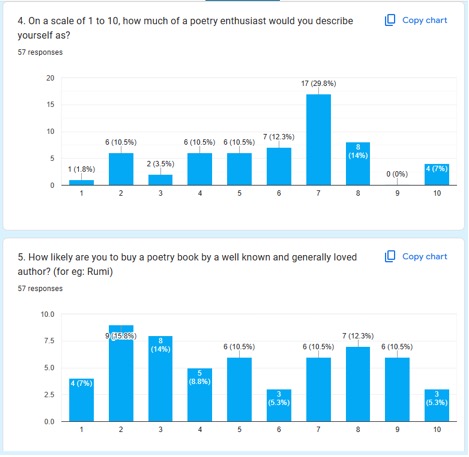
Doorway to learn how readers describe their preferences in their own words
Friends and peers would give you the exact terms used by people who only read occasionally i.e., everyday language, like:
- “I buy books when someone I trust recommends them.”
- “I prefer short reads because I don’t have time.”
- “I like books I can gift.”
-
“I save poetry for when I want to feel something specific.”
Take this information and use it to shape your book blurb/descriptions, marketing/positioning copy, and social media communication. You’d come across as an author who understands readers – not just shouts at them from a high horse.
How to survey
People tend to respond when surveys are low effort, friction-free and do not trample over their personal privacy. Keep confidentiality, ease, skippability at top of your priority. I like using Google Forms as it exports the result into Google sheets and gives results in clear charts.
Steps to create a Google Form survey:
- Start: Use a standard template or create a blank form on forms.google.com.
- Add content:
- Title and description: Click on “Untitled form” to give your survey a name and add a description for context (keep it conversational for building rapport).
- Add questions: Click the “+ ” button to add new questions, choosing types like Multiple choice, Paragraph, or Dropdown.
- Customize: Use the palette icon to change the theme, header image, and colors. (No worries if you keep it simple.)
- Configure settings:
- Required questions: Toggle the “Required” switch to make important questions mandatory. (Don’t keep too many of these; I’d suggest to not make open-ended questions mandatory, give people choices to select instead; aim to reduce friction.)
- Collect emails: Go to Settings to limit responses to one per person or collect email addresses. (It might deter people from giving you a response at all, so consider making this non-mandatory.)
- Collecting names: (People become conscious when they feel watched; consider making this non-mandatory or encourage anonymous naming.)
- Number of pages: Keep to a minimum. I suggest a crisp page. You never want to make a reader overwhelmed just filling your Google form.
- Send and analyze:
- Preview: Click the eye icon to see what respondents will experience.
- Share: Click the “Send” button at the top right to share via email, link, or embed the form.
- Review responses: View answers under the “Responses” tab, where you can see summary charts.
Takeaways for authors
When you are looking to break into the world of commercially successful publishing, it helps if you know how people, in general, talk about reading; and one way to understand this is by talking to the average reader.
A survey can break your assumptions, throw light on your potential blind spots and force you to face the squeamish feeling that comes when asking people to pay for your work (aka sales).
It also builds an ongoing conversation between you and potential readers – instead of you randomly showing up and asking people to buy a long form like a BOOK. Having a digital trail of process and thought does wonders for credibility and community.
Even if the survey responses do not directly shape any of your content, the gesture itself communicates respect. People appreciate being considered.
Finally, a survey is useful early content because it:
- helps the project feel real
- reduces uncertainty about the publishing landscape
- invites interaction (good for the algorithm)
- encourages people to participate
- signals seriousness of intent (for future work)
- builds early connection with readers
- creates curiosity (“what are they working on?”)
- creates momentum before launch
- creates a memory marker (“oh yes, this person has been working on something for a while”)
What authors should not take from this
Surveying, however, does not mean: write what people demand / follow trends blindly / optimize creativity into blandness. It simply means understand the landscape you are entering. Surveying your own circle does not give statistically perfect market data. What it does give is: direction, language, confidence, and awareness of reader behaviour.
Parting note
Take heart in the fact that reading enthusiasm ≠ reading frequency. People appreciate books, respect authors, enjoy literature, value thoughtful writing, but often read less than how much they’d like to. Your creation has merit, whether or not someone reads/ buys it.
But if you aim at generating money from your writing, you have to understand this basic fact: you are a seller. This is a marketplace. The readers are potential customers. The laws of business and commerce apply impersonally.
Bio: Rajvi Mittal is a multi-passionate author and artist from India. She has self-published a poetry chapbook titled “Reborn: Darkness is the Seed of Light” and writes a LinkedIn newsletter ‘SnowFlames Weekly’. Her writing has been published in McSweeney’s Internet Tendency, Entrepreneur Magazine and other online blogs. Her photography & artwork is forthcoming in Blood+Honey, and Flash Frog Lit Magazine. She made a career transition from a corporate consultant to support her health and is now a freelance artist. Her merch is available at her Etsy shop, Phoenix Rising Creations.
]]>Haven Speculative
They publish speculative fiction and poetry. They also publish climate crisis focused Dry and Wet issues each year; scroll down on the guidelines page for details. “We like stories that are subtle in their telling and stick with us long after we’ve finished, and we’re more likely to buy stories that balance a sense of wonder with a bold plot and emotional depth. For our two issues focused on the climate crisis, we’re particularly interested in publishing stories from people displaced by or threatened by the climate emergency (see our themes below). For our other four issues, we’re open to a wide variety of stories across the SFF and weird spectra (e.g., science fiction, fantasy, speculative horror, and beyond).” They also accept translations. During each submission cycle, they have one month reserved for submissions from underrepresented writers, and one month, for all writers. In August, they’re reading submissions from all writers.
Deadline: 31 August 2026
Length: Up to 5,000 words for fiction, up to 5 poems
Pay: $0.08/word for fiction, $20/poem
Details here and here.
(– And Reckoning publishes mostly, but not exclusively, speculative fiction, creative nonfiction, critical essays, poetry, translations, book reviews, and art on environmental justice. Pay is $0.15/word for creative prose, and S75/page for poetry. They’re reading submissions for Issue 11; the deadline is 31 August 2026. Details here and here.
— Three-Lobed Burning Eye will open for submissions of speculative fiction – horror, dark fantasy, and science fiction during 1st to 15th September 2026; submission is via their Moksha portal. They also accept translations. Pay is $0.08/word for stories of 500-7,499 words; details here.)
The Ex-Puritan
They accept fiction, nonfiction, experimental/hybrid work, interviews, reviews, poetry, and poetry in translation. The deadline is 25 September, or when filled, for the next issue; they accept a limited number of fee-free submissions every month, and read year-round.
Deadline: 25 September 2026, or until filled
Length: Varies
Pay: CAD200 per essay; CAD150 for fiction; CAD100 per interview or review; CAD50 per poem, capped at CAD100; CAD50+ per experimental or hybrid work, at an increasing scale depending on the nature of the piece.
Details here and here.
(– Short Story, a Substack-based magazine, is also open; they want short stories of 6 words to 10,000 words, and they are open from the 1st to 31st of each month. They pay $100 + 50% of paid subscriber revenue. Details here and you can see their July statistics, including payout, here.
— The Cincinnati Review will reopen for print submissions on 1st September, and close when the submission cap is reached. They pay $25/page for prose and $30/page for poetry in the print journal, and $25 for miCRo posts or special features. Their submission portal will open during the reading period.)
Chestnut Review
Chestnut Review accepts fee-free submissions of flash prose, poetry, and art. They charge for submissions of longer prose of 1,000-5,000 words, while Black and Indigenous authors can also submit longer prose for free. They read throughout the year, with cut-off dates for issues.
Deadline: 30 September 2026 for the Winter issue
Length: Up to 1,000 words for flash prose, up to 3 poems
Pay: $120
Details here and here.
Lit Fox Poetry Series
“The Lit Fox Poetry Series is a publication featuring one exceptional poem per season. … the selected poem will be our top featured poem for three months.” Submissions are closed for poetry books.
Deadline: Open now
Length: Up to 5 poems
Pay: $150
Details here.
(Submissions are also open for The Lisbon Literary Review, a new literary magazine; they’ve issued a call for poetry. “The Lisbon Literary Review welcomes submissions of original poetry in Portuguese and English, and translations across those two languages.” And, “ Submissions are open internationally to authors writing primarily in Portuguese or English. The inclusion of other languages is welcome, provided the poem is predominantly written in one of these two languages.” Send up to 3 poems – see details in Submission Format in T&C; they pay €100; details here.)
Cōnfingō Magazine
Cōnfingō is a UK-based independent publisher. Regarding the magazine, their website says, “Twice a year we publish a collection of new short fiction, poetry and art from around the world in a beautifully produced, print-only magazine.” Stories may be in any style or genre. Submission is via a form on their website.
Deadline: Open now
Length: Up to 5,000 words for fiction, up to 3 poems (see guidelines)
Pay: £50
Details here.
Bio: S. Kalekar is the pseudonym of a regular contributor to this magazine. She can be reached here.
]]>Ten years ago, at age 15, I made my first submission to a literary magazine, submitting what I realize now was a personal essay, or perhaps even autofiction, in the Short Fiction category. It was rejected; reading it for the first time in a decade, I know why; the form was the least of the problems.
Still, I wasn’t discouraged; all writers faced rejection, so the email confirmed that I was, indeed, becoming A Writer. I didn’t submit anything for the next two years, instead practicing by writing every day. When I started submitting again, I got some acceptances back-to-back, followed by a lot of rejections.
And they come to me still, carrying not just a polite “no,” but also lessons about the process of putting my work out into the world. Below are the 6 big mistakes I’ve made over a decade of submitting, and what I learned from them:
Submitting too soon
When I’d made that first submission, I’d hardly written a dozen stories in my life. I hadn’t been practicing the craft. Not only was I beginning to learn fiction writing, I’d more or less submitted a spell-checked first draft. I didn’t check for plot, for characterization, for the presence of a story in the piece. I just wrote down something because I’d come up with a nice line that I wanted to put in a piece, and then submitted it. I didn’t read that magazine nor had any particular reason to submit specifically to it. I was concerned too much with getting published to focus on the details that actually need the most attention.
Now, when I see calls for submissions, I first consider whether it’s a journal I know well; if not, whether the deadline is far enough for me to get to know it; whether I actually care about the topic; and whether I have practice writing in the genre/form.
Not reading and practicing forms that were new to me
When I’d started submitting, I’d wanted to be a writer of short stories, so that’s what I practiced. I rarely wrote essays or poetry, which I struggled to understand, let alone write. Despite this, I submitted poems to journals because I believed that if I was going to be a writer, I had to keep sending stuff out, even if in retrospect I didn’t have anything good enough. All of those poems were rejected, of course—an expected result for work that doesn’t come from practice, understanding, and at least some love for the form you’re writing.
Trying to imitate stories published in my target journals
Reading and appreciating the stories/poems published by our target journals is important. But that’s different from writing for them in a way that tries to be formulaic. When I tried to take too systematic an approach to reading my target publications, I hated writing because I was trying too hard to make my stories similar to those I’d read, hoping to increase my chances of acceptance. But one can’t force quality; one can only get better through regular practice, producing both good and bad stuff (you don’t always know which is which during the writing).
While not all my rejections were related to the quality of writing (I did get some nice notes and feedback), I lost something when I sat down with the intention to write something to fit a publication—rather than writing what I wanted to write, inspired by my reading and my interests, and then choosing a journal for it. The key is fitting a journal to the story, not the story to the journal. (This might not apply to themed submissions for awards and anthologies, however.)
Writing and submitting out of desperation
When writing—something we love—becomes attached to rewards like publication, prizes, and/or pay, things get tricky. How do you balance the internal rewards with any external outcomes (some of which might be necessary if you’re aiming to get a book published/become a full-time writer)? Aside from doubt, fear, and perfectionism, it can also lead to sheer desperation. And desperation, in turn, leads us to write things we don’t want to write or aren’t really interested in.
My initial submissions were like this, and while I later learned the importance of practice, this desperation returned anew when I started freelancing. I wrote and submitted way more than I had ever before, and I did write a lot of pieces I was proud of. But the desperation also drove me to write, pitch and/or submit a lot of things that were half-baked, not well thought-out, or simply meh. When I prioritized the outcome over the craft, my writing suffered—and so did my submission outcomes.
Trying to do everything in a single piece
Because I love learning about topics like internet culture, history, books, psychology, neuroscience, astronomy, language (to give a few examples), I read a very wide variety of nonfiction pieces. Each work that inspires me to write something like it is usually something I hadn’t encountered before.
And while these pieces show me the possibilities of nonfiction, they also set a high bar when I sit down to write something of my own—especially when I think that my topic would be perfect for that dream publication.
I end up taking all the good stuff from my varied reading, trying not only to imitate great work but also because I think, “This worked for them; maybe if I put it in here, it’ll work for me too.” This stems either from desperation or from trying to show off. Either way, the result is bloated, incoherent. Anyone’s eyes, including mine, would glaze over the words that are trying to go somewhere but actually go nowhere.
Plus, what if I miss the submission window? What if the journal closes down? But there’s no race, no limit. I don’t have to do everything in a single piece. There are lots of empty pages waiting to be filled, lots of excellent ideas I haven’t even had. We don’t run out of stuff when we do something out of love and interest.
Submitting only to well-known journals
As a young, unpublished writer, I used to think, If no one’s heard of the place where I’ve been published, what’s the point? I wasn’t concerned with an acceptance so much as an acceptance that would tell others how good my writing was.
However, I learned as I grew up, practiced and submitted more that the quality of one’s writing—or even one’s capabilities—has no direct correlation to where or how much of their work gets published. We all know of books that have made us think, “I can do better than this.” Famous presses have published absolute bummers, while little-known journals have published some very fantastic work.
Submitting only to well-known journals can be discouraging, not only because the competition is tough but also because it becomes about getting validation. And that can make us fall out of love with writing, or even hate it.
When I cast my net wide, I discovered genres I actually enjoyed and understood (fantasy and sci-fi rather than literary fiction). I started playing with writing and enjoyed the submission process because I knew those publications well and was excited at the thought of contributing to them—they’re where my favourite stories and essays were housed. Eventually, my work also found a place there. And I was proud of that work because I did it out of love.
Of course, love doesn’t necessarily guarantee an acceptance and, even if only for a minute, any rejections I receive still hurt. But if the sting doesn’t go away, there is always this little (fictional) rejection letter by Jana Bianchi, which makes me feel better when I realise that no matter how much I get rejected, things won’t get this bad.
And that’s very encouraging!
Bio: Ratika Deshpande is a writer from India. Her work has appeared in Authors Publish, Reactor Magazine, the Brevity Blog, and other platforms.
]]>Sagging Meniscus Press: Exacting Clam
They publish online and in print. They accept book reviews and also books for review: “If you’re a publicist, author, or publisher and want to tell us about your book, please feel free to pitch it to us, in the baseball or cricket sense—manually, thoughtfully, selectively, gracefully arcing the publicity-tainted projectile toward us, rather than subjecting us to an indifferent bombardment which would cause us to retreat sullenly into our calcified shell. Please contact us via our pitch form, which will put the book into our system” and also drop them a line at the email address they’ve provided. They also accept fiction, poetry, essays, reviews, and art. See this page for details about sending book reviews and books for review; their general guidelines, and submissions pages (including for book reviews) are here and here.
The Columbia Review
Their website says they are the oldest college literary magazine in the United States. And, “If you would like The Columbia Review to review your book or slate a catalog of your books (if a publisher) for review, send a query …. The Columbia Review will typically only slate books that have been published within the last year for a review, unless there is a new urgency for reviewing an old title. If you believe this is the case, please explain further in your query.” They also publish fiction, nonfiction, poetry, and translations; submissions reopen in August 2026. Details here.
The Rumpus
They accept book reviews as well as books for review. You can submit criticism / book review pitches or submissions, as well as creative work, via Submittable, and you can submit books for review via their Google form; the genres they accept for review are Literary Fiction (novels and short story collections); Genre Fiction (SciFi/Fantasy, Romance, Historical, Thriller, Western, Spy); Poetry; Nonfiction; Memoir; Essay Collection; Hybrid; and Others. They do not review YA books. They pay for creative and critical writing. See their writers’ guidelines here.
contemporary haibun online / cho
They publish haibun, tanka prose, and haiga. They also accept articles, tanka prose, and books for review in their relevant niche. ““contemporary haibun online (cho) publishes 3 issues per year, April, August, and December.
cho publishes haibun and tanka prose and articles about those forms.” Scroll down to ‘Where to send’ and further to ‘Articles & Books for Review’ section on where to send copies for review. Details here.
Rain Taxi Review of Books
‘Rain Taxi generally considers books in the categories of poetry, fiction, literary nonfiction, art, and graphic novels, unless there is a book in another genre with a significant literary connection. We review children’s and young adult books, audio books, and chapbooks, though less frequently. Rain Taxi focuses on reviews of current book releases (those published within the previous year).
Please understand that we can review only a small percentage of the books we receive. … As a quarterly publication, we often take several months to consider a book…
Also note that we DO NOT accept electronic files of any kind—only printed books (finished books or bound galleys) are accepted for consideration.” They also accept book reviews. Details here.
Compulsive Reader
Regarding accepting books and other materials for review, they say, “Although we tend to focus on literary fiction and poetry, Compulsive Reader reviews a wide range of genres, including music CD, and also features interviews with authors and musicians.” They have reviewed books on a number of topics on their website, including but not limited to audio books, fantasy, crime, biography, books for writers, graphic novels, cookbooks, literary fiction, memoir, mystery, plays, romance, satire, poetry, speculative fiction, thriller, and young adult. They also accept book reviews from writers. Details here.
London Review of Books
They publish poems, reviews, reportage, memoir, articles for their Short Cuts and Diary slots, and blogposts. They also accept books for review. They do not review ebooks. Details here (scroll down).
The New York Times
“If you wish to submit a book for review consideration, please email a PDF of the galley at least three months prior to scheduled publication … Include the publication date and any related press materials, along with links to NetGalley or Edelweiss if applicable.” Details here.
Identity Theory
They welcome digital review copies as well as hard review copies of your book/album/film; email the editor for details on where to send work. They publish short fiction, nonfiction, poetry, interviews on books, music, and film, and book and film reviews, and work for their social justice section. Details here.
Strange Horizons
This magazine pays for speculative fiction, poetry, nonfiction and reviews; fiction is open only during short submission periods. They also accept works for review. “If you wish to submit a review copy, send a short description of the work in the body of your email to reviews@strangehorizons.com. You may attach publicity material to your email but please avoid links to book trailers. … We accept both physical and electronic review copies, and especially favour the latter where available … If a work interests us we will be in touch to request a review copy; otherwise we are unlikely to reply. … We do our best to assign reviews based on interest; we can’t guarantee that every review copy will get placed with a reviewer, but we do try.” Guidelines to send books for review, and for submitting reviews, are here; their main submission guidelines page is here.
Necessary Fiction
Apart from book reviews, they publish short fiction and essays; also see their Research Notes and Translation Notes features. About what they review, they say: “We primarily review recent (i.e., within the past year or close to it) literary fiction from small/independent presses and have a particular interest in contemporary translations. While we define “literary” broadly we probably aren’t a good fit for books in firm genres or for younger readers (and definitely not for books of nonfiction, despite the number of queries we receive). Self-published authors are welcome to submit their books if they fit those interests, but please note that reviewing self-published books is not a particular focus.” To authors, publishers, or publicists who want to submit books for review, they ask you to get in touch before sending a book. “We prefer to list a title as available then provide a reviewer’s address if/when it is requested, to avoid books being mailed twice or piling up unread in our corners.” Details here.
3:AM Magazine
This is a magazine of radical literature; their tagline is ‘Whatever it is, we’re against it’. Submissions for reviews, essays, and articles are closed currently, but queries are accepted. Fiction is closed. And, “Please contact the editor before sending any books, magazines, CDs or DVDs for review consideration.” Details here.
Bio: S. Kalekar is the pseudonym of a regular contributor to this magazine. She can be reached here.
These magazines accept book reviews – of literary and genre fiction, nonfiction, poetry, and children’s books. They publish reviews in varying styles and lengths, from capsules to review-essays. Some also accept other genres, like fiction, nonfiction and poetry. Some also pay writers. Most, but not all, are open for submissions.
Little Engines
Little Engines publishes books and a digital magazine. They accept reviews, interviews, stories, essays, poems, and comics. The deadline is 9th August 2026. Details here.
Broad Ripple Review: Afterwords – The BRR Blog
Broad Ripple Review publishes literary fiction, creative nonfiction, and poetry. “In addition to our quarterly literary magazine, we also maintain Afterwords: The BRR Blog, … We accept submissions of critical book reviews and interviews for Afterwords. We also publish in house staff conducted interviews with our contributors in this space.” See more on their About page here. They accept submissions of book reviews; query for interviews. Details here and here.
Reactor
This science fiction and fantasy publisher was formerly called Tor.com. They accept pitches for essays, think pieces, list posts, reaction pieces, and reviews in the 1,000-2,500 word range for their blog (open to longer). All original content for blogs is paid. They also say, “Please note the distinction between reviews and other types of articles/essays: a review (of a book, movie, or television episode) entails a strict deadline; pitches must be made and accepted in advance of the pub/release date, and advanced copies/screeners will be provided if possible.” They pay. Details here.
Austin Poetry Review
They publish poetry book reviews: “We’re looking for reviews on poetry collections published within the last three years.” They also accept videos of poets reading their own work, submissions for the Featured Poets section (see guidelines), as well as submissions for Poetic Discourse (answers to questions on their site about poetry/poetics that change periodically). They pay $25 for poetry book reviews and $6 for poetic discourse. Details here.
Ballast
They accept poems (including translated and co-authored poems) and reviews. They accept “reviews of poetry or by poets that are engaged in academic inquiry, explication, or critique; operate as lyric essays in their own right; or otherwise embody poetic excesses”.
The Drift
The Drift is a magazine of culture and politics. They publish micro-reviews called Mentions – of books, TV, film, and more. They want proposals, not submissions, for Mentions: “State the topic in the subject line. In the email body, include your name, relevant clips, and a draft of the review, which should be 1-4 sentences. The best Mentions have a clear, narrow angle, make a few jokes, and land on a punchy kicker.” They pay $25 for Mentions, and $150-2,000 poetry, fiction, and nonfiction. Details here (scroll down).
Amethyst Review
They publish fiction, creative nonfiction, and poetry with a connection to spirituality and the sacred. “We are happy to consider reviews of recent (within a couple of years or so) literary publications that have a connection to spirituality and the sacred. 700-1000 words approximately.” They open on the 1st of each month and close when they meet their submission quota. Details here and here.
Bear Review
“Bear Review is currently accepting reviews of full length collections of poetry, poetry chapbooks, and poetry / art hybrid books. Submitted reviews must meet a minimum of 800 words. Books reviewed must be forthcoming OR published in the previous 12 months. We are particularly interested in reviews of work by BIPOC, women and womxn, and other marginalized communities.” They are also seeking regular ARC reviewers to review forthcoming publications of poetry collections and poetry chapbooks (see guidelines). They charge for poetry submissions, but not for review submissions. Details here.
Cider Press Review
Cider Press Review is a journal of contemporary poetry and translation, and they specially encourage work by underrepresented poets. Poetry submissions are currently closed; reviews are accepted year-round. “We welcome reviews of full-length books of poetry in English in approximately 750 words. We do not consider reviews of chapbooks.” Details here.
Infinity Wanderers
This is an alternative history and science fiction magazine. They also accept interviews and reviews: “ Reviews of books, films and television programmes in the genre, whether new or classic”. They accept fiction, poetry, art, miscellany, as well as press releases about books in the genre. Details here.
Reckoning
They publish creative work on environmental justice. They accept reviews and review pitches, and have separate guidelines for fiction reviews (pays $75) and for nonfiction reviews (pays $37.50). They want reviews of works on environmental justice – “The majority of our … reviews will cover books published in the last year; however, we will consider reviews of older titles that either didn’t get the attention they deserved when they were published or are freshly relevant.” They also accept fiction, creative nonfiction, critical essays, poetry, translations, and art – pay is $0.15/word for creative prose, and S75/page for poetry. They’re reading submissions for Issue 11, and the deadline is 31 August 2026. Details here and here.
Aniko Press
They accept submissions from Australia and around the world – reviews (and review pitches), fiction, nonfiction, and poetry. They also accept more experimental work. For reviews, “We are accepting one to two guest book reviews per month that fit with the tone and style of Aniko Press. Check out our current book reviews for inspiration and examples of what we look for.
We mainly focus on literary and contemporary fiction, short story collections, poetry, interesting/experimental nonfiction and exciting graphic novels. We include both Australian and international authors. We prioritise recent releases, but will also consider fresh takes on ‘forgotten’ classics or contemporary books you loved that didn’t get enough time in the spotlight.
Book reviews should be between 600-900 words, and contain a mix of literary criticism and personal opinion. …We prefer receiving completed reviews but will accept pitches with examples of other work.” Pay is AUD50 for reviews (which are open now), and AUD125 for other genres (which are closed). Details here.
London Review of Books
This well-regarded magazine accepts unsolicited submissions as well as proposals. “The best guide to what we might like is what we usually publish, including poems, reviews, reportage, memoir, articles for our Short Cuts and Diary slots, and blogposts.” Details here.
NewMyths
They publish speculative fiction, nonfiction, and poetry, as well as reviews: “Reviews should be 500-1,000 words. We prefer reviews of novels published within the past year, but also consider reviews of older works, poetry collections, anthologies, and nonfiction works related to fantasy and science fiction. Pay is $50.” The deadline is 31 July 2026 for creative genres, and pay is $0.03/word; reviews are accepted year-round. Details here.
The Los Angeles Review of Books
They publish new reviews, essays, and interviews online every day, as well as a print journal, The LARB Quarterly. “LARB welcomes pitches for our online publication on an open basis. To pitch us, send a concise email to a relevant section editor on the Masthead, or share your ideas in this form.” Details here.
Aromatica Poetica
“Aromatica Poetica loves thoughtful, idiosyncratic, intelligent, personal, humorous, passionate reviews of books, perfumes, essential oils, food, booze, and pretty much any product that has anything to do with smell or taste. We also love reviews of art and performance that incorporate aromas or olfaction.” They also want other works that engage with smell and taste – fiction, nonfiction, poetry, and art–images, video, and audio. They also accept queries about books for review. Their reading periods are January-March and July-September. Details here.
The Barrelhouse
They are currently open for book reviews and newsletter essays(a personal essay of under 1K words on a pop cultural obsession) only; submissions to other genres were closed. Reviews run online and have detailed guidelines, including, “We prefer reviews that focus on recent titles, meaning books that came out within the past six months or that are upcoming in the next six months. That guideline can stretch to about a year, but not much farther. (Our Reviews Editor has a pretty good record for response times.) We do not run retrospective reviews.
We have a strong taste for small-press titles, especially books that might not be reviewed anywhere else. We love weird books, hybrid work, and other rare birds. We are extremely unlikely to accept a review of a book by a major publisher (Harper, Random House, Riverhead, etc).
We’re interested in full-length or chapbook-length collections of poetry & prose. We’re open to memoirs and story or essay collections.” They pay $50 for newsletter essays and general submissions; book reviews are unpaid. Details here and here.
The Horn Book Magazine
They review children’s and YA books published in the US. “Articles submitted to The Horn Book Magazine should be of a critical nature on some aspect of children’s literature and should be no longer than 1600 words in length. Potential contributors are advised to have a solid familiarity with The Horn Book Magazine before submitting manuscripts. “Cadenza” submissions — witty commentaries, send-ups, poems, sketches, comics, cartoons, etc. — should be approximately 350 words (text) or fit on a 6-by-9-inch page (art).” They do not accept fiction, or work by children. They pay upon publication. Details here.
Event
This Canadian magazine accepts queries for reviews. “Read sample reviews on our website for an idea of our format and style, and please contact our Reviews Editor before writing or submitting.” They also accept fee-free submissions of fiction and poetry during their reading periods, and non-fiction via a contest, for which there is a submission fee (open now). They pay $40/page for book reviews and poetry and $35/page for fiction, up to $500. They will open for fiction and poetry by Canadian writers on 1st August 2026; submissions will be capped. Details here.
The British Fantasy Society Journal
“BFS Journal is a biannual periodical devoted to scholarly reflections on aspects of Fantasy (including Horror, Weird, and other forms of imaginative literature).
We are looking for well-researched, critical articles on aspects of Fantasy (see call for submissions), reviews (retro, or recent publications including novels, short story collections, graphic novels, films, television, stage plays, TTRPGs, computer games, podcasts, and emergent forms), convention and conference reports, well-written letters discussing Fantasy, celebrations and obituaries of key figures in the Fantasy community, and original artwork.” They are also accepting pitches for articles on the theme, Gender in Fantasy; the deadline for pitches is 31st August 2026. Details here.
MetaStellar Magazine
“We are interested in reviews covering any form of entertainment — books, movies, TV Shows, videogames, and so on — as long as it falls into the science fiction, fantasy or horror genres. We prefer a word count between 500 and 800 words, but also accept longer pieces if you are writing a listicle, such as “Ten Best Fantasy Novels Involving Dogs.”” Reviews (and review pitches), essays, excerpts, and reprints are unpaid and accepted year-round. They pay for flash fiction, for which they have reading periods. Details here and here.
Bookforum
Their website says, “Since its first issue in the summer of 1994, Bookforum has been staking out new territory in the world of book reviews, inviting authors to address books and cultural trends with curiosity, critical insight, and a distinctive personality. Contributors have taken on an array of topics, writing essays, columns, and reviews about fiction, history, fashion, feminism, current events, policy, bestsellers, fashion, film, music, pop culture, and personal obsessions.” You can read about them here. They also run a themed summer issue. There are no writers’ guidelines, but they do say where you can pitch them. Details here.
Slightly Foxed
Their website says, “Our contributors are established writers, journalists and people from other fields who share their passion for particular books and authors. Since it is entirely independent, Slightly Foxed is free to follow its own bent, to promote unfashionable enthusiasms, to celebrate the offbeat and the unusual. Contributors are encouraged to discuss their chosen books with passion and wit, to air arcane knowledge, to delight in eccentricity and to share the joys of exploring the extraordinary, the little-known and the downright peculiar.” Writers should check their index first to make sure they have not already covered their chosen book. They pay. Details here and here.
Cleveland Review of Books
They publish reviews, essays, interviews, as well as fiction, creative nonfiction, hybrid works and poetry. “While we are especially committed to publishing writing on, about, and from Cleveland and Ohio, as well as the Rust Belt and greater Midwest, regional connection is by no means a requirement. That being said, do let us know where you live in your pitch email.” They have detailed guidelines, please read them carefully. Web rates are $150, and print rates are $400. Details here.
Fresh Words: An International Literary Journal
They accept reviews of up to 500 words. They also publish poetry, fiction, essays, plays, diaries, excerpts, e-interviews, and travelogues. They’re also accepting submissions a few other projects currently, which you can see here. Details here.
Kyoto Journal
This print journal welcomes “Asia-related articles, essays, reportage, personal observations, interviews, poetry, reviews, fiction, humor, and translation (or various combinations of the above). We look especially for material with a long “shelf-life.” Our readers tend to keep back issues of KJ for reference; we’re concerned with building an accumulative body of material of lasting value. Our masthead states: “Insights from Asia” – submissions must have some clear connection with Asia.” They have detailed review guidelines, please read them carefully. Payment is a contributor copy. Details now.
Rain Taxi
This is a print journal, with an accompanying online edition. “Our literary quarterly provides a forum for the sharing of ideas about books, particularly those that may be overlooked by mainstream review media or marginalized for presumed strangeness, difficulty, or other othering. … While Rain Taxi focuses on reviews of current book releases (generally those published within the previous nine months), it also devotes space to interviews, essays, and critical reflections on older books that continue to resonate. Because we are focused on the kind of writing that has been historically underrepresented, we are especially interested in book coverage written by and/or about BIPOC, LGBTQIA+, and women authors. … We primarily seek reviews between 500 and 900 words long. Reviews must be submitted through the Google Form (see guidelines); interviews and essays may be submitted via email.” Submissions are accepted year-round, except during June and December. They also accept books for review. They do not want original fiction or poetry. Details here.
Cosmic Roots and Eldritch Shores
They publish science fiction, fantasy, myths, legends, & fairy tales; they also want fact-based articles, reviews, and humor that relate to the type of stories they publish. They also accept fiction and nonfiction reprints. They pay $0.02/word to $0.08/word for original fact-based articles, and $0.08/word for original fiction. They’re open on the first and second day of every month. You have to create an account and sign in to submit. Details here and here.
Boston Review
They’re open for essays and reviews. “Boston Review is a general interest magazine of ideas, politics, and culture. We primarily publish long-form argumentative essays; substantial and ambitious review essays; political, social, and cultural analysis; and occasional reporting and commentary on current affairs.” And, “Our review essays mostly cover nonfiction, though we also consider writing on works and tendencies in literature, art, and culture. Criticism should go beyond simple summary or flat evaluation to make a compelling and original argument. We do not consider narrowly conceived reviews of a single novel or poetry collection, but the publication of such works can serve as a good occasion for an ambitious feature essay, an assessment of a cultural trend, or a wide-ranging profile of a writer’s life and work.” They do not want personal essays or memoir, op-eds, fiction, or poetry. Details here and here.
Fiction Week Literary Review
The Fiction Week Literary Review accepts essays and book reviews. “We are looking for essays that are at least peripherally related to the art and craft of innovative writing. Book reviews about innovative books of fiction or poetry will also be considered.” They also accept innovative fiction and innovative, leading-edge poetry. Details here.
West Branch
West Brach, a respected literary magazine from Bucknell University, publishes fiction, creative nonfiction, and poetry. For reviews, “Book reviews are typically arranged by assignment, and we currently publish only poetry reviews. If you are interested in writing reviews, please query with a sample. Our pay rate for reviews is highly competitive.” Pay for other prose is up to $200 and for poetry, it is $100. Submissions will reopen on 1 August 2026. Details here.
Good River Review
This magazine is affiliated with Spalding University. They accept review pitches – “We welcome queries to review new books (no more than 2 years since publication) of fiction, creative non-fiction, poetry, hybrid and cross-genre forms, and writing for children and young adults. … We are particularly interested in reviews of work that speaks to the current urgencies of race, class, gender, and the environment, as well as titles from independent and university presses.” They accept pitches for capsule reviews as well as longer reviews. They also accept fiction, nonfiction, poetry, drama/scripts, and writing for children and young adults. Details here.
The Wise Owl
This is an India-based literary magazine. They accept review pitches — of books, plays, films and releases on the OTT platform (usually recently published or forthcoming). They also publish interviews, fiction (multi-genre), nonfiction, poetry, and art. Details here.
The Ammonite Review
“Inspired by the fossils that line the shores of the Bay of Fundy, we approach the editorial process like fossil hunters—patiently searching, unearthing, and holding space for what endures. Our magazine seeks to create a place of discovery, mystery, and reflection, where literature can reveal the hidden layers of human and more-than-human experience.” You can read about them here.They accept fiction, nonfiction, and poetry, as well as reviews/criticism. “We accept reviews of novels, short story collections, poetry collections, memoir, and essay collections. We give preference to reviews that focus on recent titles (published within the last year and/or are forthcoming). Please be sure to include the publisher, page count, and date of the book release.” This journal was established in 2025, and is open year-round. Details here.
Bio: S. Kalekar is the pseudonym of a regular contributor to this magazine. She can be reached here.
This list of publishers meet our guiding principles, but are only open to free submissions from historically underrepresented writers or focus on publishing content produced by historically underrepresented writers. Some of these publications are open to a wide range of writers including writers of color, gender non-conforming and LGBTQ+ writers, and those living with disabilities. Some have limited definitions and are only interested in work by Black authors. Some are open to submissions from all authors for a fee, but allow free submissions from limited demographics.
We try to make it as clear as possible who the publisher is seeking work from. Sometimes the focus of the press is limited, even though there are no limitations on who can submit. A few of the opportunities are also limited by geography, again, we try to make this clear. There are always additional submission details at the site we link to, but we try to cover the basics as best we can as part of this list.
If you belong to a limited demographic that is not listed here, this list might be helpful to you.
As long as a press/opportunity/journal is open to submissions we will continue to list it, so some of the content on the list is new, some overlaps with previous issues. This article is an ongoing collaborative effort by Emily Harstone and S. Kalekar. Please send us an email at support@authorspublish.com if you have any feedback or an opportunity/journal/publisher, to recommend.
Literary Journals/Magazines
Usawa Literary Review: Refuse
This India-based literary journal wants submissions on the ‘Refuse’ theme for the Summer 2026 issue. “SUBMISSIONS ARE STILL OPEN FOR REFUSE. Send us the work that was called “too angry,” “too political,” “too much,” or “too difficult.” Sometimes that’s where the real writing begins.” They pay INR1,000/$12, and the submission deadline is 31st May 2026. Submission is via a form. See the social media post here and the detailed guidelines on this theme are here.
Augur
They are open for submission of speculative fiction and poetry from underrepresented Canadian writers; “From May 5th to 31st 2026, Augur Magazine’s priority call is open for submissions from BIPOC, 2SLGBTQIA+, and/or disabled creators who are living within the settler-defined border of the land colonially known as Canada; or creators who hold dual citizenship; or Canadian ex-pats.” They pay CAD112 for flash fiction up to 800 words, CAD0.14/word for short fiction of 800+ to 5,000 words and CAD100 per poem, send up to 5 poems; the deadline is 31st May for this call. (Augur will open for general submissions from all creators from 1st to 15th July 2026.)
Tasavvur
Tasavvur is a magazine of South Asian speculative fiction and nonfiction. Regarding who can submit, “Writers of South Asian origin or association (broadly defined — including diaspora, mixed heritage, or meaningful cultural affiliation)
Non–South Asian writers whose speculative fiction stories are deeply rooted in South Asian themes or settings”. They accept fiction submissions, pitches for non-fiction, and queries for artwork. Send up to 5,000 words for fiction. They pay $0.05/word for fiction, and $100 for commissioned non-fiction. The deadline is 31 May 2026.
Details here, here and here.
Proximity: An AGNI Portfolio of Writing and Art by Women of Color
AGNI, a literary magazine, charges for online submissions (via Subfolio) of fiction, nonfiction, poetry, and hybrid forms, but postal submissions are free. And online submissions of conversation/interviews, reviews, art, and submissions for Proximity: An AGNI Portfolio of Writing and Art by Women of Color: “This portfolio gathers women writers and artists of color from around the world who are committed to using their voices, through written or visual art, to excavate and interrogate our connections within the systems of power that affect us all, both globally and at home.
Proximity might be defined as geographic, political, linguistic, historical, embodied, environmental, generational, intimate. What do we risk and what do we yearn for when we engage with oppression and injustice through our art? How do we support—and challenge—each other toward liberation?
The editors seek fiction, nonfiction, poetry, and visual art that is fearless and unapologetic and inspires us to center a radical new canon. We welcome works in translation, with a preference for translators who also identify as women of color.” They pay $30/page for prose, $50/page for poetry, up to $300, and the deadline is 31 May 2026; details here and here.
Boudin
Boudin is looking for looking for fiction, poetry, creative nonfiction, and visual art that celebrates Pride. Send us your best pieces that explore what it means to have hope and pride in the LGBTQIA+ community. Authors may submit up to three poems/microfictions (under 500 words). The deadline is May 30th.
The Rome Review
They are open to submissions from all writers and state that “Writers from underrepresented backgrounds are strongly encouraged to submit”. They are open to submissions of creative nonfiction, fiction, poetry, and hybrid work till July 1st.
Abundance
They are open to submissions till June 20th, on the theme “Ekphrastic Creation”. They are open to submissions from everyone but particularly encourage underrepresented authors to submit.
Midnight & Indigo
They publish work by Black women writers only. They are open for character-driven literary fiction, creative non-fiction, and speculative fiction. Length guidelines are 1,500-7,000 words for literary fiction, minimum 1,200 words for nonfiction, and 2,000-7,000 words for speculative fiction. Pay is $0.07/word for fiction, $150 for nonfiction. The deadline is 30 June 2026. Details here and here.
Fourteen Hills
Their general submission period is currently open and will remain open until June 15th. They have fee free submissions for BIPoC, LGBTQ+ and disabled writers. They accept poetry, fiction, creative nonfiction, visual art, and experimental and hybrid work. You can learn more here.
beestung
“beestung considers poetry, fiction, creative nonfiction, hybrids, and art by creators who fall under the non-binary umbrella, genderqueer umbrella, and two-spirit umbrella. Multilingual work and work in translation is welcome. Historically underrepresented writers are encouraged to send work.” They pay $20. They are closed for general submissions till December 2026 but are open for a special Pleasure-themed issue. The call is open till 13th June and there is an extended submission window for BIPOC writers till 30th June, details here.
The Belladonna
They publish only work from women, non-binary, genderqueer, and gender non-conforming authors. They publish satire and other humour focused pieces, but they are not interested in satirical news stories.
East Jasmine Review
East Jasmine Review is an electronic literary magazine that publishes quality fiction, nonfiction, poetry, articles and reviews. They don’t have strict rules around who can submit but they state “Our first goal is to publish diverse voices that may not have mainstream access or traditional access to publishing. This includes but is not limited to LGBTQIA, ethnic minorities, women, lower socio-economic status, those who are older or younger, religious minorities, and non-American persons”.
Bipolar Poetry
This not-for-profit online publication publishes original poetry by people who have been diagnosed with bipolar affective disorder.
The B’K Magazine
This art and literature magazine prioritizes and pays traditionally marginalized creators, but they are open to submissions from all. They have very in-depth and detailed submission guidelines that everyone should read carefully before submitting.
In the Veins
Their website says they are “dedicated to publishing bold stories that push boundaries in Splatterpunk, horror, satire, and LGBTQ+ themes. We champion voices that explore the shadows of speculative fiction, fostering a community where dark imagination thrives and diverse narratives flourish. … We’re especially interested in the works of underrepresented groups: members of the LGBTQ+ and BIPOC communities, but we welcome all voices within the dark hard edged horror and satire communities.” They accept fiction (flash and short), poetry, articles, and art related to their genre.
CVNT
A new journal that declares they exist “for the solicitation, exhibition, advancement, & support of transfeminine writers”. Submissions are restricted to transfeminine people, binary trans women, & genderqueer folks. They accept submissions of poetry, fiction, & creative nonfiction on a rolling basis.
Gasp Magazine
I’m not linking to this publication in the title, because their website is not safe for work as they are a publisher of adult work. Please do not click on this link unless you are 18+/ They focus on sharing a multifaceted discussions on sexuality, eroticism, and queerness. They are interested in essays, interviews, research articles, creative writing, poetry, artistic illustrations, and photography (with additional rules) that reflect upon sex or the absence thereof in one way or another.
The Saartjie Journal
This new journal is only open to writing and visual art by Black women artists and writers. They accept submissions of previously unpublished original poems, short stories, and visual art.
Mande
This is a journal of bipolar talent. “Mande is always open to submissions from bipolar creatives on any topic. While I appreciate the long shadows bipolar throws, I’m particularly interested at the moment in its high points, in any joy or positive elements you find in bipolar. We also publish work by people familiar with bipolar, as long as it’s directly related to manic depression.” They pay for fiction, nonfiction, poetry, and art. They pay $50-250.
Cripple Punk Mag
This Substack publishes “essays, criticism, news and reviews, literary nonfiction, fiction, rants and raves, comics, and hybrid works on the subject of disability and live music, especially within the context of punk, alternative, and DIY music.” They also have an annual print anthology. Payment starts at $10 and is dependent on length and sliding scale based on need. Submissions are accepted on a rolling basis. Previously published work is allowed, and work should be between 300 and 1,000 words in length.
The West Trestle Review
This respected journal is only open to submissions poetry and art by creators around the globe who self-identify as women or as non-binary. They are always open to free submissions by BIPOC writers who self-identify as women or as non-binary, and you can see those guidelines here.
Decolonial Passage
According to their website they “publish writing from writers of all backgrounds regardless of race, origin, or gender while simultaneously centering African, African American, and Black Diaspora writing.” Their mission statement goes into more details about this. They are open on a rolling basis to essays, creative nonfiction, short stories, and flash fiction. They are open to poetry only during the months of February, June, and October; and for prose, only during April, May, August, and December.
AC|DC
They publish short stories and creative nonfiction by LGBTQIA+ authors. They are currently open to submissions.
Magnets and Ladders
They publish the work of disabled writers in two issues a year.
DisLit Youth Magazine
They only publish work by writers 14-22, and they primarily publish disabled writers.
AURORE
This publications tagline is “a curated collection of erotic stories written by and for women and LGBTQ+ based on their own experiences”. Because it is a NSFW site, the link to get to it is here, instead of the title, please only click on it if you are 18+ They publish nonfiction erotica and their website is NSFW, please do not visit it if you are under 18.
Heaven Magazine
They are interested in publishing fiction, creative non fiction, flash, and poetry by all underrepresented creators.
Sinister Wisdom
A multicultural lesbian literary & art journal. Founded in 1976, this literary journal is always open to submissions.
Saffron City Press
Saffron City Press is an online literary journal dedicated to amplifying the voices of Middle Eastern and Middle Eastern-American writers.
Plentitude
They want submissions from LGBTQ2S+ writers only; their Submittable has separate submission slots for Canadian and international writers. The Gender Bender section is only open to Canadian writers. Every genre has a monthly submission cap. Pay is CAD60 per poem, CAD125 per prose contribution (fiction and creative nonfiction), CAD100 for book reviews and Genre Bender (hybrid) submissions. The submission deadline for Canadian writers is end-May 2026. Details here and here.
The Kalahari Review
A weekly African literary magazine interested in material exploring modern Africa and Africans in unique and avant-garde ways. They publish their work on Medium.
Transition
Born in Africa and bred in the diaspora, Transition is a publication of the Hutchins Center at Harvard University, published three times annually. Transition publishes writing by and about Africa and the African diaspora, with an eye towards a global perspective. They accept submissions year-round on a rolling basis, and generally respond to submissions within four months.
Lavender Review
An international, biannual e-zine published in June and December, they are open to submissions of poetry and art by, about, and for lesbians. Submissions are open year round.
Ricepaper
This publication offers Asian Canadian context to ongoing arts and cultural issues, new perspectives on emerging and established Asian Canadian artists, and challenges mainstream media perspectives, little-known facts of interest, or critical stories that haven’t been told elsewhere. They are open to submissions from Asian writers around the globe as long as the editors can see a link between the content and some aspect of the Asian Canadian experience.
Raising Mothers
Raising Mothers celebrates and centers the experiences of Black, Indigenous, and Brown parents. Some sections have reading periods; columns are open year-round. Guidelines are here. See their call for 2026 here.
African Writer
They are open to all genres of literature from Africa and the African Diaspora. They do not allow simultaneous submissions.
Afritondo
According to their website, “Afritondo is a media and publishing platform that aims to connect with and tell the stories of Africans and black minority populations across the globe.” They accept a wide range of work, including manuscript-length work.
Brittle Paper
Brittle Paper is an online literary magazine for readers of African Literature. They accept the following: “fiction, poetry, creative non-fiction, book reviews, essays, literary commentaries, fun listicles, and any writing with a literary bent”.
Torch Literary Arts
Torch Literary Arts is a nonprofit organization. They publish and promote creative writing by Black women only; you can read more about them here. They publish contemporary writing by experienced and emerging writers. “We are interested in work that challenges and disrupts preconceived notions of what Black women’s contemporary writing should be.” General submissions are accepted for Friday Features only, in which they publish fiction, creative nonfiction, poetry, and drama (including that accompanied by video or dramatic audio). Send up to 3,500 for prose works, up to 10 pages for drama, or up to 5 poems. Pay is $150. Submissions are accepted on an ongoing basis; you can submit here.
Bi Women Quarterly
BWQ features the voices of women “with bi+ sexualities (i.e., bi, pan, fluid, and other non-binary sexualities)” and they see “woman” as a broad category and welcome contributions those who identify as trans, non-binary, cis, etc. They publish articles, creative writing, musings, and more.
KOENING ZINE
They publish art, fiction, poetry, and creative nonfiction submissions primarily by Asians, but they are open to submissions from non-Asians. Their uniting theme is Asian Folklore. Submitters must be over 18.
POETRY SANGO-OTA
We only usually include journals currently open to submissions, but this list is always published on the third Thursday of a given month, and this journal is only open to submissions through the 1st to the 10th of each month, so we are listing it and encouraging you to set a calendar alert for when it reopens on the 1st of the next month. “We are interested in poems with a keen connection to a sense of place, nature, or otherworldly geographies.” They only publish African poets, and pay N2,500 per poem.
The Gay & Lesbian Review
The Gay & Lesbian Review is a bimonthly magazine of history, culture, and politics targeting an educated readership of LGBT people, and their allies that publishes themed features (2,000-4,000 words), reviews, interviews, and departments. They have announced a couple of themed calls, and they also invite suggestions for future themes.
- Inside a Frame: Coded messages in art through the ages
- Sex in Public: From bathhouses to “cottaging”
- Going South: LGBT lives below the Mason-Dixon Line
Writers can send proposals or complete pieces. They pay for features ($250) and full-length book reviews ($100).
The Acentos Review
The Acentos Review publishes writing, art, music and multigenre work by Latinx writers. They are open to submissions all year long. Details here.
Craft
This respected literary journal is open to creative work from authors of all backgrounds, but they offer free submissions + fast response times to BIPOC and other mis- and underrepresented writers, here. Craft pays $100 for flash and $200 for short fiction and creative nonfiction.
The Lighthouse / Black Girl Times
The tagline of The Lighthouse is, “Cultivating spaces of solidarity and safety for southern Black girls to shine through focused programming and research.” They have an extensive guide for pitching articles, including “We … are always looking for thought-provoking stories and other content from marginalized communities, Black girls, (in particular, but not exclusively) and gender non-conforming people. In addition to story and long-form story pitches and op-eds, they accept photography and original artwork for their online blogging platform, The Black Girl Times, and their monthly newsletter, The Black Girl Times Redux. Also, “Each month, we have an editorial theme board (kind of like the mood boards interior designers use) we post on our social media accounts (@luvblkgrls). The theme board is intended to be an inspiration and provocation of thoughts, ideas and feelings. Your response(s) can be literal or abstract and loose. And again, it might not have anything to do with anything we’ve seen.” Pay is $0.25-$1/word. Pay for art (graphic design, cartoons and photo essays) is $150-1,000.
Screen Door Review
They only publish work by individuals who are Southern and queer. You can learn more about how they define Southern here. They publish flash fiction and poetry.
Emergent Literary
An exciting new literary journal that accepts a wide range of submissions from Black and Brown authors.
Presses/Anthologies
Cat Eye Press: Don’t Go for the Vault – A Bank Robbery Horror Anthology
This is a fiction anthology. They want “horror stories involving bank robberies. While the title for the anthology is “Don’t Go for the Vault,” we want characters who do exactly that. We want to see what you have hidden behind that giant metal door. Give us a reason to heed this legendary piece of bank robbery advice.
Stories can take place in any time period and do not need to occur exclusively within the confines of a bank. The three main requirements for stories are:
- Story must involve a bank robbery;
- Story must mention or include a bank vault door being opened; AND
- Story must have horror elements (either inside or outside the vault).
While these requirements may seem simple, we encourage you to think outside the box.” They also accept reprints. They close on 20th May for general submissions from all writers, and have an extended submission window for BIPOC, 2SLGBTQ+, Disabled, Neurodiverse, and other underrepresented voices till 31st May. Pay is $0.05/word for original stories of 1,500-4,500 words.
The Truth We Carry: An Anthology of Survivor Voices
“The anthology is focused on publishing creative work from survivors of domestic abuse and sex trafficking. While survivorship and/or lived experience with abuse or exploitation is a prerequisite to being published with The Truth We Carry, and we do expect submissions to deal with some aspect of being a survivor, your submission does not have to be autobiographical, and it can be fiction. The consistent element we look for an “aha!” moment about the survivor experience.” And, “Please note: We aim for ~75% of published work to be from Maine survivors.” They pay $100 and will accept submissions till 30th June 2026, or until they meet their submission cap, whichever is earlier. Details here and here.
Scylla: The Monstrous & The Divine Sapphic Anthology
Authors must be female identifying or non-binary; and the main character/s must be sapphic/wlw. They want short and flash fiction as well as poetry for this anthology. They have detailed guidelines, including, “Submissions should focus on Sapphic goddesses and monsters as you’ve not seen them before. Bring them down from the heavens and out of the caves. While goddesses and monsters aren’t like us, they do still crave the company of ones who love, fear and worship them. Not necessarily in that order.” And, “Sapphic urban fantasy, political fantasy, magical realism, sci-fi of ALL kinds, contemporary fantasy, weird fiction, and/or gender-bent takes are all welcome. Just make it speculative! Special consideration will be given to mythologies outside Greek and Roman (though interesting takes on these are still welcome).
We are interested in goddesses and mythic monsters hailing from all cultures and backgrounds.” Length guidelines are up to 1,000 words for flash fiction and poetry, and 2,500-5,000 words for short fiction. They pay AUD0.10/word up to AUD400 for original fiction and reprints are capped at AUD100. The deadline is 31 July 2026 (5 PM AEDT). Submission is via a form.
Thyme Travelers 2: An anthology of speculative fiction by Palestinian writers
Their website says, “Roseway, an imprint of Fernwood Publishing, will be publishing a sequel to the award-winning and acclaimed anthology Thyme Travellers featuring speculative fiction by Palestinian writers. … This anthology is open to writers who identify as Palestinian. This includes all Palestinians living anywhere in the world, and of any race. Authors from marginalized groups are encouraged to submit.” Payment is $0.08/word for stories up to 5,000 words. The deadline is 31 August 2026.
DILIM Press: DILIM Anthology of Dark Fiction from the Philippine Diaspora – Galleon Dreaming
They want stories with a connection to the Philippines or Filipino diaspora. “Volume I: Galleon Dreaming explores the trade era and how the legacies of colonization continue to shape our island chain.
Aswang, ghostly sailors, and ocean creatures navigate their own journeys between displacement and a sense of belonging.
We are seeking short stories and poems that explore your ideas and thoughts about how to bridge the abyss between our past and future, how we carry our belongings and our dreams to distant shores, and how we know what’s inside of our own unique box of treasures-literal and metaphorical-what do we most value now and always?” They want short stories in the following genres: historical fiction, magical realism, fantasy, science fiction, horror, adventure, mystery, or up to 5 poems. Send fiction up to 7,000 words, or poetry up to 5,000 words. They pay $0.07/word for originals and also accept reprints (see guidelines). And, “We send North America and Philippines-based writers two print copies of the final work.” The deadline is 30 May 2026, or when filled – they will close submissions early if they meet their quota. Galleon Dreaming is their inaugural anthology. They have other anthologies listed too, with later deadlines. Details here, here, and here.
Heyday Books: Berkeley Roundhouse program
Heyday is an established independent and nonprofit publisher that focuses on California and the American West. They publish nonfiction books that explore history, celebrate Native cultural renewal, fight injustice, and honor nature. They are open to submissions from Native voices in particular for their Roundhouse imprint, which you can learn more about here.
Palimpsest Press
They only publish Canadian authors. They are open to submissions from authors who identify as BIPOC, Deaf, or Disabled, all year round. They accept submissions from authors who do not identify as BIPOC, Deaf or Disabled from March 1st through March 31st. They publish poetry and other literary genres.
Adarna House
This established press based in the Philippines is committed to promoting culture and languages is support of Filipino artistry and talent. They are open to submissions from Filipinos 18 years or older, based anywhere in the world. There is no limit to the number of pitches one may submit. Submissions may be in Filipino or English or come with a Filipino or English translation.
Lantana
They are an award-winning children’s book publisher based in England, United Kingdom. They are looking for manuscripts and book dummies by authors and illustrators from under-represented groups. They almost exclusively publish stories with child protagonists (including poetry, graphic novels and non-fiction) and are not looking for stories only featuring animal characters.
The University Of Arkansas Press
The University of Arkansas Press accepts unsolicited proposals for scholarly and trade books on topics related the African American history and culture. You can visit their website here to see the titles they’ve previously published.
aunt lute
A multicultural women’s press. Their priority is to publish work by women, both transgender and cisgender, particularly women of color. We have reviewed them here.
Little Puss Press
A feminist press run by trans women. They are open to general submissions of fiction and non-fiction manuscripts. They are also open to reprint proposals of literary/historical works of significance by transgender authors. They have good distribution, excellent press, and have already published work that has won a major award.
Arte Público Press
They focus on publishing literary work by “Hispanic writers”, and they publish work in both English and Spanish, but primarily focus on English work. They also have bilingual children’s and YA book imprint, Piñata Books.
Phoenix
Phoenix is a new speculative imprint launched by Nigerian publisher Ouida Books in collaboration with Nnedi Okorafor and Lọlá Shónẹ́yìn. Phoenix is dedicated to publishing African speculative fiction and fantasy (Africanfuturism and Africanjujuism). You can learn more about it here.
The Black Lawrence Immigrant Writing Series
This opportunity, from Black Lawrence Press, is for immigrants living in the US – for manuscripts of fiction, nonfiction, poetry, and hybrid writing. “Poets and authors, at any stage of their careers, who identify as immigrants are welcome to submit a book manuscript of poetry or prose or a hybrid text for consideration. Submissions are accepted year-round. However, selections are made in June and November for a total of two books per year. In addition to publication, marketing, and a standard royalties contract from Black Lawrence Press, authors chosen for the Black Lawrence Immigrant Writing Series will receive a travel stipend of $500, which can be used for book tours or in any manner chosen by the authors.”
North Dakota State University Press: Contemporary Voices of Indigenous Peoples Series
The goal of this series to feature the authentic stories, poetry, and scholarly works of Native Americans, First Nations, Maori, Aborigines, Indians, and more to give voice to contemporary Indigenous peoples. NDSU Press considers book-length manuscripts of fiction, nonfiction, and poetry for publication in this series.
Tundra Books, Puffin Canada, Penguin Teen Canada
These children and teen focused Canadian imprints are open to direct submissions by underrepresented authors and illustrators only. Authors need not be Canadian.
Monsoon Books
This respected press accepts unsolicited manuscripts with Asian, particularly Southeast Asian, themes.
Arsenal Pulp Press
A Canadian independent press that publishes a wide variety of work, prioritizes work by LGBTQ+ and BIPOC authors. We have reviewed them here.
Lily
A small poetry press that publishes work of varying length. Submitting shorter work is free for everyone, but submitting poetry manuscripts is free only for poets who identify as Black. They are always open to these submissions.
Angry Robot
A great science fiction publisher that only accepts direct submissions from Black authors.
Heartdrum
Heartdrum is an imprint of HarperCollins Children’s Books, which is edited by Cynthia Leitich Smith, and is in partnership with We Need Diverse Books. Native and First Nations writers and writer-illustrators are welcome to query her directly via a form on her website. Native and First Nations illustrators are also invited to reach out.
Magabala Books
They are an Indigenous publishing house that just publishes Aboriginal and Torres Strait Islander writers, storytellers and illustrators.
Opportunities/Support/Contests
The Irene Adler Prize
The Irene Adler Prize winner will receive a $1,000 US scholarship. The competition is open to women from any country, commencing or continuing to pursue a bachelor’s, master’s, or Ph.D degree in journalism, creative writing, or literature at a recognized post-secondary institution in 2026-27. One of the application requirements is a 500-word essay on one of these five prompts on the website:
— Illustrate what you have learned and gained from meeting a person (or people) from another culture.
— What development in recent history makes you most optimistic about the future of women?
— Describe the most unforgettable dream – asleep or awake – you have ever had.
— Write a fictional short story with a female protagonist and a dramatic twist ending.
— Show what the rise of women’s sports worldwide means through non-fiction storytelling.
The prize is intended to be applied to educational expenses such as tuition fees – please see the rules. The prize is $1,000; and there are up to two prizes of $250 each. The deadline is 30 May 2026. Details here (download 2026 submission guidelines and rules).
Speculative Literature Foundation: Older Writers Grant
They offer grants for writers of speculative literature, spread out across the year; during May, they’ll be open for The Older Writers Grant for writers who are at least 50 years old at the time of grant application, and is intended to assist such writers who are just starting to work at a professional level. The writing application sample could be of fiction, poetry, drama, or creative nonfiction, of speculative literature. A writing sample (see guidelines) is part of the application. They are scheduled to open soon for submissions.
The grant is $1,000 and the deadline is 31 May 2026. Details here and here.
The PEN/Bare Life Review Grants
“The PEN/Bare Life Review Grants support literary works in progress by immigrant and refugee writers, recognizing that the literature of migration is of inherent and manifest value. PEN America will confer two PEN/Bare Life Review Grants of $5,000 each.” The deadline is 15th June 2026. Details here, here, and here.
(PEN America is also open for other grants till June 15th, see their Submittable for details.)
Sambasivan & Parikh and Free Spirit Publishing: 2026 Asian Voices in Children’s Literature
This will be their first annual Asian Voices in Children’s Literature Writing Contest, open for writers of Asian heritage in the US. It is for children’s books “for ages 0–4 (50–125 words) or for ages 4–8 (300–1,000 words)”. The books “Must feature authentic, realistic characters of Asian heritage
- Must focus on one or more of the following topics: resilience, character development, self-esteem, identity, getting along with others, engaging with family and community, or other topics related to positive childhood development
- Must be connected in writers of Asian heritage in the US some way to the writer’s personal experience”
The contest is run by Sambasivan & Parikh and Free Spirit Publishing. Free Spirit Publishing is an imprint of Teacher Created Materials (TCM); they also run the Black Voices in Children’s Literature and Latino Voices in Children’s Literature contests, both of which are yet to announce their 2026 submission dates. Apart from a cash prize, winner receives other opportunities as well, including a meeting with the publishers. Winner will be considered for publication but this is not guaranteed. A slot will open on their Submittable page for this category during their submission period (there are other opportunities listed there, too); or you can submit to the contest by other means (see guidelines). Please send your entries only during the submission period. The grants are $1,000, $500, $300, and the deadline is 31st May 2026.
Abode Press: QTBIPOC Fiction Book Award
Abode Press is open to submissions for this prize from writers of color who identify as queer and/or trans that reside in the USA and are 21. Authors must submit a fiction manuscript for a novel that is at least 60k in length or a short story collection that is over 40k. Submissions close June 1st.
Hudson Valley Writer’s Center: Scholarships
They are open to applications for their scholarship program from May 15th-May 30th. Anyone who cannot afford their classes can apply, but they especially encourage Writers of Color, Women and Non-Binary Writers, and LGBTQIA+ writers to apply. All scholarship applicants must live in the USA and be over 18.
Princeton University Press: Global Equity Grants
These grants are for authors of underrepresented groups to support the preparation of works that is already under contract, in production, or published within the last 12 months. Grants range from $500 to $1,000. The grants can be used to cover a wide range of supports including parental/family care, and translation. More details at the source. Applications are considered on a rolling basis.
BIPOC scholarship for Emily Harstone’s classes at The Writer’s Workshop at Authors Publish
Each time Emily Harstone offers The Novel Writing Workshop (for manuscripts in progress), Submit, Publish, Repeat (for poems, short stories, and CNF publication in literary journals), and Manuscript Publishing for Novelists (for completed novel and memoir manuscripts) through the Writer’s Workshop at Authors Publish, there is now an opportunity for two writers who identify as BIPOC to take it for free. If you registered last year, please note that the form re-set in January, and you are encouraged to fill it out again.
Emily Harstone is the author of many popular books, including The Authors Publish Guide to Manuscript Submissions, Submit, Publish, Repeat, and The 2025 Guide to Manuscript Publishers. She regularly teaches three acclaimed courses on writing and publishing at The Writer’s Workshop at Authors Publish. You can follow her on Facebook here.
]]>Please note that if a publisher doesn’t have a specific submission window they can close at any time, and publishers that use Submittable can close at any point because of submission caps (although these publishers generally reopen to submissions at the end of the month).
If a publisher has closed to submissions unexpectedly, please send us an email at support@authorspublish.com.
Please read the full review, which we link to in the publish name, and carefully consider fit before submitting work. I can not stress enough that you should only submit to presses that are a good fit for your work, and that you should carefully read and follow submissions guidelines before submitting that work. Over the past year we had several presses ask to be de-listed because they were deluged by submissions, even after moving to this format. Still more presses have had to temporarily close to submissions because of an influx of inappropriate submissions.
Dreamsphere Books
Dreamsphere Books publishes fantasy, science fiction, horror, thriller, and mystery books. They focus on publishing genre work, but are not interested in YA Romance or Adult Romance as other imprints, Deep Hearts YA and Deep Desire focus on these genres. Dreamsphere is an imprint of Story Perfect Books which you can learn more about here. It’s a small, family-run company based in Canada, and one of the editors does self-publish his work through one of the imprints. You can learn more about the Dreamsphere here, including the staff.
Wild Heart Books
This small press focuses on publishing “historical romance novels set prior to 1950 and woven with the truth of God’s love”. You can see their staff page here. They were founded by an established Christian Historical Romance writer. They really focus on their niche, and seem to be successful within that context. A number of their books have over 70 ratings on Amazon. Their covers are well-designed and genre-appropriate.
Slashic Horror Press
Slashic Horror Press is an LGBTQ+ Horror press. They welcome submissions from allies, but LGBTQ+ voices come first and foremost. They also state that “if you only have a gay character on page 50 and they don’t do anything except re-affirm stereotypes… then you aren’t an ally. ” They are only interested in work that feature LGBTQ+ content, including themes, plot, and characters. If this is not a good fit for you, please do not read further. They also are not interested in any genres outside of adult horror (although they have a YA imprint that is open to submissions here). They are open to all sub-genres within horror and to novella submissions as well as novels. They prefer work between 30,000 and 90,000 words. They are not interested in short story submissions.
CKN Christian Publishing
CKN Christian Publishing is an imprint of Wolfpack Publishing. CKN is currently open to unsolicited manuscripts in Clean Fiction. They are open to the following clean genres but prefer series to stand alone novels: Romance, Historical Fiction, Western (including romance and non-romance), Amish, Mystery (all sub-genres, including cozy), Post-apocalyptic, Thriller. They do not share their definition of clean fiction, but it generally means fiction without profanities, that are not explicit sexually, and do not contain graphic violence.
Inner Traditions and Bear & Company
Founded in 1975 by Ehud C. Sperling, Inner Traditions has always focused on publishing work related to spirituality, the occult, as well as Eastern religion, philosophy, and practices. In 2000 they acquired Bear & Company, which focused more on Native American culture, alternative Christianity, New Age, and healing arts. You can learn more about the founding and growth of Inner Traditions here. They are currently distributed by Simon & Schuster.
Carolina Academic Press
Carolina Academic Press was founded over 50 years ago, focusing on publishing nonfiction books aimed at lawyers. They are still primarily a law publisher, but they’ve also published titles in other areas for a long time now, including titles on history, sociology, criminal justice, education and politics. You can learn a little more about them here.
Blue Dot Kids Press
Blue Dot Kids press is a small publisher that focuses on publishing purposeful books for kids under 12. They focus on publishing “stories that connect us to each other—and to the home we call Earth”. They also really believe in the principles of diversity, equity, and inclusion. You can get a good feel for what they’ve previously published here. They accept agented and unagented submissions.
Inkubator Books
This Dublin, Ireland-based press focuses on publishing crime fiction, mystery, and thrillers. They do not publish work outside of this genre, and they do not publish work outside of Amazon. Most of the work they publish do very well on Amazon through Kindle Unlimited. The books they publish are not just available digitally, they also use Amazon to offer print on demand (POD) copies. You can learn more about the company here, and see the masthead here. It’s worth mentioning that one of their directors, Brian Lynch, comes from a background in television. This seems to impact the publisher’s approach and makes them a little different then a lot of other publishers.
Andrews McMeel Publishing
Andrews McMeel is a large publishing house that publishes up to 150 books a year. They are one of the largest publishers that will read proposals by authors that have not been previously published and do not have an agent. Andrews McMeel Publishing is a leading publisher of general nonfiction trade books, gift books and humor books. Their company’s core publication categories are: cookbooks, comics & humor, and puzzles & games. They are open to some other categories as well; looking through their web catalog is the best way to get a feel for what kinds of books they publish.
Emily Harstone is the author of many popular books, including The Authors Publish Guide to Manuscript Submissions, Submit, Publish, Repeat, and The 2025 Guide to Manuscript Publishers. She regularly teaches three acclaimed courses on writing and publishing at The Writer’s Workshop at Authors Publish. You can follow her on Facebook here.
]]>
These are themed calls and contests for fiction, nonfiction, and poetry. Some of the call themes are: love; motherhood; aftermath; into the archive; vampires; coffee; heightened anxiety; obsidian (space horror); while the snowstorm was raging; illusion & confusion; fantastic voyages; doom scroll.
THEMED CALLS
Chortle: Love
“We’re seeking short humor pieces (700 words or fewer) with a funny, unique POV on romance, dating, love, or relationships.
Short humor means we’re generally open to satire, parody, lists, fake articles, absurdist pieces, and other formats you might see in McSweeney’s or The New Yorker’s Shouts and Murmurs section. … Before you submit, I highly suggest you read some of our most popular posts to get a sense of our readers’ tastes.” They do not want personal essays or short fiction. Also see their tips for strong submissions, as well as common mistakes they see writers making.
Deadline: 6 February 2026
Length: Up to 700 words
Pay: $100
Details here.
(And, Talk Vomit is accepting submissions on the theme, It’s Complicated. They’re open till 1st March or until they reach a submission cap. There is no payment. Details here and here.)
Little Somethings Press: Motherhood Anthology
They want “poetry, prose, and art centered on motherhood — the joy and the trauma...Poetry should be under one page, and prose under 500 words.”
Deadline: 7 February 2026
Length: See above
Pay: $40
Details here.
The Suburban Review: Aftermath
The Suburban Review is an Australian literary magazine, and they want submissions of fiction, non-fiction, and poetry on the Aftermath theme. “So, tell us… where to from here?
Whether you’re starting from scratch or back to your old tricks, we want writing that honours the past, tends to the present, and shapes the future. Show us non-fiction that sticks around to pick up the pieces and artwork so indelible it defies a clean slate. Send us twist-y comics, ghost stories and poetry tender enough to soothe a comedown… or inspire a comeback.” They also accept comics and art.
Deadline: 8 February 2026 (5 p.m. AEDT)
Length: 500-2,500 words for fiction, 1,250-2,000 words for nonfiction, up to 3 poems
Pay: Up to AUD450 for fiction, up to AUD550 for poetry, AUD400 for nonfiction
Details here and here.
(Submissions are also scheduled to open for NonBinary Review and the theme is Saying Goodbye to Yesterday; they accept speculative fiction, nonfiction, poetry, and art on the theme, till end-February or until their submission cap is reached, whichever is earlier. Submission is via Duosuma. The deadline is 28 February 2026, or until their submission cap is met, whichever is earlier; they pay up to $30; details here and here.)
Griffith Review: Into the Archive
Griffith Review is an Australian literary magazine and they want fiction and nonfiction submissions for issue 93; the theme is Into the Archive. “The archive has long been a form of collection, preservation and communication. As the internet and social media reshape what, why and how we record information, whether for personal or institutional means, the nature of the archive itself is also in flux. How does the archive mediate the relationship between public and private space? How do archives shape individual and collective memory? Should the archivist preserve without intervention? What will the archives of the future look like? And in what ways do other mediums – bodies, places, cultures – act as their own kinds of archive? This edition of Griffith Review goes on the record to reveal the secrets and surprises of the archive.”
Do not send poetry. They mostly accept work from writers in Australia, and some work from overseas writers.
Deadline is 15 February 2026 (11:59 pm AEST)
Length: Up to 4,000 words for prose
Pay: AUD0.75/word
Details here and here
(Griffith Review is also open for an Emerging Voices contest, for which they charge a submission fee; the deadline for that is in April.)
Flame Tree: Vampires
This is a fiction anthology of vampirism in all its forms. “Vampire-like creatures appear in almost every culture in some form: from ancient civilisations such as the Romans, Greeks, Hebrew and Mesopotamia, to the walking, blood-drinking corpses of mediaeval Europe and the Transylvanian tale of Vlad the Impaler, which of course gave rise to Bram Stoker’s Dracula. This anthology will include tales that reflect both these older legends and also the current view of modern-day vampires – as evoked in films such as Sinners and 30 Days of Night, as well as in literature such as Stephen King’s Salem’s Lot, the American Vampire comic series, George R.R. Martin’s Fevre Dream and Anne Rice’s Interview With a Vampire just to name a few.” They do not want reprints.
Deadline: 15 February 2026
Length: 2,000-4,000 words
Pay: $0.08/word
Details here.
(Submissions are also open for Need: Horror Stories You Can’t Live Without; “Addiction. Hunger. Desperate Love. Medical care. Compulsion. Illness. Oxygen. Technology. If it's about an all-consuming, soul-destroying, life-altering NEED -- I want it. I need it.” They pay $20 for fiction up to 2,000 words, and the deadline is 28th February 2026. Details here.)
100-Foot Crow: Coffee
They want speculative fiction drabbles, of exactly 100 words; horror must also have a speculative element (science fiction or fantasy). They want submissions on the Coffee theme, as well as unthemed submissions. See the kind of stories they do not want, and they also list their hard sells. Submission is via a form.
Deadline: 15 February 2026
Length: 100 words
Pay: $8
Details here.
The Slab Press: Obsidian – The Dark Space Novelette Anthology
“We are looking for darker stories about exploration, isolation, and the harsh conditions of space. Think space horror, like Sunshine or Event Horizon, psychological stories, dystopian, and bleak. The crucial thing is the space setting.
What we will love: stories that focus on character.”
Deadline: 15th February 2026
Length: 9,000-25,000 words
Pay: 1p a word up to £100
Details here.
(Submissions are also open for The Slab Press’s Screams and Wails – The Rock-Horror Anthology;they want “original horror short stories with music at their still-beating heart. Think cursed instruments; songs that drive the listener mad; zombie fans; haunted studios.
What we will love: anything with music or music culture as a predominant theme, but are particularly keen on alternative rock types such as rock, indie, metal, goth, prog, dub etc. We want the mood, style and trappings of music, which means fiction, aspiration, glamour, dirt and grit, but mostly fiction.” Do not send real music lyrics or reprints. They accept translations – see guidelines. Pay is 1p a word up to £50 for stories of 2,000-9,000 words, and the deadline is 28 February 2026; details here.)
The Rebis: The Moon
They publish “Creative writing and art inspired by tarot. … The Rebis is a physical publication and a digital newsletter. Each print issue will focus on one card, where every contributor's interpretation adds layers of richness and depth. The newsletter unpacks broader themes of tarot and the creative process.” You can read more about them here. They want submissions on The Moon. “We are looking for original writing, artwork, and any other form of creative expression that you dream up inspired by the 18th card of the Major Arcana.” See examples of the themes they want to explore on their guidelines page, including nonlinear time, ancestral time, dream time; ancestry, inherited memory & collective grief; disorientation & bewilderment; resistance to Western logics of coherence; diverse cultural understandings of the Moon; tidal intelligence & water stories (Tidalectics, flood states, brackish zones, amniotic memory); lunar states beyond Full/New Moon (progressed lun; ations, eclipses); subcultural spaces & underground worlds; nonhuman consciousness, shapeshifting, anti-anthropomorphism, biodiversity; and more. And, “We are especially interested in publishing experimental and genre-bending work (creative non-fiction, short stories, flash fiction). Personal memoirs, researched articles, interviews, and poetry are all welcome, too.” Regarding non-fiction, “Please submit either a first draft, or an outline with a 500-word excerpt. The excerpt can be the opening paragraphs or a developed idea from another section—please specify in your submission.” They accept fiction, nonfiction, poetry, and artwork, hybrids, as well as collaborative works (see guidelines).
Deadline: 17 February 2027
Length: Up to 3 poems; up to 2,000 words for prose
Pay: $100-200
Details here and here.
Poetry Wales: On Teaching
They want pitches of essays, interviews and submissions of poetry to feature in their upcoming issue. “As always, we welcome work on any and all themes, but we do have a particular slant that we are especially interested in hearing about; for Summer 2026, we want to explore the meeting point between poetry and teaching. … We are open to all poetry but poems by teachers would be welcomed in this issue. Teachers and tutors are often focussed on supporting the creative practice of others – in this issue, we want to spotlight your own practice. Let us know in your cover letter what context you teach in, and please submit a maximum of four poems, but know that the poems themselves do not necessarily have to be on teaching related topics.
We also have a general call for poetry which may include non-teachers and/or on non-teaching topics.” They’re also looking for submissions on ‘How I Teach a Poem’ and tributes to the poet and critic Jeremy Hooker.
Deadline: 28 February 2026, or until filled
Length: Varies
Pay: Unspecified
Details here.
Scylla Publishing: Who Am I? A Sapphic Spec Fic Anthology of Identity and Purpose
This is a fiction anthology. “This anthology aims to explore sapphic identity and purpose through the lens of fantasy and speculative fiction. Give us your adventure, introspection, daring, romance, or conflict!
Put simply, being sapphic is not all we are, but it does play a role in who we are and the choices we make. Same with our characters. We’re looking for stories that give sapphic characters something amazing to do while remaining visibly and proudly queer.” Please see their detailed guidelines, including about hard sells. And, “Authors must be female identifying or non-binary.
We will be stating in our marketing that all contributors are sapphic/wlw. If you are uncomfortable with this, please do not submit, or use a pen name to submit.” They also accept reprints and translations. Apart from payment of AUD0.10 per word, they’ll pay an additional AUD50 per story if your story is to be used in whole or in part in the email/social marketing campaigns for the anthology. You can submit via Duosuma, or a submission form on their website.
Deadline: 28 February 2026 (5pm AEDT)
Length: 2,000 and 5,000 words
Pay: AUD0.10/word, up to AUD400, potentially more if story used for marketing campaign
Details here.
Inkd Publishing: Heightened Anxiety Anthology
They are open for a thriller/suspense. “Heightened Anxiety – we’re searching for the thrills and suspense that quicken the heartbeat of the reader.
There is no restriction as to how you incorporate the theme into your story. We encourage you to weave the theme into an engaging story with well-developed characters and deep emotion. Suspense and thrillers are encouraged over horror for this anthology, but a great horror story may rise to the top.”
Deadline: 28th February 2026
Length: 2,000-7,000 words
Pay: $10 + royalty share
Details here – scroll down.
(Inkd Publishingis also open for their fourth anthology in their Behind the Shadows series; they want horror fiction. “Gore is accepted, but good characters we engage with are paramount and a satisfying ending is a must. … There is no restriction as to how you incorporate the theme into your story. However, we’ll be seriously impressed if you can work within Sci-Fi or Fantasy, but they won’t be the bulk of the accepted submissions.” Submission is via a form. US authors also get a contributor copy – see guidelines. They pay $10+ royalty share for stories of 2,000-6,000 words and the deadline is 31 March 2026; details here.)
Shtriga: Slavic Supernatural Anthology
They want Slavic fantasy and horror fiction for this anthology; the theme is Slavic folklore and mythology.
Deadline: 28 February 2026Length: 1,500–7,500 words
Payment: $35
Details here.
MEMEZINE
Memezine wants “pieces that blur the lines between art, literature, and content. We want work that feels like it only could have been written now. Send anything that directly or indirectly engages with memes, current events, viral content, apps, trends, social media, pop/internet culture, and technology. Gift us your best and your worst because we want to explore all facets of participation in this digital landscape.” They are reading submissions for their Spring issue. They want “traditional or hybrid pieces that directly or indirectly engage with memes, political/current events, viral content, trends, social media, pop/internet culture, technology, and any other work that blurs the lines between art, literature, and content.”
Deadline: 28 February 2026
Length: Up to 3 pieces (up to 5 pages total) for both prose and poetry
Pay: $10
Details here and here.
Black Beacon Books: The Fourth Black Beacon Book of Mystery
They want “Fair-play detective stories where the reader is called upon to solve the puzzle. We want clues, red herrings, and a final reveal. Give our clever readers a puzzle! …DO NOT send a submission that is not a mystery. We don't want crime or detective stories without a mystery to solve. We don't want supernatural tales.” They also accept reprints.
Deadline: 28 February 2026
Length: 3,000 and 9,000 words
Pay: $30 for originals
Details here.
(Black Beacon Books is also open for Kindle-only novelettes. “Preferred genres are fair-play mystery, suspense, folk horror, ghost stories, and post-apocalyptic.” They pay S50 for novelettes of 9,000 and 25,000 words; no reprints. The deadline is 15th February 2026; details here.)
The Ranger's Almanac
They accept “stories, poetry, artwork, photographs, and music for consideration in a (US) Forest and Park Service-specific literary journal” from rangers and creators across the US. Submissions must be related to, or inspired by, a national/state forest or park and must be PG-13.
Deadline: 28 February 2026
Length: Stories of 500 to 10,000 words
Pay: $5 for poems, photos, and reprints; $10 for music and original audio pieces; $25 for artwork; $5 per 500 words for stories
Details here and here.
Altar: Spirals and Stars / Spring
This is a new magazine; “We’re not a typical literary magazine, we’re your guide for the season. Yes you’ll find poems and beautiful stories but there’s also reviews, recipes, and rituals. We want to provide a space for creatives and help you navigate the energy of the season whether it’s through prose or some kitchen magic, we’re here.” They want submissions for their first issue. “Our inaugural issue explores Spring and all that comes with it. Buds breaking through willow trees. Fresh blooms scenting the air. The return of the songbirds and rabbits. Ferns unraveling on the forest floor. Fertility magic, fae, gardens. New beginnings.
While the season is filled with new life and bright energy, there’s also abandoned nests, a struggle to break free from the cold, the chance of getting whisked away by the fae and never being seen again.”
The want fiction, nonfiction, poetry, art, reviews, recipes, and spells/rituals. Their submission portal will open during the reading period.
Deadline: 1st March 2026
Length: Up to 10 pages for prose, up to 3 poems
Pay: $5
Details here.
FLARE Magazine: Disability as Strength
FLARE Magazine accepts creative submissions that relate to chronic illness, disabilities, and mental health in some way; they are open for their themed contest, on Disability as Strength; it is open for international submissions.“We want pieces that show finding your voice when it comes to managing mental health, disabilities, and chronic illnesses. So often, a disability, a chronic illness, and/or a mental health condition is seen as a stigma or a weakness. But we didn’t have a choice–we were dealt a bad hand. So, this is your chance to find your voice and showcase how being disabled has made you (or a character, if fiction) stronger. What are your badges of honor, your battle scars? What does your “fight” look like?” The first three winners get cash prizes, runners-up get online publication (no monetary payment).
Value: $125, $75, $50
Deadline: 1 March 2026
Open for: Unspecified
Details here. (FLARE Magazine is also accepting general submissions that relate to chronic illness, disabilities, and mental health till 13th February; there is no payment for these submissions; details here.)
Thema: While the Snowstorm Was Raging...
They publish three themed issues a year. They accept short stories, essays, poetry, and art. Their upcoming theme is ‘While the Snowstorm Was Raging...’. They have other themes too, with other deadlines. They also accept reprints. Only writers outside of the US can submit by email, US-based writers have to post their submissions.
Deadline: 1 March 2026 (see guidelines)
Length: Up to 20 pages for fiction, up to 3 poems
Pay: $10-25
Details here.
Transcendent Fiction Publishing: Verify You’re Not Human Anthology
Tf Publishing is a furry & speculative fiction publisher. And, Verify You’re Not Human is “an anthology about therian experiences. Stories may be realistic without any fantastical elements, or may result in transformation or some other kind of adapting to a therian identity over the course of the story.
The main character of the story must be therian (or similar forms of identity, such as otherkin) - this can be a “coming out” story as the character recognises themselves as therian, or can be an established identity.
The story should have a strong focus on what it means to be therian - stories where this is incidental or not a focus will likely not be accepted. There are, however, many ways to be therian and all kinds of this will be considered.” Stories may be of any age rating including explicit 18+ stories, and may be of any genre so long as they include obvious therian (or otherkin, etc.) main characters.
Deadline: 1 March 2026
Length: 2,000-10,000 words
Pay: AUD 1c/word
Details here.
Liars’ League: Illusion & Confusion
They want themed short fiction in any genre – flash fiction, short stories. and novel extracts (so long as they can stand alone). One of their upcoming themes is Illusion & Confusion:“Give us conjurors & confidence tricksters, halls of mirrors, AI hallucinations, Kafka-esque bureaucracies & any other illusory, confusing fictions your twisted brain can invent”. Apart from cash payment, Liars’ League offers reading of your story by a professional actor, as well as podcast, video and online publication of your work.
Deadline: 1st March 2026
Length: 800-2,000 words
Pay: £20
Details here and here.
(Liars’ League has other themes listed as well with later deadlines, including Above & Below: “Lofty or lying low, your stories can fly high in the clouds or drag us down to hell, literally or metaphorically…. Go above or below, to deep-sea trenches & radio-towers, mineshafts & Alpine peaks & don’t forget the social stratospheres, from high & mighty monarchs to the downtrodden & penniless”. Deadline: 3rd May 2026, details here and here.)
ROF Publishing House: Pathways to Imagination - Whispers Made Flesh Anthology
They want stories “where the unseen insists on being seen. This volume explores what happens when ideas, desires, fears, prayers, rumors, secrets, memories, or grief take on form. These are stories of embodiment and consequence, where what was once intangible leaves a mark on the living world.
We're drawn to genre-blending work that is eerie, intimate, playful, unsettling or quietly devastating. Stories where the strange is not decoration, but consequence.” And, some genre mashups they like are: Folk Horror entwined with intimacy or inheritance; Cosmic Horror filtered through identity, memory or grief; Dark Fantasy intersecting with desire, obsession, or romance (see the submission form for more).
Deadline: 15 March 2026
Length: 1,000-7,000 words
Pay: $25-45
Details here and here.
(Also, Cosmic Horror Monthly will open briefly for a CL Moore tribute fiction call, from 1st to 7th March 2026; they pay $0.03/word for fiction up to 5,000 words; the submission link will be active during the submission period; details here.)
Critical Blast Publishing: Fantastic Voyages Anthology
“We are looking for portal stories, with characters taken unexpectedly and unexplainedly from the world they know into a world they don't. We're talking rabbit holes and wardrobes here. Absurdly huge magician's top hats and the yawning mouths of hippos at the zoo.”Deadline: 31 March 2026
Length: 2,500 to 10,000 words
Pay: $25
Details here.
Whisper House Press: Doom Scroll Anthology
They want social media horror fiction. They have detailed guidelines, including, “Think of the influencer grind forced on (or volunteered into?) creators for video apps, the performative nightmare of business-oriented sites, the curated perfection of photo-sharing sites, the niche obsession of sub-reddits, or the high-stakes world of dating apps.” They are reading general submissions (from all writers) till end March, and have an extended submission window for till mid-April for underrepresented writers. Please see their submission requirements/options before you begin work, to ensure the recipient can see the document history, to ensure the no-AI rule.
Deadline: 31 March 2026 for general submissions; 15 April for writers from diaspora communities, BIPOC, LGBTQ+, and/or Autistic writers
Length: 200 to 2,000 words
Pay: $30
Details here.
Skipjack Review: Music
“These waters are eclectic, baby, sometimes irreverent and odd, but mom loves us anyway—Mother Nature, that is. And we love her. That’s why everything we publish at Skipjack Review shares a reeling concern for the world around us.” This literary journal publishes fiction, creative non-fiction, and poetry. They also publish an anthology. And they want submissions for their Music-themed anthology. “Whether it’s sweetness to your ears or the sounding of an alarm, Skipjack Review wants to see your most musical writing and art. For this special anthology, we’re looking and listening for shortform fiction, essays, CNF, and art about music and its relationship to our environment.” Some submissions are have a submission fee, but there is no fee for Music themed submissions.
Deadline: Open now
Length: Up to 5,000 words for prose
Pay: $0.01/word
Details here (general submission guidelines) and here (theme details – see the relevant category).
THEMED CONTESTS
(Apart from the themed contests, there are also some unthemed ones open now, including:
-- VCA Playwriting Award: The winning writer will receive a fee, a guarantee of publication by Methuen Drama, and a fully-produced, 4-week run of their script at The Glitch in Waterloo. Two runners-up will receive mentorship. Additionally, up to 15 shortlisted writers will receive written, developmental feedback on their script, and invitation to a talk by Methuen Drama on getting work published. Winner receives a £2,500 fee, or 10% of the production’s ticket sales, whichever is greater; the deadline is 20 February 2026; Details here and here.
-- A Public Space Editorial Fellowship: This is a program for aspiring editors who must be residents of New York City for the duration of the fellowship; the fellowship period is approximately six months, from June 1, 2026 through November 30, 2026. Two Editorial Fellows will be selected to work alongside the editorial staff at A Public Space on various aspects of the magazine. They have some eligibility and application requirements. They pay $6,000, and the deadline is 15 February 2026; details he.
-- Poetry Northwest: James Welch Prize for Indigenous Writers:
This is a poetry prize for Indigenous writers who are community-recognized members of tribal nations within the United States and its trust territories. Only poets who have not published more than one book-length collection are eligible. Apart from cash prizes, two poets will also be invited to read at a literary venue; the award is $1,000 each, and the deadline is 15 February 2026; details here (scroll down), here, and here.
-- Lunch Ticket: Diana Woods Award in Creative Nonfiction: This award is for a creative nonfiction piece of up to 3,500 words on any subject. The contest is open in February and August. The award is $250, and the deadline is end-February; details here.
-- Lunch Ticket: The Gabo Prize for Literature in Translation & Multilingual Texts: Translators and authors of multilingual texts are encouraged to submit their work for The Gabo Prize. Writers should indicate whether the translation falls under poetry or prose, and include the original work along with your translation. Original, bilingual work qualifies for the Gabo Prize. This contest, too, is open in February and August. The award is $200, and the deadline is end-February; details here.
-- Poetry Foundation: Ruth Lilly and Dorothy Sargent Rosenberg Poetry Fellowships: These grants are for US poets ages 21-31 years. Applicants have to register on their online portal. Poets can also apply for alternative formats to submit applications. One of the application requirements is a writing sample. The grants are $27,000 each; the deadline is 2nd March 2026 (virtual information session, deadline to request alternative application formats, and cut off to submit application portal registration for first time applicants are earlier – see guidelines); details here; see all of Poetry Foundation’s grants and awards for individuals here.)
Narrative ‘Tell Me a Story’ High School Contest
They want a poem, story, or essay, on a theme by students in grades 9-12 all over the world – see guidelines for suggestions on what the theme can entail, and length guidelines. The work must be submitted by the student’s English teacher. The prompt is, “One True Thing”.
Value: $500, $200, $100; $50 for finalists
Deadline: 4 February 2026
Open for: High school students
Details here.
Footnote x Counterpoints Literary Prize
This is open to writers from a refugee or migrant background who is a resident of the UK or Ireland. For this cycle, they want an excerpt from a fiction manuscript. They have detailed guidelines, including, “Submissions must be for a fiction book centred on themes of displacement, courage and/or belonging … and consist of a sample of 8,000-10,000 words and a detailed synopsis of a minimum of 1,500 words, as well as a fully completed online submission form. You will be asked to provide an estimated word count for the complete book, as well as the date by which you would be able to deliver the completed manuscript. You must be able to deliver a complete manuscript of approx. 60,000- 100,000 words before 27th June 2027.”
Value: £15,000
Deadline: 13 February 2026 (see guidelines)
Open for: Those from a refugee or migrant background in the UK/Ireland
Details here.
International Thriller Writers Scholarships
They are awarding two separate scholarships for ThrillerFest: the Fresh Perspectives Scholarship for any underrepresented author, published or unpublished, and the Undiscovered New Voices Scholarship for any unpublished author who is writing a mystery/thriller novel (80k-100k words). Each scholarship recipient will receive a cash stipend and a free pass to attend ThrillerFest XXI, which takes place May 5 – May 9, 2026 in New York City. One of the application requirements is a writing sample. Application is via a form on their website.
Value: $1,000 stipend, ThrillerFest pass
Deadline: 15 February 2026
Open for: Unspecified
Details here.
(Also see The Poisoned Pen / Barbara Peters Scholarship for ThrillerFest 2026, for ITW members; details here.)
The Gay & Lesbian Review: The Charles S. Longcope Jr. Writers and Artists Grant
They are awarding three grants of up to $5,000 each. “Emerging scholars, writers, or artists whose proposed project makes a contribution to LGBTQ+ scholarship or the arts are eligible to apply. Multi-author applications and international applicants are welcome. The gift(s) will be awarded to scholars, writers, and artists to provide funding to write an article for The G&LR and to begin, complete, or advance LGBTQ+ related writing and other creative projects such as a research paper or thesis, a book, a podcast, a video, a script, a novel, a multimedia creation, or an art installation. Proposals that incorporate discussion of race, gender, and class, disability, or other similar topics are of particular interest.”
Value: Up to $5,000 each
Deadline: 15 February 2026
Open for: Emerging scholars, writers, or artists whose proposed project makes a contribution to LGBTQ+ scholarship or the arts
Details here.
The Academy of American Poets: 2026 Raiziss/de Palchi Fellowship
The fellowship recognizes “outstanding translations into English of modern Italian poetry through a $10,000 book prize and a $25,000 fellowship, given in alternating years. The Raiziss/de Palchi Fellowship will be given in 2026 to enable an American translator to travel, study, or otherwise advance a significant work-in-progress. The Academy invites applications from American translators currently engaged in the translation of twentieth-century Italian poetry. The winning translator will receive an award of $25,000 and a five-week residency at the American Academy in Rome.”
Value: $25,000, residency
Deadline: 15 February 2026
Open for: American poets translating Italian poetry
Details here and here.
(Also see the Academy of American Poets’ Harold Morton Landon Translation Award, a $1,000 award recognizing a poetry collection translated from any language into English and published in the previous calendar year; the deadline for that, too, is 15th February; details here.)
Christopher Tower Poetry Competition
This is for young poets studying in the UK, aged 16-18 years. Submit a poem of up to 48 lines. The theme for 2026 is ‘A Riddle’.
Value: £5,000, £3000, £1500; £500 for runners-up
Deadline: 19 February 2026 (12 noon GMT)
Open for: Young poets studying in the UK
Details here and here
West Chester University: Five contests
They run some contests, five of which are free to enter, and offer cash prizes.
-- Iris N. Spencer Poetry Award: This contest is for undergraduate poets enrolled in a US college or university for poems composed in the traditional modes of meter, rhyme and received forms. Prizes are $1,500, and $500.
-- Sonnet Award: This is a contest for undergraduate poets in the US, for sonnets. The prize is $1,000.
-- The Villanelle Award: This contest is for undergraduate poets enrolled in a US college or university, for villanelles. The prize is $1,000.
-- Myong Cha Son Haiku Award: This contest is for undergraduate poets enrolled in a US college or university for unpublished, original haiku. The prizes are $1,500, and $500.
-- Rhina P. Espaillat Award: This contest is for undergraduate poets enrolled in a US college or university for original poems written in Spanish, and translations of English poems to Spanish. The prize is $500.
Deadline: 20 February 2026 for all West Chester University contests
Open for: Undergraduate poets in the US
Details here (scroll down) for all the West Chester University poetry awards; click on each contest name for details.
NYU Journalism: Matthew Power Literary Reporting Award
The Matthew Power Literary Reporting Award is “to provide the means for promising early-career, creative nonfiction writers to report on an untold story that uncovers truths about the human condition”. Writers can apply for one of the institute’s awards per year.
Deadline: 22 February 2026
Value: Up to $15,000
Open for: Unspecified
Details here.
Imagine Little Tokyo Short Story Contest
This is a short fiction contest run by the Little Tokyo Historical Society in Los Angeles. Stories must take place in Little Tokyo, and can be set in the past, present, or future. Stories can be in Japanese (5,000 ji or fewer) or English (up to 2,500 words). There are three categories: Youth (under 18s), Japanese, and English. They want fictional stories set in Little Tokyo.
Value: $500 in each category
Deadline: 28 February 2026
Open for: Unspecified
Details here (download the guidelines and agreement form).
BCALA Self-Publishing Literary Awards
The Black Caucus of the American Library Association (BCALA) is now accepting submissions for the 2026 Self-Publishing eBook Award. “Through this contest, the BCALA honors the best self-published ebooks by an African American author in the U.S. in both fiction and poetry genres.
These awards acknowledge outstanding achievement in the presentation of the cultural, historical and sociopolitical aspects of the Black Diaspora. The purpose is to encourage the artistic expression of the African American experience via literature and scholarly research including biographical, historical, and social history treatments by African Americans.”
Value: $2,500 each for a self-published poetry and prose ebook
Deadline: 28 February 2026
Open for: African American authors in the US
Details here.
(Submissions are also open for The Caine Prize for African Writing, also called the African Booker. Entries must be sent by the publisher or a third-party institution that is independent of the author – entries sent by the author will be ineligible. It is for published short stories of 3,000 to 10,000 words, written by an African writer, published within the last five years – see guidelines. The award is £10,000, and the submission deadline is 27 February 2026, 12:00 GMT.)
The Sejong Cultural Society Writing Contest
This is only for US and Canadian writers. The Sejong Writing Competition aims to introduce young adults to Korean culture through poetry. They are currently open for a sijo contest – you can enter in the adult division (age 19 and older) and pre-college division (age 18 and younger – see guidelines). They have detailed guidelines, please read them carefully.
Value: Adult division: $1,000, $750, $500; pre-college division: $500, $400, $300, and $50 each for honorable mentions
Deadline: 28 February 2026
Open for: Young US and Canadian writers (see guidelines)
Details here and here
Kinsman Quarterly: Voices of Mixed Heritage
This is an award forauthors and poets of mixed heritage or relationships. “Submit essays, fiction, or poetry exploring themes of multicultural or third-culture identity, love, belonging, home life, and pain. We seek heartfelt reflections on living between worlds.
Win up to $500 in cash prizes and publication in Kinsman’s upcoming anthology.” They accept prose of 300 to 2,000 words, and up to 10 pages of poetry. Please note, you have to log into their website to access submission guidelines.
Value: $500, $250, $150; $25 Amazon gift cards for runners-up
Deadline: 28 February 2026
Open for: Authors and poets of mixed heritage or relationships
Details here.
(Kinsman Quarterly has other contests in 2026 too, both fee-based and fee-free, see brief information about those on this page; again, you have to log in to access detailed information.
The Orwell Society Dystopian Fiction Prize
The Orwell Society is organising its annual short story competition for current students (both BA and MA) at British universities. They want dystopian narratives of up to 3,000 words. The theme for 2026 is Belonging. “Exploring the following concepts:
What it means to truly belong
The impossibility of returning home or inability to recapture the past”.
Value: £750
Deadline: 28 February 2026
Open for: Current students (both BA and MA) at British universities, who are permanent UK citizens
Details here.
The Kelpies Prize for Writing
This is for Scotland-based writers, for writers who want to start a career in children’s books. A couple of the submission requirements are the first five chapters of a book for children, either fiction or non-fiction, or a whole picture book story (see guidelines), as well as “a short piece of writing (1,000–3,000 words) for children that includes one of the following phrases at any point in the piece: • And then I remembered the porridge was still on the stove • We didn’t plan to get lost in the woods • If only I could remember what [insert character name] always said
This can be a short story, poetry or a picture-book text; it can be comic, dramatic, moving, largely dialogue or whatever you like. It can be very different from your writing style in (1) (see guidelines): show us your range!” They are looking for work for children ages 3 to 13. They do not want works for young adults.
Value: £500, mentorship
Deadline: 28 February 2026
Open for: Scotland-based writers
Details here (download guidelines) and here
(They also have a prize for illustration.)
The Tom Grass Spirit of Adventure Literary Prize
This prize is for writers aged 25+. They want short pieces of stand-alone prose in either fiction or non-fiction (1,500 - 3,000 words). “It can be adapted from a longer work but must be satisfying to read by itself.
The prize invites writers from all walks of life, whether writing a short story, essay, memoir, piece of reportage, historical investigation, or other hybrid form, as long as the writer reflects the sensibility of the prize.
The prize is not aimed at the action-adventure genre nor limited to the idea of physical adventure. We invite writers to grapple with the spirit of adventure in any way they interpret. Pieces will be read and judged on their literary merit and their engagement with the general reader.” Entrants must not have a previous or new book under contract with a mainstream publisher (see guidelines), or be represented by a literary agent. All three finalists will also get a meeting with a literary agent. The fee-free reading period for this prize is until 28th February; after that, they charge a submission fee.
Value: £1,000; £500 each for runners-up
Deadline: 28 February 2026 (for fee-free submissions)
Open for: Emerging writers who are 25+ (see guidelines)
Details here and here.
Baltimore Science Fiction Society Poetry Contest
For this contest, poets are required to submit poetry on science fiction/fantasy/horror/science themes. Send poems up to 60 lines. Winners will receive a cash prize, convention membership and be invited to read their winning entries at Balticon. Attendance at Balticon is not required to win.
Value: $100, $75, $50
Deadline: 1 March 2026
Open for: All poets
Details here.
(A couple of contests with later deadlines are:
-- Verity Bargate Award: Launched in 1982, the Verity Bargate Award one of the longest-established playwrighting awards in the UK. It is “Soho Theatre’s flagship new writing award with the winning play produced in a full production on our stages.” Emerging playwrights in the UK or Ireland can enter; you must have had fewer than three professional productions. The winner receives £12,000 and the deadline is 13th April 2026; details here and here.
-- The Mike Resnick Memorial Award: This award is sponsored by Galaxy’s Edge magazine and Dragon Con. They want a science fiction story by a new writer (who has not been paid a per-word rate of 6 cents a word or more or received a payment for any single work of fiction totaling more than $50). Send stories up to 7,499 words. Writers do not need to be members of Dragon Con. The awards are $250, $100, $50, and the deadline is 15 April 2026; details here (scroll down) and here.
-- Terrain.org Editor’s Prize: They welcome submissions on place, climate, and justice – fiction (short story, flash fiction series, novel excerpt, radio play, or other fiction piece) and non-fiction; they are not open for poetry in 2026. They also accept translations, and art. Payment for general submissions is a minimum of $50. And, “All accepted submissions by writers of color, members of the LGBTQ+ community, women, and/or other marginalized communities whose contributions explore place particularly in the context of social, environmental, or climate justice are considered for our annual Editor's Prize of $500 per genre.” There is no separate submission process or entry fee for this contest; they have other, fee-based contests too. Certain sections, like Letter to America and ARTerrain, are open year-round. Submissions close on 30th April for fiction and non-fiction. The Editor’s Prize for underrepresented writers is $500 per genre. Details here.)
Bio: S. Kalekar is the pseudonym of a regular contributor to this magazine. She can be reached here.
You can get a good feel for what they publish by going to their catalog here. They appear to publish about four books a year.
You can see their submission guidelines, along with the submission guidelines for Globe Pequot’s other imprints, here. Please note that not all of the imprints open to submissions appear to be actively publishing work still.
Emily Harstone is the author of many popular books, including The Authors Publish Guide to Manuscript Submissions, Submit, Publish, Repeat, and The 2025 Guide to Manuscript Publishers. She regularly teaches three acclaimed courses on writing and publishing at The Writer’s Workshop at Authors Publish. You can follow her on Facebook here.
This is the longest and most accurate list of poetry manuscript publishers who do not charge fees for online or postal submissions.
A number of the publishers on this list have at least one free reading period a year, where they will consider all the manuscripts submitted to them. A few of the publishers are open all the time. Some have a limited window that can be as short as two days, or as long as three months. Some have newsletters that notify potential submitters when they re-open. If that is the case I mention that as part of the listing.
On most of our lists it isn’t unusual for a few of the publishers to be closed, but the numbers are much higher here, because poetry publishers generally have shorter submission windows, and some only read submissions through fee-free contests.
The presses listed here change dramatically every year, even if the number listed doesn’t shift that much. That is because between presses closing (to submissions or period), or moving towards a paid model, it’s normal for me to remove up to 20 presses a year, and then add 20 new ones.
A number of them have geographic or other limitations, but the majority are open to authors of any nationality and background. The list is in no particular order.
Unlike other lists and reviews on Authors Publish, I do not do full background checks or complete reviews on all the publishers.
That is partially because the task would be overwhelming in terms of time and also because most poetry presses are small and it is hard to find out that much about them, but I still spend at least 15 minutes looking into most of the presses before adding them.
I eliminated any press that had glaring red flags, but please research any of the presses on the list you are considering submitting to. To learn more about what to look out for, please go here.
Also it’s important to note, that just because a press qualifies for this list, it in no way makes it an automatic good fit for your poetry manuscript.
There are a lot of presses on this list that I would not submit to. Some I admire, but my poetry would not be a good fit. Some don’t have good enough distribution for my personal needs. These are just two examples, but I hope they help make my point, that you should make sure that presses meet your personal criteria and are a good fit for your work before submitting work to them.
It is also important to note that most poetry manuscript publishers want their authors to have a track record of publication. Most want to see a history of authors publishing their work in literary journals. If you haven’t started submitting to literary journals yet, reading Submit, Publish, Repeat is a good place to start. This includes publishing poems that are in the manuscript you are submitting. If you open any traditionally published book of poems there is usually a list of poems that have been previously published in the back of the book.
In the free eBook, Poem to Book, I talk more about the steps poets can take to make their manuscripts more publishable. The end of that eBook includes an outdated version of this list. Please refer to this list instead.
Please spend time with the presses catalog and submission guidelines before proceeding to make sure your work is a good fit, and appropriately submitted.
Three people work on this list every year, and I am grateful for everyone’s contributions. On average it takes over 30 hours to update and add to this list, a process we undertake yearly. It is far from our most successful list, but it is the one closest to my heart.
If you know of another publisher who belongs on this list, or if you find an error or an update for this list, please email support@authorspublish.com.
Also, If you are not opposed to paying submission fees, this Substack focuses on poetry manuscript publishing opportunities, and they sometimes help writers pay the fees. I found some of the fee-free presses listed there and I think they are very much worth supporting.
- Sea Crow Press
A small press that publishes literary fiction and poetry that was started in 2020 that is seeking Eco-Poetry manuscripts only. You can learn more here. - Arte Público Press
Arte Público Press, affiliated with the University of Houston, specializes in publishing contemporary novels, short stories, poetry, and drama based on U.S. Hispanic (Cuban American, Mexican American, Puerto Rican, and others) cultural issues and themes. To learn more, refer to their submissions page. - June Road Press
A small US-based press that publishes wonderful poetry collections, and they do not accept work from international writers. This year they are not reading for poetry collections, but are accepting individual poems for consideration in an anthology. You can learn more here. - House of Anansi Press
This is an established Canadian press that also publishes nonfiction and literary fiction. They only accept submissions from Canadian citizens and residents. They are generally open to submissions of prose and poetry. You can learn more about them here. They are currently scheduled out to 2030 for poetry collections so if you want your work to be published on the earlier side of things, they are not the right fit for you currently. They also are currently going through some restructuring which you can learn more about here. - Carcanet
A UK-based publisher of poetry. They have one to two reading periods a year with specific limitations. They have yet to announce their 2026 submission period. To learn more about their submission guidelines, visit their website here. - Ekstasis Editions
A Canadian publisher of poetry manuscripts. They have been around since 1982. They usually consider submissions from Canadians only. To read their submission guidelines, go here. You can visit their main page here. - Coach House Books
Coach House Books publishes innovative poetry, literary fiction, drama and select nonfiction, primarily by Canadian authors. They accept only 10 or so submissions per year. You can learn more here.They plan to reopen to fiction and nonfiction submissions on January 15th, they are still open for poetry submissions. - Northwestern University Press
A university press open to unsolicited poetry manuscript submissions. Learn more here. Please note that you have to scroll down for the poetry manuscript guidelines. They are not open to submissions at the time of this update. - Cornerstone Press
You can read our full review of the press here, They publish a number of genres including poetry manuscripts. Learn more here. - Salmon Poetry
This Irish poetry press asks that you query first. They are currently closed to new submissions. Learn more about them here. - Nine Arches Press
A small poetry publisher. You must have a track record or a small audience in the UK to be seriously considered by them. They plan to reopen to submissions in August 2026. To learn more, refer to their submission guidelines. - Unicorn Press
A North Carolina-based poetry publisher. They have one reading period a year and do not consider work outside of that. In 2026, they will be open from May 1st through June 30th. Learn more here. - Faber
This respected British publisher is open to unsolicited submissions of poetry only. Learn more here. - Parlyaree Press
Parlyaree Press was established in 2023 in Atlanta, Georgia. They are focused on publishing work that “expands, reveals, and interrogates the mainstream”. They want their books to “exist in the liminal space between what was and what will be.” In terms of poetry they want chapbook-length (or longer!) poetry collections. See our review of them here and their submission guidelines here. - Bench
Bench is a new small literary press focused on publishing prose and poetry. They only publish 2-4 books per year. At the time of this update they are closed. To learn more, go here. - Querencia Press
We’ve reviewed this small press here. You can see their submission guidelines here. They are currently closed to submissions but plan to reopen in 2026. - Acre Books
Acre Books is an imprint of The Cincinnati Review. They focus on publishing literary fiction and poetry. They are interested in novels and short story collections. They are not accepting submissions of full manuscripts. They ask that authors query first. Read our review here. They have an open reading period for poetry in January. - Persea Books
A respected literary publisher open to queries. Read our review here. - ECW Press
They are only open to fiction and poetry books submitted by Canadians; there are no citizenship restrictions on writers submitting nonfiction. Learn more here. - Puncher & Wattmann
This small press tries to have a reading period every year. They haven’t announced an upcoming one yet. You can learn more here. - Turtle Point Press
They accept only a couple of new authors a year, but they are open to querying. They only respond if they are interested in seeing more. You can learn more here. - Great Place Books
This small but ambitious press only publishes 1-2 books per year. They publish prose and poetry and you can read our full review here. - Lamar University Press
They publish poetry, fiction, nonfiction, and drama. They are only open to submissions in April and November. You can learn more here. - Wolsak and Wynn
They publish books by Canadian authors mainly, and discourage non-Canadian residents from submitting. They accept submissions from January 1st to March 31st each year. Learn more here. - Two Plum Press
Two Plum Press produces slim volumes of literary works both contemporary and classic. Titles include works of poetry, essays, fiction, philosophy, visual art, travel, and food writing. You can learn more about them here. - Brick Books
An established and respected Canadian publisher, they are open only to submissions from Canadians. They generally have only one submission period a year. To learn more, go here. - Biblioasis
This literary press is based in Windsor, Ontario. They publish poetry, fiction, and nonfiction. You can learn more here. They only allow submissions via Duosuma. - CLASH Books
CLASH Books started in 2015, They publish fiction, nonfiction, and poetry. They stress that they are “extremely selective about poetry”. Learn more here. - Invisible Publishing
Invisible Publishing publishes literary fiction, poetry, and creative nonfiction. Read more here. - Alaska Literary Series
Published by the University of Alaska Press, this series publishes only work by those with a connection to or writing about Alaska, or the circumpolar north. Learn more here and here, make sure to click on the subheading for the University of Alaska Press. - Broken Sleep Books
A UK-based company that publishes contemporary poetry and prose of a more experimental slant. They have four open reading periods a year each with different parameters. Learn more here. - Deep Vellum
They are a nonprofit publisher of poetry, nonfiction, and prose, open to submissions based on queries. Learn more here. - Green Writers Press
Green Writers Press is a rural Vermont-based publishing house that aims to spread environmental awareness and social justice. They publish poetry, fiction, nonfiction, and youth literature. They are open to submissions from March 1, 2026, until June 1, 2026. Learn more here. - Changes Press
They are planning to have a general open reading period for full length manuscripts in spring 2026. Learn more here. - Game Over Books
A press that publishes excellent work and is periodically open to submissions. They are not currently open to submissions Learn more here. - Bad Betty Press
They are a UK-based publisher of chapbooks and full length manuscripts. Because of lack of government funding last year they did not have an open reading period in 2025. It’s unclear if they will have a reading period in 2026, but I’m keeping them on the list for now, just in case. You can learn more here. - Shearsman Books
A UK-based publisher of poetry. Read their guidelines carefully. Learn more here. - Luath Press
This UK-based press publishes a wide variety of genres, including poetry. Learn more here. - Black Ocean
They have a number of submission periods, some with limited demographics, others without. Learn more here. - Vine Leaves Press
They publish poetry under their Vignettes imprint, they also publish hybrid work. They generally have at least one submission period a year. They are currently open to submissions through the 31st of January 2026. To learn more, go here. - Broadstone Books
A small press that primarily publishes poetry. Their current reading period closes at midnight EST January 31, 2026. They have very detailed and helpful FAQs that must be reviewed. Submissions are restricted to authors living at least part-time in North America. Learn more here. - Lily
A small press that publishes excellent poetry. They charge for general submissions, but offer free submissions for poets who identify as Black. Learn more here. - Texas Review Press
They have a number of reading periods a year, some are paid contests, some are free. All have a cap on 300 submissions so please submit early in the month that they are open (the first day is safest). Some of their submission periods are open to all authors and some have geographic limitations. To learn more, go here. - Green Bottle Press
A small UK press. They have no strict geographic restrictions but state “if you are submitting from outside the UK or Ireland, please consider if you have any friends or fans of your work in these islands. If you live in the US for example, you should have a strong network of readers here, otherwise it will be very hard to sell your work. It would be better for you to seek publication in your own country.” They are currently closed to submissions but will have their next reading period in April. To learn more, go here. - Jackleg Press
This small press primarily focuses on publishing poetry and short story collections. They only consider queries from US-based writers. You can learn more here. - Arc Publications
This established and respected UK based press is open to unsolicited manuscripts for its UK & Ireland list once a year, from the 1st through the 15th of June. You can learn more here. - Emma Press
This small but established UK based press tries to have one open reading period per year. At the time of this update no schedule has been shared. You can learn more here. - The Gallery Press
An Irish poetry press that publishes work by Irish and Ireland based poets. To learn more, go here. - BloodAxe Books
This UK-based press is established and respected, and will only consider poets who have not already published full-length collections, but have published widely in literary journals. They do not plan to be open to submissions this year because they currently have a full schedule. They are remaining on the list because they have a long track record of regularly being open to submissions. I will remove them from the list next year if things have not changed. Learn more here. - Action Books
A small press that publishes a range of genres including poetry, you can learn more about them here. You can sign up to be notified of when they reopen to submissions here. - Fernwood Press
A small royalty-paying press that publishes poetry. You can learn more here. - Woodhall Press
A small press that publishes a variety of work, including poetry. You can read our review of the press here.They reopen to submissions on January 15th, 2026. - Circling Rivers ]
A small press that is open to poetry and nonfiction submissions. They are closed to submissions at the time of this update. Learn more here. - Hub City Press
A respected press with great distribution. They publish books of literary fiction, poetry, creative nonfiction, regional nonfiction, nature, and art. They only publish writers living in or from the southern US. They charge for some submission periods but not others. Some submission periods allow poetry, others do not. Learn more here. - Giramondo
Giramondo doesn’t have any strict guidelines in terms of geography, but they do appear to have a track record of publishing primarily writers from Australia and New Zealand, and they expect submitting writers to be familiar with their catalog. They publish quality poetry, nonfiction, and fiction. They have limited submission windows. On their website you can sign up to be notified when the next one opens. Learn more here. - Fremantle Press
They accept submissions of unsolicited manuscripts from authors of Western Australian origin or whose main place of residence is Western Australia, or non-Western Australian authors whose work has a strong Western Australian focus. They publish nonfiction, fiction and narrative nonfiction, poetry, and books for children and young adults. They reopen to poetry submissions on 28 February 2026. Learn more here. - Bottom Dog Press/ Bird Dog Publishing
They focus on publishing working class literature. Books must be a minimum of 80 pages. To read their submission guidelines, go here. - Black Lawrence Press
This press charges fees for most submissions but has one series that focuses on publishing the writing of Immigrants to the US, and is open to fee-free submissions by authors that are immigrants to the US. Learn more here. - Ben Yehuda Press
They only publish the work of Jewish poets and writers. Learn more here. - Arteidolia Press
An artist-run press based out of Ridgewood, Queens with focus on publishing collections of poetry, visual poetry, essays & experimental writing. You can learn more here. - World Poetry
This respected press has good distribution and is open to queries, but only of collections by single authors of poetry translated into English. They are also open to proposals in early June. You can learn more here. - Blue Cactus
They accept submissions for full-length manuscripts by women, transgender and gender-nonconforming People of Color in the Pacific Northwest on a rolling basis. They are not interested in receiving manuscript submissions from someone who doesn’t match this description. They are not open to poetry submissions during every submission period. Learn more here. - Yellow King Press
A small press open to submissions of poetry and short stories. They ask that you submit “no more than five poems or two short stories in a single word doc.” They are currently closed to submissions. Learn more here. - Peepal Tree Press
Peepal Tree specializes in Caribbean and Black British writing. They publish poetry and fiction. Learn more here. - Book *hug Press
A Canadian small press that focuses primarily on publishing Canadian authors. They publish a range of literary works, including poetry. They will reopen to submissions in 2027 Learn more here. - Counterpath Press
This small literary press only responds to queries they are interested in. Assume rejection if you have not heard from them in 90 days. Learn more here. - The African Poetry Book Funds Award: Sillerman First Book Prize University of Nebraska Press
This prize is for poets born in Africa, or who are nationals of an African country, or whose parents are African, and who have not yet had a full-length poetry book published. It is open to submissions annually between September 15th and December 1st. Details here. - Beautiful Days Press
A small press that focuses on poetry. They are closed to submissions but have an email list you can sign up for that announces reading period openings and publications. Learn more here. - Princeton Series of Contemporary Poets
They accept submissions every May for this prestigious and highly competitive series. You can learn more here. - Codhill Press: Guest Editors Poetry Series
In 2022 Codhill Press launched this series. They plan to be open to submissions again this May. They still have the guidelines up from last year’s session here. - Moon Tide Press
A small poetry focused press based out of Southern California. They only accept postal submissions. You can learn more here, and here. - Phoenix Poets Series: University of Chicago Press
The 2026 reading period opens on October 1st. All submitting poets must be over 21 and publishing their first or second book. Learn more here. - Nightwood Editions
A small press focused on publishing work of literary merit in Canada. They are only accepting work from Canadian writers. Learn more here. - The Andrés Montoya Poetry Prize
The Andrés Montoya Poetry Prize supports the publication of a first full-length book of poems by a Latinx poet residing in the United States. It is awarded every year and generally submissions close in February. The title will be published by the University of Nevada Press. The winner for 2025 has yet to be announced but the judge for 2026 is the Ruth Lilly Poetry Prize winner Rigoberto González. You can learn more here. - At Bay Press
A respected Canadian publisher, they only accept submissions from Canadian authors, something they only make clear as part of their submission form. They only publish a few titles every year, including poetry and literary fiction. Learn more here. - Louisiana State University Press
They accept a wide variety of submissions, including poetry. Learn more here. - Wet Cement Press
They publish 3-5 books a year, and poetry is one of the genres they publish. Learn more here. - Wayfarer Books
This book publisher and literary journal is currently only open to direct submissions from marginalized creators. You can learn more about that call here and you can learn more about the press here. - Turnstone Press
A small Canadian press, open to submissions from Canadian authors only. Learn more here. - Third Man Books
They publish only six titles a year across many genres, but are open to submissions. Learn more here. - 8th House Publishing
They took a few years off from publishing, and at one point, I thought they were fully defunct, but for over a year now they are back, actively publishing and open to submissions again. Learn more here. - EastOver Press
They publish collections of short stories, essays, and poetry, as well as the literary journal Cutleaf. They are currently closed, but when they have been open in the past, there is a cap at 100 submissions. To learn more, go here. - Wakefield Press
This small Australian press mostly publishes work from Australasia, including poetry collections. Although they don’t appear to have any strict guidelines about geographic limitations, I personally wouldn’t submit to them unless I was based in the region. You can learn more here. - Ronsdale Press
This Canadian small press is only open to submissions from Canadians with a track record of publishing their work. To learn more, go here. - Shanti Arts
Shanti Arts describes itself as “a fiercely independent publishing company whose work is grounded in nature, art, and spirit”. They publish poetry primarily. Learn more here. - Ranger Press (RPRESS)
RPRESS is “an avant garde micro-press specializing in showcasing the best visual and concrete poetry, as well as all hybrid and uncategorizable genres (text + visual)”. If they are interested they respond within 30 days. Otherwise assume rejection. They are currently closed to submissions. You can learn more here. - Plough Publishing House
Plough Publishing House was founded in 1920, and they publish books on faith, society, and the spiritual life, including collections of poetry. They have a very specific faith-based perspective. Please spend time on their site and with their catalog before submitting. To learn more, go here. - The University of Calgary Press; Brave and Brilliant Imprint
This University press’s literary imprint publishes poetry alongside other genres. They are currently closed to submissions but plan to announce their next reading period in April. They are only open to submissions from Canadian citizens and permanent residents. Learn more here. - Third Hand Books
They describe themselves by saying they “promote experimental writing with core commitments to the lyric, which is equipment for exploring the nature of human experience at the limits of language”. They are closed to submissions at the time of this update. To learn more, please visit their website here. - DarkWinter Press
This small Canadian press publishes novellas, novel-length manuscripts (85 000 words or less), short story collections, and poetry collections “with a twist. We do not publish creative non-fiction”. They are reopening to submissions only from Canadian writers in March 2026. To learn more, go here. - Silver Bow
This small press based out of Canada is open to poetry manuscript submissions, as well as other genres. They have specific submission guidelines that must be followed. Learn more here. - Palimpsest Press
They only publish Canadian authors. They are open to submissions from authors who identify as BIPOC, Deaf, or Disabled, all year round. They accept submissions from authors who do not identify as BIPOC, Deaf or Disabled from February 1st through March 31st. They publish poetry and other literary genres. Learn more here. - Pen & Anvil
This small press publishes a wide variety of literary work but are particularly interested in first collections by poets with a relationship to Boston or New England. To learn more, go here. - Red Rook Press
This student-run press focuses on publishing work by new and upcoming writers. To be eligible for publication, they state “you must be enrolled as a graduate or undergraduate student (at any institution) during the semester of publication”. They are open to submissions till 1st April 2026. To learn more, go here. - Serving House Books
They are open to fee-free submissions of poetry collections once a year. In 2026, the fee-free reading period is until 28th February. To learn more, go here. - The Poetic Justice Institute Prizes
Formerly called the Poets Out Loud Prize, they have free submissions for BIPOC writers. They only have one reading period a year, in the early fall. You can learn more here. - Perugia Press Prize
This feminist press publishes women, inclusive of gender-expansive identities. Their reading period is during the fall. They have a submission fee, but waive it for all BIPOC submitters. You can learn more here. - White Stag Publishing
They describe themselves by saying “White Stag is looking for full length poetry manuscripts in the scope of our thematic elements, which can include themes of alchemy & the occult, mysticism & spirituality, folklore & mythos, the speculative or supranatural, or intersections of witchcraft & activism.” They are open to submissions including poetry manuscripts, only from US residents or individuals with a US mailing address. Their open reading period closes February 1st, 2026. You can learn more here. - Lit Fox Books
This nonprofit press is based in Austin, TX.They offer a fee-free period for a book award every year, usually in December. The 2026 fee-free period ends on 15th January. To learn more, go here. - Andrews McMeel Publishing
We’ve reviewed this established and well distributed press here. In the past five years they have focused more on publishing a very specific kind of poetry, generally classified as “instapoetics”. They are very successful in this space, and you can see what they currently publish here. To learn more or submit, go here. - Inanna Publications and Education Inc
This Canadian feminist press allows international submissions and publishes poetry as well as other genres. They plan to reopen to submissions in 2026, but have not announced an exact date. You can learn more here. - Wildhouse Press
Wildhouse Press (WHP) is a small press based in Boston, that started actively publishing work in 2021. Their tagline is “Adventurous Spirituality – for unconventional people.” You can read our full review of them here. They generally have one reading period a year, usually in the fall. You can learn more on their website here. - Yale University Press They are only open to submissions of poetry in translation. You can learn more in our full review of the press here.
- Another New Calligraphy
This small but established Chicago based literary press. They have a very distinct catalog which you can get a feel for here. Their submission guidelines are here. - Bainbridge Island Press
This small press is open to submissions from poets for their first book only. Manuscripts should be approx 80-120 pages in length. They publish many books a year. To learn more, go here. - Doubleback Books and Sundress Publishing
Doubleback Books is an imprint of Sundress Publishing that reprints books from small independent presses that have closed. They host one open reading period a year, generally from May to August with submissions made via email. Sundress Publishing as a whole has an open reading period for books that have never been previously published, and they offer free submissions to BIPOC poets, they also are starting to have a fee-free period during some reading periods. You can learn more here and here.
Emily Harstone is the author of many popular books, including The Authors Publish Guide to Manuscript Submissions, Submit, Publish, Repeat, and The 2025 Guide to Manuscript Publishers. She regularly teaches three acclaimed courses on writing and publishing at The Writer’s Workshop at Authors Publish. You can follow her on Facebook here.
]]>Some calls are themed. Some outlets pay writers. Many also publish other genres, like science fiction, fantasy, suspense, or others, as well as nonfiction and poetry. Most, but not all, are open now for
submissions, or are opening soon.
Flash Phantoms: Halloween
They want horror stories of up to 1,000 words; they also accept 100-word drabbles. Currently, they want submissions on the Halloween theme. One story will also be selected for their Story of the Month page, and will be paid $25. The deadline for this call is 30 September 2025. Details here.
Angry Gable Press: Cozy in the Apocalypse Anthology
They speculative fiction and poetry (science fiction, fantasy, horror, and Weird) for this anthology. “Hoping to create contrasting emotions with apocalyptic settings, we require pieces that capture the interplay of two specific different themes in this call: cozy and apocalypse. What does cozy mean to us?
Cozy means comfortable or comforting: soft sunsets, kittens mewing in their sleep, or sipping coffee as the chickadees chirp in the morning. We want at least one scene exploring cozy in this manner.Okay… but what about apocalypse?
Apocalypse should be the setting in which you place your piece. It can be in a pre-, mid-, or post-apocalypse. And we see an apocalypse as a major event that changes the norms of a society. That includes our Earth, but any number of other Earths, or realities you feel like writing about.” They pay $25 for stories of 500-8,000 words, and $20 for poetry. They are open until filled. Details here.
Tales of Horror Magazine
They focus on stories and poems that are horrific and weird. They publish stories “from gothic horror to detective tales and adventures and sword and sorcery”. They pay $0.06/word for fiction up to 5,000 words, and $40 for poetry (send one poem). Details here (scroll down).
Skummel
They accept flash and short fiction (up to 5,000 words), as well as poetry. “We’re drawn to all forms of dark, unsettling, absurdist, and experimental literature.” They also accept reprints. Details here.
Kaidankai
“Kaidankai is a weekly podcast and online outlet for tales of the supernatural. We are a celebration of the genre in all of its forms–from poetry to personal experience, from romance to horror. It is the diversity of interpretation of the supernatural that excites us, so experiment and send us your tale(s). If it is selected, your story will be read on the podcast and posted on the Kaidankai.
The kaidankai is based on an activity from Edo period Japan, when 100 people would gather in a room with 100 candles to tell their creepy tales. After each tale, a candle would be blown out. As the room grew darker, the tales grew more ominous. When the last tale was told…well, that’s just too terrifying to talk about.” Send stories of 1,000-3,000 words. Details here and here.
The Horror Zine
They publish fiction — “not only horror, but mystery, suspense, science fiction, speculative, and most of all, good character development. I am also looking for Hitchcock-type endings, Twilight Zone-type weirdness, and/or something deliciously twisted. A surprising ending is a plus. I am also looking for good ghost stories, monster stories, vampires, but something exciting and new is even better.
And! Remember the legends….vampires are killed by stakes, werewolves by silver bullets, and zombies by a shot to the head. If you are going outside the box on any of these, make it believable for readers who are used to the status quo of legends.” They also publish poetry and art. They will reopen for submissions in October or November. Details here.
Broken Antler Magazine
“Broken Antler publishes horror and weird fiction, as well as sci-fi and dark fantasy. The editors are partial to a wide range of subgenres—body, cosmic, folk, gore, etc. …. If your work fits into the horror genre, or is some version of fucked-up, send it our way.” They also publish poetry, creative nonfiction, art, and accept queries for reviews and interviews. They pay $10 for work published online, and $20 for work published in print. They have the print journal, an online journal (BAM Quarterly) and the blog as well as home of their LGBTQIA+ creator series called The Marrow (closed now). For the online journal, the deadline is 30 September 2025. Details here.
Flame Tree Anthologies
Flame Tree often issues calls for anthologies; they usually announce these calls here. Currently they are reading for Wars in the Stars Short Stories, deadline 1st October; Africanfuturism, deadline 2nd November; Gilgamesh, deadline 9th November; Helen of Troy, deadline 9th November 2025; as well as two other anthologies with deadlines in September, Folklore & Horror, and Christmas Ghosts – see below for these two anthologies.
— Folklore & Horror Short Stories: They want fiction for their Folklore & Horror Short Stories anthology, part of their Gothic Fantasy series. “Whisperings in the gloom of the trees, primeval mysteries, terrifying omens unfolding… within all of us lurks innate fear and subconscious respect for ancient rites. Following on from our successful Beyond & Within title Folk Horror, we now open the doors, for our Gothic Fantasy series, to more stories rooted in the dark side of the land and nature, of global mythologies and folktales, of ritual and isolation. Whether you mine the rich seams of occult traditions and esoteric practices, or the myriad fantastic elements of legend and folklore, whether the action unfolds in a rural village or remote forest, your story will have an almost tangible atmosphere of foreboding and superstition, of the untamed power of nature and the wild.” They pay $0.08/word for original stories of 2,000-4,000 words, and the deadline is 26th September 2025. They also accept reprints. Details here.
— Christmas Ghosts Short Stories: This is a fiction anthology. “The time of cheer and goodwill to all… Or is it? For many, Christmas falls in the bleak midwinter, in the long dark hours where cold icy fingers ever encroach upon the fire valiantly struggling in the hearth. Time-honoured literary tradition leaves us with bountiful stories of gothic chills and festive fear, tales of the dark, moody, ghastly and ghostly.
This new collection will focus on the last, most hair-raising of these – the seasonal spectre. Your story will shiver with eerie apprehension as we encounter all manner of yuletide ghosts – malevolent demons, terrifying wraiths or spirits of fateful Christmases past perhaps, seeking eternal rest.” They pay $0.08/word for original stories of 2,000-4,000 words, and they also accept reprints. The deadline is 28th September 2025. Details here.
(And, Fantasy Magazine, another pro-paying outlet which publishes all kinds of fantasy, including dark fantasy, is also reading fiction and poetry for its 100th issue; the theme is Transition, Migration, and Borders: Movement in, and of the Body. They pay $0.10/word for fiction up to 5,000 words, and $50 for poetry; the deadline is 17th September 2025. Details here and here – there is a special submission category for BIPOC writers.)
Crepuscular Magazine
Crepuscular wants “microfiction stories exploring places, characters, and questions buried in the gray areas between this and that, here and there, night and day, alive and dead, evil and good, feminine and masculine, up and down, real and unreal. If you’re not quite sure what that means, lean into that feeling. … While we lean toward speculative pieces, we have a love for those in-betweeny pieces that blur genre. We accept horror (both spec and non), fantasy, science fiction, general/literary fiction, and everything in between.” They pay $0.10/word for stories up to 250 words. Drabbles are a hard sell. Details here.
Exquisite Death
They publish horror fiction (up to 3,000 words), poetry, and music. “Exquisite Death is looking for the dark, the surreal, the atmospheric and macabre. Dark fantasy and horror only. No excessive gore or erotica.” Details here.
Sometimes Hilarious Horror
Their tagline is, ‘It’s exactly what it sounds like…’ – they accept horror fiction (including reprints) of up to 15,000 words, as well as poetry, novel chapters, and cover art. Work is released to their Ko-Fi subscribers. They pay $10-25. Details here.
Sloth & Envy Press: Toad Shade Zine – We’re All Going to Die
They’re reading for their fourth issue; the theme is We’re All Going to Die. They also have an illustration for inspiration. “Send your horror stories and your horrible arts.” They pay $20 for stories of 500-2,000 words. The deadline is 30th September 2025. Details here.
The Dark
They want horror and dark fantasy of 2,000-6,000 words. “Don’t be afraid to experiment or to deviate from the ordinary; be different—try us with fiction that may fall out of “regular” categories. However, it is also important to understand that despite the name, The Dark is not a market for graphic, violent horror.” They pay $0.05/word for originals and also accept reprints. Details here.
Easton Tales Publishing: Stolen – A Horror Anthology
“One of the things that terrify people is a loss of power and the feeling of helplessness. We’re looking for horror tales that tackle the theme of stolen. Whether it’s kidnapping, identities, possession, lifeforce, etc., as long it’s well-written and on theme, we want to read it. Bring us your scariest and chilling stories where the characters go through a sense of helplessness.” They pay CAD10 for stories of 2,000-6,000 words. The deadline is 30 September 2025. Details here.
Dissonance Media
They are looking for 4,000-6,000 word sci-fi horror stories for a special (audio) project. They prefer slow burn stories. “If you think that your writing has the ability to spook the pants off our listeners, then you are just who we are looking for!
If your story is accepted, our team will work hard to transform your piece into an auditory experience never to forget.” They pay $50. Details here.
Whytaker Lyon Press: Virginia Fantastic Anthology
“VIRGINIA FANTASTIC invites you to weave strange and wondrous speculative fiction that reimagines the Commonwealth of Virginia as a land of mystery, magic, and the unexpected. From the misty peaks of the Blue Ridge to the haunted shores of the Chesapeake Bay, we seek flash stories that infuse Virginia’s iconic landscapes, history, and culture with the supernatural. …. We crave tales that blend the eerie with Virginia’s natural beauty, historic depth, and quirky charm. Whether it’s a chilling encounter on the Appalachian Trail, a magical uprising in Richmond’s Fan District, or a futuristic twist on Norfolk’s naval legacy, your story should make readers see the Commonwealth in a haunting new light. We welcome speculative fiction of all stripes: fantasy, horror, sci-fi, or magical realism, that transforms Virginia’s landmarks, legends, and hidden corners into realms of wonder and unease.” And, “Stories must contain a speculative element (Fantasy, Horror, Science Fiction, Slipstream, Magical Realism) and take place in Virginia. Feel free to mash genres and include Mystery, Romance, Western, etc.” No erotica. While stories must take place in Virginia, writers from anywhere in the world are welcome. They pay $5 for stories of 700-1,000 words. The deadline is 15th December 2025. Details here.
Cosmic Horror Monthly
They usually have two brief reading periods, 1st to 7th January and 1st to 7th July, for weird and cosmic fiction. Occasionally, they open for special calls. They pay $0.03/word for stories up to 5,000 words; their submission portal will open during the reading period. Details here.
The Last Girls Club
This is a feminist horror magazine. Their upcoming theme is ‘Secret Police, ICE, and the Disappeared’, for which they’ll open on 1st October and will stay open until 15th October 2025, or until they reach their submission quota, whichever is earlier. “In America, we are living in dangerous times. Reckless raids by faceless government thugs are terrorizing our population. Some joke about what amounts to internment camps(Alligator Alcatraz). Wonder if they’ll be chuckling when they or a loved one end up there. Citizens are being kidnapped and held without due process. This is not new in the fascist overreach playbook and probably won’t end soon. That’s why we’re here. Time to rattle your sabers and pitch feces at the walls. They can’t get us all and here’s your chance to explore and extrapolate the horrors of a secret police or the ways the oppressed might rise up to extract their pound of flesh from said police.
From the mass graves worldwide, souls cry out to be heard and remembered. Write hard.” They want works of up to 2,500 words for fiction, and up to 3 poems. Query the editors for nonfiction/reviews. Pay is $0.015/word for fiction, and $10 for poetry. Details here and here.
Ghostlight: The Magazine of Terror
“Ghostlight: The Magazine of Terror is a magazine devoted to horror fiction (500-5,000 words), art, and poetry. It is published once a year (Spring) by the Great Lakes Association of Horror Writers. (It) is open to all writers, poets, and artists. … We specialize in horror in all its guises, particularly for adult audiences. We’re open to most settings and themes, from historical, modern, supernatural, and even the future. We want our writers to push the boundaries of horror.” US writers receive a print contributor copy, and overseas writers get a digital copy. The deadline is 1 December 2025. Details here and here.
The Dread Literary Review: Horror in the Mundane
They are reading submissions on Horror in the Mundane theme (up to 5,000 words). “There are a few ways one could describe this subgenre, but, at its core, Horror in the Mundane is a subgenre of horror fiction that creates anxiety, fear, and dread from typical situations and/or objects, most often leading into a sense of threat. In many cases, the very nature of reality is thrown into question. The fragility of safety and sanity, apprehension along with the unsettling nature of day-to-day life- you get it.” The deadline for this theme is 1 October 2025. They are always open for submissions for weekly shorts and monthly magazines, and also publish poetry. Details here.
Malefic Magazine: The Long Dark
Their tagline is, ‘Literary Horror & Elegant Speculative Fiction’. This is a new magazine, they are reading for their first issue, and the theme is The Long Dark. “We seek stories that linger in the mind long after the final page—tales that disturb through subtlety rather than shock, that find terror in the familiar, and that treat horror as a legitimate means of examining the human condition. Think The Haunting of Hill House, not Friday the 13th. Think “The Fall of the House of Usher,” not Saw. We want fiction that whispers rather than screams. Winter horror themes they’re drawn to include isolation’s grip (snow-locked cabins, severed communications); cold as living malevolence; the long night’s psychology; ice-preserved secrets; and holiday darkness. They want fiction (500-5,000 words), nonfiction, and poetry. The deadline is 15 November 2025. Details here.
Blood Moon Rising
They publish all things horror. For fiction, they say, “We will accept all kinds of horror fiction, from vampire tales to “slasher” stories and anything is between (but it must not overuse profanity or other foul language. Violence is okay without going into the torture porn area.”
They also accept nonfiction, poetry, and art. Details here.
Black Hare Press: Eerie Christmas Anthology
This is an anthology of dark, eerie fiction. “Tis the season… for something sinister. We’re looking for holiday tales wrapped in dread—haunted snowfalls, sinister Santas, cursed gifts, and festive cheer turned feral. Whether it’s ghost stories by the fire or blood on the tinsel, we want your most chilling Christmas horrors.” Stories “should be rooted in the Christmas or broader holiday season. Horror is a must—psychological, supernatural, quiet, gruesome, or somewhere in between.” They pay $5-10 for stories of 500-3,000 words. The deadline is 30 September 2025. Details here and here.
Remains
Their About page says, “Remains is a new colour print magazine edited by Andy Cox and illustrated by Richard Wagner, who worked together on Black Static and other publications. It contains new horror fiction ranging from short stories to novellas, and various features.” Their first issue was published in January 2025. “Submissions of previously unpublished fiction are very welcome from everyone everywhere.” Details here.
The Other Folk: Fables for the Dying Series
“FftD is open to horror-themed flash and short fiction and nonfiction, prose poetry, and hybrid works. … We want horror that means something–a moral, a lesson, a life-shattering realization, a meditation on the thing that most frightens and unsettles you. In other words, FftD will happily champion thoughtful horror, especially when crafted with attention to language, character, and imagery. … We’re interested in a wide range of horror subgenres, including but not limited to psychological horror, ghost stories, surrealist and cosmic horror, horror-comedy, broody gothy stuff, body horror, and eco-horror. Really though, our tastes contain multitudes.” They do not want extreme horror. Send works up to 1,500 words. Details here and here.
Dayjob Publishing: Exit Interview Anthology
This will be their first fiction anthology. “Have you ever left a job on bad terms? Did you leave because your boss was a jerk, or because there was extreme favoritism? What did you wish you could have done? Have you ever fired someone and deep down feared what they might do? In under 4,000 words give us the scary, weird, and extreme events surrounding someone quitting their job. Think as far outside of the box as you wish.
We’re looking for horror, thriller, or mystery stories but will consider anything that excites us. No erotica, shiny vampires, wizards entering wizard school, or any shades of grey in any quantities, please.” The deadline is 30 October 2025. Details here.
The Horror Tree: Trembling With Fear
The Horror Tree, a great resource for dark / horror fiction readers and writers, also publishes fiction in a section called Trembling With Fear. They accept drabbles (exactly 100 words), the Unholy Trinity (three linked drabbles) short fiction (up to 1,500 words), and serialized fiction (up to 15,000 words – see guidelines). “We publish dark speculative fiction: horror, dark scifi, dark fantasy, and more. If it’s dark and speculative, we’d love to read it.” For short fiction, they also have various annual themed calls (reading on the Halloween theme till 13th October) and seasonal submission periods for unthemed short fiction (the upcoming Fall submission period is 1st to 15th October 2025). Drabbles, submissions to The Unholy Trinity, and serials are accepted on an ongoing basis. They can pay $5 for short fiction (see guidelines). Submission is via a form on their website. Details here.
Bindweed Christmas Ghost Horror Anthology
Bindweed wants stories for a Christmas ghost horror anthology. “We’re looking for ghost stories of up to 3000 words set during the festive season. They can be sad, sinister, funny, or even have some paranormal romance. Think supernatural horror, rather than slasher (although, if the slasher ends in a few ghosts out seeking revenge, that might work…)”. The deadline is 1st October 2025. Details here.
Into the Deep, Dark Woods Anthology
This is a fiction and poetry anthology. “Into the Deep, Dark Woods is an anthology exploring the magic and mystery of the primeval wilderness, where tangled branches create a foreboding canopy. Think of the creatures that inhabit the forest and the people who stumble upon them. Behind a towering hickory could be a fairy circle, a dragon’s lair, or a druid’s cairn. The deep, dark woods lurk everywhere—on an alien planet, in the wilderness of a virtual world, or even in your own backyard.
Your story might be about a desperate lost hiker who bargains with a forest creature to find the way home; revolutionaries who combat AI-powered logging machines; a bamboo forest with wish-granting pandas who have a twisted sense of humor; someone hiding from a deadly stalker; or a wood fairy and human whose ill-fated romance might just work out after all.” Accepted genres are fantasy, science fiction, horror, suspense, mystery, humor, and romance. “The setting of “deep, dark woods” must be central to the story. Diverse cultures and non-traditional legends and persons welcomed.” Stories must be PG-13. They pay $0.06/word for stories up to 5,000 words. The deadline is 15th October 2025. Details here.
Night Shade Books: Best Horror of the Year
This is a reprint anthology of horror fiction and poetry that was published in 2025, edited by Ellen Datlow. “I am looking for stories and poetry from all branches of horror: supernatural, uncanny, sf horror, psychological, dark crime, terror tales, or anything else that might qualify.
This is an all reprint anthology, so I’ll only consider material published in 2025. Deadline is December 1st 2025. … If a book or magazine is coming out after my deadline, I’ll look at galleys or manuscripts.” Details here.
Bio: S. Kalekar is the pseudonym of a regular contributor to this magazine. She can be reached here.
]]>Egret Lake was founded by Tess Jones. They are a small publisher based in near Seattle. They focus on publishing romance and women’s fiction. Egret published their first book in 2023, and their initial focus appeared to be on publishing poetry but it has since shifted to the current genres.
You can get a good feel for what they have published so far, here. So far they seem to be on track to publish between two and four books a year. I like most of their covers and all of them do seem genre-appropriate. The fiction that they’ve published so far has around between 30 and 100+ ratings on Goodreads (leaning more towards the 100 rating mark), and around 50 or so on Amazon. This is a good start for a small press.
They are currently open to submissions of romance and women’s fiction manuscripts that are between 50,000 and 150,000 words in length.
For me there’s one confusing aspect of the website. The use of the word ship, in the following two sentences:
“I am interested in authors who are on board to grow their careers by shipping multiple novels in one genre.”
“I’m interested in authors who plan to write and ship multiple books in the women’s fiction genre, creating a strong brand.”
Now I know what the word ship means in the context of fanfiction, boating, and mailing things, but I don’t think it is meant to be interpreted in any of those contexts here. I don’t know exactly what it means here. It could mean writing in the context of the first quote but not the second. I did think it could be about promoting the book, but don’t see a direct connection either. Now I don’t think this is a big deal, but it was confusing to me.
The complete wishlist is on the website, but in terms of romance, Egret Lake is mostly interested in a series of books or a book with series potential and they particularly like romance with a humorous element. They will not consider historical romance.
For women’s fiction they are interested in comedies featuring mothers, book club books, and cozy reads in a small town. They give additional information about what they are seeking including some comparable times as part of their submission guidelines here.
They are not looking for “historical fiction, historical romance, five pepper spicy romance, suspense, thriller, science fiction, fantasy, young adult, true life stories, biographies, based on a true story, paranormal, or erotica. I am also closed to poetry submissions at this time.”
As the “I” they use throughout the website makes clear, they are currently a one-person operation, so that’s something to take into consideration.
To see their full guidelines, please go here.
Emily Harstone is the author of many popular books, including The Authors Publish Guide to Manuscript Submissions, Submit, Publish, Repeat, and The 2024 Guide to Manuscript Publishers. She regularly teaches three acclaimed courses on writing and publishing at The Writer’s Workshop at Authors Publish. You can follow her on Facebook here.
]]>
Not all are currently open to submissions but most are. If you know of another journal that belongs on this list send us a link, at support@authorspublish.com.
If you are a younger writer, we have a list of specialized publications here. If you are a member of an underrepresented community, our most recent monthly round-up of those opportunities is here; this list is updated and released on the third Thursday of every month.
Bipolar Poetry
This not-for-profit online publication publishes original poetry by people who have been diagnosed with bipolar affective disorder.
Harleen Literary Magazine
They are only open to submissions from Military Women (and non-binary individuals) including: “Active Duty, Veteran, Guard, Reserve, Midshipmen, Cadets, Government Civilians & Contractors, Foreign Military Service Members & Veterans, & Military Spouses”. They pay a token amount, and close to submissions on February 28th. They publish a wide range of writing as well as photography.
Thin-Skin
A new literary journal that is focused on publishing work of writers that are 50 or older.
The Awakenings Review
They are committed to publishing the works of artists, writers, and poets with mental illness. They also accept submissions from those with a family member or friend with mental illness. They publish two issues a year. I cannot link directly to their submission guidelines, but if you scroll down on the main page there is a yellow panel that says “Submit your work today” and clicking on it, will lead you to the instructions.
The Shallot
The Layered Onion publishes The Shallot: Journal of Mental Health, Art, and Literature twice a year. Make sure to check the theme of the issue before submitting.
Tint Journal
This beautiful online journal showcases the original work of writers for whom English is a second or non-native language.
Furrow
They accept unpublished poetry, fiction, nonfiction, art, and comics by undergraduate students in the United States. They reopen to submissions on Dec 1, 2025.
Immigration Diaries
This publication focuses on sharing the work of writers who are also immigrants.
Luna Station Quarterly
They only publish work by women-identified speculative fiction writers.
Mistake House
This literary journal publishes fiction and poetry by student writers actively enrolled in graduate and undergraduate programs around the world.
The Banshee
They bill themselves as “the leading journal for women who scream”. They publish a wide variety of work by women and non-binary writers (as long as non-binary writers are comfortable with their work appearing in a women’s magazine). They are a paying market.
Passager Journal
This journal was founded in 1990 to focus on publishing writing by authors who are 50 and older. Since 2005 they’ve also published books (although they are only interested in working with authors who were previously published in the journal or poets over 70 who enter their contest). There is a fee to submit electronically, but postal submissions are free. They are currently open to submissions of poetry and prose.
Text Power Telling Magazine
They publish a wide range of work by sexual trauma survivors, those who love survivors, as well as those who support survivors.
Boomer Lit
Technically open to submissions from writers of all ages, they describe themselves as having a “home base in the Boomer generation.”
Grand Dame Literary
Publishing women writers of every age, particularly memoir, and work that could be categorized as women’s fiction/genre. They are currently closed to submissions. There is a charge to submit to some categories.
Bloom
A literary site devoted to highlighting, profiling, reviewing, and interviewing authors whose first major work was published when they were age 40 or older, and they recently started accepting poetry and fiction submissions from authors who first publish or publish in a new genre at 40 or later.
Room Magazine
This established Canadian lit magazine publishes “original fiction, creative nonfiction, poetry, and art by folks of marginalized genders, including but not limited to women (cisgender and transgender), transgender men, Two-Spirit and nonbinary people”. They go on to say “We encourage writers with overlapping under-represented identities to submit, and we don’t want writers to feel restricted by gender or genre labels, so if you are unsure if your work is a fit for Room“. They are currently open to submissions of work for their themed Science issue.
Susurrus
An online literary arts magazine for artists from the American South. They are closed to submissions at the time of this update.
Gyroscope Review
This literary journal publishes an annual “Crone Power” issue in the fall. This year they are open to submissions for it from July 1st through September 1st, or until the issue is filled.
Military Experience and the Arts
MEA is a 501(c)(3) non-profit organization whose primary mission is to work with veterans and their families to publish short stories, essays, poems, and artwork in their bi-annual publication, As You Were: The Military Review, periodic editions of Blue Nostalgia: The Journal of Post-Traumatic Growth, and others. They will soon close for submissions.
The Wrath-Bearing Tree
Established by combat veterans and maintained by a diverse board of veterans, military spouses, and writers compelled by themes of social justice and human resilience, The Wrath-Bearing Tree accepts submissions of essays, reviews, fiction, and poetry on military, economic, and social violence written by those who have experienced military, economic, and social violence or their consequences.
Consequence Forum
A paying journal that publishes work addressing the human consequences and reality of war and geopolitical violence. They will close for submissions on 15th October. They pay.
Quartet Journal
A journal that publishes poetry by women over the age of 50.
The Other Side of Hope
This UK-based literary journal publishes creative work by refugees and immigrants only. They are currently fundraising to continue publishing in 2025 and 2026.
Blue Collar Review
Their mission is to “expand and promote progressive working class vision of culture”. Submissions have to be mailed.
Workers Write
This long-running themed journal focuses on working class writers. They are putting a themed collection called Tales from the Concourse and contain stories and poems from airport and airline workers’ points of view. Their deadline for submissions is Dec 31st, or until filled. They are a paying market.
Persimmon Tree
An online magazine of the arts by women over 60. You do have to sign up to be a subscriber in order to submit but it is free.
Bamboo Ridge Press
This established literary journal only publishes authors located in Hawai’i or the Pacific region or with a direct connection to that region. They are currently closed to submissions.
REMAKE
REMAKE accepts submissions from current first-year students of any work produced during their first year of undergraduate study. There is no age limits on who can be a first-year student, and they are open to submissions from students returning to school after a hiatus. They have additional details on their website. They are currently closed to submissions but reopen October 1st.
The Incarcerated Writers Initiative
The Incarcerated Writers Initiative at Columbia University serves as a resource for incarcerated writers (current and former) to submit their work for detailed critique. Each submitter receives feedback from a Writing Program student, offering a constructive response to their work and ideas on how to improve its effectiveness. They accept submissions year-round, but they are only actively reading submissions September through March. All submissions received before early December are considered for the Spring publications of Exchange and the Columbia Journal.
Certain Age
They are only open to submissions from women ““of a certain age” and a lot of attitude”. They are currently closed to submissions.
Résonance
While anyone can submit, they particularly encourage work by and/or about the Franco-American communities of the United States and their realities. They state that they will favor works that relate to this subject/community
Emily Harstone is the author of many popular books, including The Authors Publish Guide to Manuscript Submissions, Submit, Publish, Repeat, and The 2024 Guide to Manuscript Publishers. She regularly teaches three acclaimed courses on writing and publishing at The Writer’s Workshop at Authors Publish. You can follow her on Facebook here.
Harlequin Intrigue books describes themselves by saying, “They are for fans of novels by Sandra Brown, James Patterson and Iris Johansen. They are high-stakes thrillers and procedurals where determined characters go through a spectrum of tensions as they work to solve a crime.”
They publish six new titles a month, and you can see what they’ve released recently here.
Not only do they want a high intensity crime story, with a complex plot that is fully resolved in terms of the crime, they also want a romance with a complete romantic arc. The sensuality in Harlequin Intrigue books is low to moderate and there should be no graphic sexual details or explicit language but the main characters must share “a palpable physical and emotional attraction and have a meaningful connection to the crime”. The crime itself should not involve gratuitous violence. Subplots should be minimal.
The word count is 55,000 to 60,000 words. They ask that authors submit their full manuscript alongside a 3-7 page synopsis that describes “your story, including plot outline, character development and conflict resolution/ending.”
The submission guidelines also boast that “Several New York Times bestselling authors have launched their careers with Harlequin Intrigue!” but they do not disclose the names of their authors. They do share the names of their editorial team. To see those, and the additional information they share, go here, and scroll down to the section called Harlequin Intrigue. Please read the complete guidelines carefully before submitting.
Emily Harstone is the author of many popular books, including The Authors Publish Guide to Manuscript Submissions, Submit, Publish, Repeat, and The 2024 Guide to Manuscript Publishers. She regularly teaches three acclaimed courses on writing and publishing at The Writer’s Workshop at Authors Publish. You can follow her on Facebook here.
]]>