Emily Harstone is the author of many popular books, including The Authors Publish Guide to Manuscript Submissions, Submit, Publish, Repeat, and The 2026 Guide to Manuscript Publishers. She regularly teaches three acclaimed courses on writing and publishing at The Writer’s Workshop at Authors Publish. You can follow her on Facebook here.
Please note that if a publisher doesn’t have a specific submission window they can close at any time, and publishers that use Submittable can close at any point because of submission caps (although these publishers generally reopen to submissions at the end of the month).
If a publisher has closed to submissions unexpectedly, please send us an email at support@authorspublish.com.
Please read the full review, which we link to in the publish name, and carefully consider fit before submitting work. I can not stress enough that you should only submit to presses that are a good fit for your work, and that you should carefully read and follow submissions guidelines before submitting that work. Over the past year we had several presses ask to be de-listed because they were deluged by submissions, even after moving to this format. Still more presses have had to temporarily close to submissions because of an influx of inappropriate submissions.
Major Street Publishing
Major Street Publishing is a leading business book imprint, that has been around for 15 years. They are now a part of Moore Street Media. Even though all their submission guidelines are on the same page, each of the Moore Street Media imprints is distinctly different, which is why we are reviewing them separately. Moore Street Media and all of their imprints are based in Australia.
Plumleaf Press
Plumleaf Press is a small press based in Oakville Ontario. They started publishing work in 2015. Their books are represented by Ampersand Inc, and are distributed by the University of Toronto Press, which is good. They were founded by editor Maggie Goh. This is how she describes the name: “The name Plumleaf Press combines my father’s surname, Lee (李), which means plum, and my mother’s surname, Ye ( 葉), which means leaf. In Chinese tradition, the plum, which blossoms even in the deepest winter, is a symbol of tenacity and integrity. A green leaf signals renewal and hope”.
ARP Publishing
In 1966 Arbeiter Ring Publishing was founded initially as a workers’ collective. They started by publishing a few Marxist-leaning and left leaning books each year. Over time they have come to operate as ARP Books although their official name is Arbeiter Ring Publishing Ltd. They currently say this is their mandate: “To publish a dynamic combination of non-fiction, literary fiction, essay, poetry, and other writing that cannot be constrained by genre categories while encouraging innovative new writing.” They are based out of Winnipeg, Manitoba. You can learn more about their history and vision here. You can see what they have recently published if you scroll down here.
Arndell
Launched in August 2024 by Australian author T L Swan, Keeperton is a new press with good distribution. You can learn more about its launch here. They describe their publication by saying, “Keeperton is a publisher that takes immense pride in our commitment to prioritising authors at every step of the publishing journey. We understand that each author has a unique voice and story waiting to be heard, and we are dedicated to ensuring that they are at the heart of everything we do.” You can read their full About Us here, but Arndell is their signature imprint, and so far, all the books they’ve published are under the Arndell imprint, which only publishes Romance. They are also open for submissions of Crime & Thrillers, and Children’s Fiction, and of Romantic Fiction for their Keeperton imprint, which I’ve also reviewed.
Shadow Mountain
Shadow Mountain is an imprint of Deseret Books. Both publishers have their roots in The Church of Jesus Christ of Latter-day Saints, but Deseret Books focuses more on producing faith-based content. Shadow Mountain publishes primarily fiction and they have published a number of New York Times bestselling books. They are very firm about publishing “clean books only”. However the authors need not be members of The Church of Jesus Christ of Latter-day Saints. They have limited reading periods every year, and one of them is the 1st-7th of September.
Crooked Lane
Crooked Lane was founded in 2014 as a press specializing in crime books. They have an experienced staff and have managed to publish some well known authors already. They publish a range of mysteries that lean towards the cozy, and they are not opposed to publishing a series of books. You can see their catalog here. They have recently started publishing horror fiction also, and are open to submissions in that genre as well.
Pen & Sword Books
Pen & Sword Books is an established and respected publisher of nonfiction. They are based in the UK. They are also the majority shareholder for Script Publisher Services, which is a major distributor. Pen & Sword Books has excellent distribution, primarily in the UK. They are best known for publishing specialist military history books, under their Pen & Sword imprint, but publish a range of nonfiction books under other imprints as well. You can see their full list of imprints here.
Harlequin Medical Romance
Harlequin Medical Romance is looking to publish manuscripts of 50,000 words set in the medical world. They say they are seeking “Intense, uplifting and relatable romances set in the medical world. Experience the rollercoaster of emotions, ambitions and desires of today’s medical professionals.”
Dreamsphere Books
Dreamsphere Books publishes fantasy, science fiction, horror, thriller, and mystery books. They focus on publishing genre work, but are not interested in YA romance or adult romance as other imprints, Deep Hearts YA and Deep Desire focus on these genres. Dreamsphere is an imprint of Story Perfect Books which you can learn more about here. It’s a small, family-run company based in Canada, and one of the editors does self-publish his work through one of the imprints. You can learn more about the Dreamsphere here, including the staff.
Wild Heart Books
This small press focuses on publishing “historical romance novels set prior to 1950 and woven with the truth of God’s love”. You can see their staff page here. They were founded by an established Christian historical romance writer. They really focus on their niche, and seem to be successful within that context. A number of their books have over 70 ratings on Amazon. Their covers are well-designed and genre-appropriate.
]]>
Launched in 2021, Gastropoda publishes new content on a rolling basis. They accept submissions on a rolling basis, too. Although they accept all forms and styles of writing, they especially like surprising pieces that subvert traditional narrative expectations, pieces that leave room for mystery, pieces that use sensor-rich language, and pieces that “make our hearts hurt a little”.
Authors may submit up to three pieces total, in one or multiple genres. Authors of fiction and creative nonfiction may submit pieces up to 1,000 words. Poets may submit poems up to 50 lines. They also accept prose poems under 200 words. Submitting authors can except a response within one week.
Gastropoda accepts submissions via email, not online or by post. They accept simultaneous submissions but ask that authors withdraw writing published elsewhere. They do not accept previously published work.
Gastropoda only accepts submissions that follow the guidelines they’ve posted online. Please read these guidelines in full before submitting.
If you would like to learn more or submit to Gastropoda, please visit their website.
Bio: Ella Peary is the pen name of an internationally published author and editor. After earning a Master of Fine Arts degree in poetry from Sarah Lawrence College, she lived as a monastic for five years. She now lives as a lay monastic, and teaches poetry, flash fiction, and literary publishing at the Authors Publish Writers Workshop. Her writing has been published in Room, The Apple Valley Review, Fourteen Hills, and elsewhere. And a number of full-length manuscripts she’s edited have received major international awards, including The Best Graphic Novel of the Year (Comics Finlandia), The Montaigne Medal, and The National Indie Excellence Awards. She’s also a long-time literary journal reviewer and editor at Authors Publish Magazine.
That’s the danger.
You write one shiny little line and suddenly your brain behaves like a Labrador retrieving tennis balls. Again. Again. Throw another metaphor into the yard. Make it wink. Make it acrobatic. Somebody compare heartbreak to expired yogurt in a motel fridge. Fantastic. Pulitzer incoming.
Meanwhile the actual story is lying unconscious behind the building. I know this because I’ve written entire paragraphs that functioned like decorative scarves thrown over emotional plumbing problems. Very stylish. Absolutely leaking underneath.
Cleverness is addictive partly because it creates the illusion of authority. A sentence arrives wearing sunglasses indoors and everybody assumes the writer knows what they’re doing. Readers laugh. Readers underline things. Workshop people make appreciative little humming noises like somebody served expensive cheese.
But occasionally you reread the scene later and realize nothing happened except linguistic gymnastics performed above an emotional sinkhole.
That realization feels terrible. Like discovering your houseplant is plastic after watering it for eight months.
The issue isn’t wit itself. Wit can sharpen pain beautifully. Humor often carries emotional truth more effectively than solemnity does. Some griefs become visible only sideways. A joke can expose loneliness faster than six pages of literary fog rolling across symbolic furniture.
But there’s a difference between voice and performance.
Voice reveals.
Performance distracts.
You can feel the difference physically while reading. Voice pulls you closer to the nervous system underneath the prose. Performance keeps reminding you somebody intelligent is operating machinery nearby.
One feels intimate.
The other feels like attending a magician’s birthday party against your will.
And look, writers who grow up praised for being “smart” are especially doomed here. Every sentence becomes a chance to prove verbal agility. You start writing like a raccoon stealing silverware. Ooo shiny object. Another one. Stack them higher.
The problem usually starts with fear. Plain sentences terrify insecure writers because plainness removes hiding places. If a simple sentence lands emotionally, the feeling stands naked in the room. No smoke machine. No jazz hands. Just truth sitting there chewing ice loudly.
That kind of exposure makes people panic.
So instead the prose starts doing backflips.
Characters don’t cry anymore. Their sadness becomes “an orchestra of abandoned shopping carts rattling through the cathedral of late capitalism” or whatever sleep-deprived nonsense the writer cooked at 1:40 a.m.
Brother. He’s just sad.
And sometimes the cleverness actively sabotages emotional timing. Somebody says something devastating, then immediately follows it with a witty observation because the writer got nervous about sincerity lingering too long. This happens constantly. Comedy as emotional hit-and-run.
You’ll see it in dialogue especially. Characters become stand-up comedians during moments where actual humans would probably stare at a wall struggling to inhale correctly.
Everybody in fiction suddenly has the verbal precision of an exhausted philosophy professor who also moonlights as a Twitter account.
Real people are clumsier than that. Emotion interrupts elegance. Fear scrambles syntax. A person mid-heartbreak usually does not produce six consecutive quotable lines polished like artisanal countertops.
They say weird stuff.
They repeat themselves.
They ask where their charger went while their marriage disintegrates near the microwave.
That awkwardness matters because sincerity has texture. It sweats. It hesitates. Clever writing sometimes sterilizes scenes until they smell faintly of expensive candles instead of human panic.
And honestly, readers can sense insecurity inside over-performed prose. You can feel the writer tugging your sleeve every six seconds.
Look what I did there.
Did you catch that metaphor.
Please admire my sentence architecture.
It starts resembling emotional tap dancing.
Which is unfortunate because the strongest sentences often don’t announce themselves at all. They arrive quietly. Cleanly. No fireworks duct-taped to the syntax. They trust the feeling enough to stand still. That kind of confidence takes years.
Maybe because writers eventually realize readers are not starving for brilliance nearly as much as they’re starving for recognition. They want language that notices something true about being alive. A clever sentence can accomplish that sometimes. Absolutely.
But if the sentence exists mainly to display the writer’s intellectual abs, people feel it. Deep in their animal bones. The prose becomes all mirror. No window. And eventually even beautiful smoke starts smelling like something’s burning underneath.
Bio: Sabyasachi Roy is an academic writer, poet, artist, and photographer. His poetry has appeared in The Broken Spine, Stand, Poetry Salzburg Review, Dicey Brown, The Potomac, and more. He contributes craft essays to Authors Publish and has a cover image in Sanctuary Asia. His oil paintings have been published in The Hooghly Review. You can follow his writing on Substack here.
]]>I recently attended a book talk by a local author whose hometown-inspired novels made me wonder: what is it about regional fiction that attracts such a loyal and enthusiastic readership? Literary regionalism has been popular since at least the nineteenth century, and the appeal of “local color” has since exploded in contemporary fiction, from small-town cozy mysteries and romances to insular horror settings. Regional fiction is rich ground for writers, who don’t need to travel far afield for inspiration when it can be found right in their own backyard. Small-town doesn’t mean small appeal: consider, for example, the success of the atmospheric, New England settings of Stephen King’s horror novels or the tourism economy that has arisen around the quaint communities of Louise Penny’s Three Pines mysteries, based on Quebec’s Eastern Townships. These fictional locales are grounded in the authors’ lived experience and local knowledge, resources that writers in any genre can draw on to make their stories feel grounded and ensure that, for the reader, they hit close to home.
What is Regional Fiction?
Don’t be fooled: the regional novel is not just about setting. Yes, this type of fiction often takes place in rural locales, drawing on earlier Romantic penchants for the pastoral or provincial, but it has evolved into almost a kind of anthropological lens, focusing not just on place but also on people and culture—dialect and slang, local customs, landmarks and cultural sites, and social organization. There is a lot of diversity in this mode; focusing on one region, such as the American South, might bring up anything from Mark Twain’s Reconstruction-era novels to the post-WWII short stories of Flannery O’Connor to Toni Morrison’s Southern Gothic masterpiece, Beloved. The distinguishing factor of regional fiction is its recognizable and highly developed sense of place.
Landmarks and Customs
Fantasy novels often include maps of their complex kingdoms and realms; however, regional fiction’s precise geography also requires careful spatial planning. Author Caleb Wygal, for example, includes a map of key locations in Myrtle Beach as bonus content in the fifth-anniversary edition of a novel set in the real-life South Carolina vacation spot. Building a story around specific locations adds realistic detail and engages readers with the fictional world by making it accessible, not just visually but physically. Walking tours of the real-life locales that inspire regional fictions, for example, benefit local communities by drawing tourism and engage readers by providing off-page opportunities for fans to follow in characters’ footsteps and further explore their favorite stories.
Besides landmarks, which might include natural features, historical architecture, or distinctive mom-and-pop shops, local settings are excellent places to stage unique cultural events. The community parade, fair, festival, or block party can be the catalyst for any number of conflicts, epiphanies, resolutions, or even heartfelt romantic meet-cutes (Christmas market, anyone?). Ancient and arcane rituals and traditions, complete with mummer’s masks, often feature in folk horror; on the other hand, the town potluck or village fête is an excellent device to bring together a cast of characters all in one place for a dramatic dénouement.
Slang and Dialect
One of the elements that makes regional fiction so relatable and authentic is the genre’s deliberate attempt to capture the way that ordinary people communicate. Many authors think about how to write realistic dialogue. Observing familiar local patterns is one way to improve the consistency and realism of character speech. By incorporating candid regionalisms, authors can create conversations and expressions that feel natural. Mark Twain was famous for his use of vernacular in his literary fiction because his characters’ colloquialisms cut through formalities and convention to resonate with everyday audiences. Besides adding to a story’s realism, regionalisms in character speech provide a shorthand for sprinkling in details about a character’s background and personality. Are there socio-economic factors that inform how a character expresses themselves, for example? Obscure slang might also offer opportunities for misunderstanding, misdirection, or flashes of comic relief.
Character and Situation
Characterization goes hand-in-hand with language. Regionalism taps into not only how people speak but also how they behave in particular settings. What family feuds and community cliques create tension in the neighborhood? Which social hierarchies dominate the landscape—a magnate with commercial interests, an old-money family resistant to change, local law enforcement agents with an axe to grind? Authors can take advantage of opportunities for observational research, recording interesting incidents or personalities that they encounter day-to-day, in order to gain inspiration for character traits and social conflicts that have a true-to-life quality. While it might seem counterintuitive, honing in on the local and specific will have widespread appeal: similar characters and situations are universal, and, as Agatha Christie’s small-town sleuth Miss Marple once said, “Human nature is much the same everywhere, and, of course, one has opportunities of observing it at closer quarters in a village.”
Bio: Emily Cline is a writer-researcher interested in literary history, especially topics touching on genre fiction. Her writing has been published in Mental Floss and various academic journals.
]]>Ley Lines is published annually each spring, in March or April. Launched in 2025, they’ve published two online issues so far. The first issues features writing by 12 contributors, while the second issue features writing by 18 contributors. The journal also includes artwork and photography.
Ley Lines is open to submissions once each year during their reading period. Right now they are open from September 1 through December 31. Poets may submit up to four poems. Authors of fiction and nonfiction may submit one piece. Although they don’t have a word or line limit for any genre, they prefer prose that is 5,000 words or fewer, and poetry that is 80 lines or fewer. Submitting authors can expect a response within three months.
Ley Lines accepts submissions via email, not online or by post. They accept simultaneous submissions but ask that authors withdraw writing published elsewhere. They do not accept previously published writing, and they do not accept writing generated or assisted by AI.
Ley Lines only accepts writing that follows the guidelines they’ve posted online. Please read these guidelines in full before submitting.
If you would like to learn more or submit to Ley Lines, please visit their website here.
Bio: Ella Peary is the pen name of an internationally published author and editor. After earning a Master of Fine Arts degree in poetry from Sarah Lawrence College, she lived as a monastic for five years. She now lives as a lay monastic, and teaches poetry, flash fiction, and literary publishing at the Authors Publish Writers Workshop. Her writing has been published in Room, The Apple Valley Review, Fourteen Hills, and elsewhere. And a number of full-length manuscripts she’s edited have received major international awards, including The Best Graphic Novel of the Year (Comics Finlandia), The Montaigne Medal, and The National Indie Excellence Awards. She’s also a long-time literary journal reviewer and editor at Authors Publish Magazine.
Opportunities:
The Conroy Center Writer’s Residency is open for applications till August 30th for it’s Fall 2026, residency. Coinciding with the annual Pat Conroy Literary Festival, the nonprofit Pat Conroy Literary Center offers this residency. The residency at MarshSong Cottage is for October 20th to 27th, 2026 overlapping with the 11th annual Pat Conroy Literary Festival on October 23, 24, and 25, which the selected writer will be invited to attend. It is open to all prose writers. You can learn more here.
Epistle Literary Magazine is open for submissions from now through September 15th, 2026. They are seeking work on the theme “How has an educator or mentor shaped you?” They will consider poetry, short fiction, creative nonfiction, and letters to honor educators. For this issue, only authors based in the US will receive a print contributor copies. Please read the full guidelines before submitting.
Wordrunner eChapbooks has free open submissions to their 4th micro-prose issue. No payment except to Editors’ Choice ($25). They close to submissions on August 31st.
The Hooghly Review is open to submissions through August 31st of fiction, creative nonfiction, play and script, as well as art and photography. You can learn more about this call here.
Annick Press has a respected editorial mentorship program that reopens for applications on September 1st, 2026. Only Canadian citizens and permanent residents of Canada who are part of an underrepresented community in Children’s publishing may apply. Details here.
Stoat Poetry is currently reading for their second issue. They are open for until 31st August 2026. They consider up to six poems per issue (40 lines maximum per poem) on any theme. Their full guidelines are here.
The PERCH is a creative arts journal with mental health themes focused on original voices. They reading for their next issue which they are calling The Mix. This is what they have to say about the theme: “THE MIX, refers to the double-sided nature of mental illness and mental health. Put together, it creates a complex, tangled and beautiful mixture of emotions, attitudes and experiences. To be more specific: there is no doubt that mental illness is painful, sometimes excruciatingly so, and at times cruelly limits its sufferers from attaining their hopes and dreams. At the same time, many psychiatric survivors have spoken about the newfound depth and awareness that their journeys have brought them, and their appreciation of every moment, and the new stories that they have experienced and learned to tell. Without romanticizing the burdens of illness, this issue of THE PERCH will attempt to get at the puzzle of it all: the highs and low, the joys and sorrows, and the brilliant things that can derive from the experience. ” You can learn more about this submission call here. They close to submissions on October 31st.
The Rush Magazine is the online literary journal of the MFA program at Mount Saint Mary’s University, Los Angeles. They are currently “looking for poetry that emphasizes form. The forms may vary – from sonnets to villanelles, from pastoral odes to elegies, and everything in between – however, no matter the form, the verse must contain a strong sense of structure. Please submit no more than six poems at a time, and do not exceed six pages.” They also accept micro fiction & micro non-fiction as well as photo poetry, video poetry, and photo stories.
News:
Over the past year, from friends and subscribers, I’ve heard many complaints about the same issue, across a wide range of journals. I’m sharing this now, not to call out a particular journal, but to warn readers who pay to enter contests, to be aware of this issue. For some contests, when you pay the entry fee you are then signed up for a year’s subscription to the journal, or to at least one issue of the journal. This is actually generally helpful, as long as the subscription doesn’t automatically renew. Now many of these contests, including ones offered by Ploughshares, involve automatic renewal. This is not a helpful practice and can be very costly if you don’t find out in time to cancel your subscription.
Subscriber Success Stories:
Kathy O’ Fallon won the 2026 Henry Morgenthau III Poetry Prize for her book Proof of Life from Passager Books.
Robert M Tobias’ book What Lives in Me was published by Finishing Line Press.
David Cleofas Avila’ s poem Hearts Aplenty was published in the Magnets and Ladders.
Patti Heisler‘s book, BOONDOCKS BRIDE, was published by Cupid’s Arrow Publishing.
Laurie Hall’s story Growing Hope was published in Critical Blast‘s anthology, Fantastic Voyages.
Justin Warren Jackson’s short story What’s Wrong with Candlewood? was published in Kaleidoscope – A Queer Anthology, 2026 Edition from Cloaked Press. His short story Bleb Central, the Best Address in Town was published in Survival from Dragon Soul Press.
Roy Barnes’s nonfiction The Backyard That Became Our Major League Dream was published by Narratively.
Joanne Durham‘s poetry book Chasing Justice, was published by Shanti Arts. Sample poems are posted on her website.
Kate LaDew‘s book what it feels like to be run over (mm/dd/yyyy) is available for pre-order from Westbrae Literary Group.
Robert C Yeager’s book The Great Mogul was published by Rogue Phoenix Press.
Barton Paul Levenson’s novelette, Witches, has been published by The Arcanist Online.
Beth Sherman’s novella-in-flash, How to Get There From Here, was recently published by Ad Hoc Fiction.
Julie Novak-McSweeney’s poem A Given Language was published in The Dilettante.
Ashok Shenolikar’s story An Afternoon at the Ballgame was published at Freedom Fiction.
Paul Benkendorfer’s flash fiction, The Dancing Lights, was published by Lothlorien Poetry Journal.
Cortnie B Duran’s CNF piece Starlights was featured in the July 2026 edition of The Esthetic Apostle.
Glenna Turnbull‘s short story, White Elephant, was published in Toronto Journal and her novel, The Art of Getting Lost and Found, was published by Breakwater Books.
R. P. Singletary’s debut novel Speak Softly Among Iceburgs, was published by Parlyaree.
Tytti Heikkinen’s art piece While Europe Was Burning was published in Writers Resist.
Dick Kellogg’s poem Modern Verse was published in Gather Magazine.
Caroline Wolf Mansour’s novel The Sun in Winter is available for pre-sale from Left Field Publishers.
A.J. Parker‘s short story Pony was published in Space & Time Magazine.
Diane Carmony’s poem Precise Wonder was published by Poets for Science.
Sam F. Hutchins’ short story The Blood Donation was published by The Piker Press.
Kelli A. Wilkins’s short story Neighborhood Watch was published in the Witches Save the World: Covens, Cauldrons, and Curses Gone Right anthology, released by Gorgon’s Gaze Press.
S.Burgess’s fiction piece The Being of a Poet was published by egophobia.
Charles Sartorius’s short story Fire Then Ice was featured online at MetaStellar. His song Follow the Heart was included in Wild Greens.
Alice Rose’s chapbook Post Humanist Religion was published by Parlyaree Press.
Valerie Thornton‘s short story Murder in the Skies was published by Freedom Fiction Journal.
Giles Kelvage’s short story The Sweeper and the Child was published by JMWW.
John Tures’s story The Pickets II: Keeping Secrets was published by Gaslamp Pulp and his short story A Decent Level of Tranquility was published by AcademFic. His story A New Precedent: Legal Jeopardy II was published in The Alien Buddha’s Got Beef from Alien Buddha Press.
Sunitha Mookken’s poem The Pain, It Gets Better was published by Poem dStellium. Their poem Eternal Stranglehold of Eternity is part of the Poets of the Parthenon anthology published by the Creative Writing Academy of Greece. Their microchap The Good Things in Life was published by Origami Poems.
Clive Radford’s novel The Speed House On James Street was published by Rogue Phoenix Press.
Nancy Antle‘s story Here I Am was published by The Orange Rose Lit Mag.
F.I. Goldhaber‘s poem Do They Hate Their Children? was included in My Galvanized Friend. Their poem Boycott Bewilderment was published in Cacti Fur; and A Matter of Privilege was featured on The Five-Two.
Chris Clemens‘s micro flash Last Sunset at Lake Temagami was published by Fictive Dream, and their poem Six Minutes Till School was published in Heartlines Spec, and their dribble flash How We Kept Going was in selected for Best Microfiction 2026.
Please send us an email at success.stories@authorspublish.com if you have a publication success you want to share in our next update. You must include a link to the publication. You can also include a link to your website (if you have one), and the publisher/journals main landing page. To be featured in the September update your work must be published no earlier than June. Work available for pre-order can be shared. Please note that we are only listing work that has been traditionally published by literary journals, magazines, or traditional presses. We are not covering vanity presses or self-published books. We are not vetting presses before adding them to this list. We can only list three successes per person per update.
Bio: Caitlin Jans has an MFA from Sarah Lawrence College. She is the co-founder of Authors Publish and The Poetry Marathon. Her work has appeared in numerous anthologies and literary journals including: The Literary Review of Canada, The Fiddlehead, Jelly Bucket, The Penn Review, The Adroit Journal, and Killer Verse. Her prose and poetry has been nominated for The Pushcart Prize, BILiNE, The Best Small Fictions Anthology, and The Best of the Net. You can learn more at her website or follow her on Facebook.
]]>Black Fox Literary Magazine
They accept fiction, nonfiction, and poetry, and have fee-free as well as fee-based options. For general fiction: “We enjoy receiving submissions from under-represented genres such as: YA, romance, flash fiction, mystery, etc. We ask that you keep submissions to 5,000 words or less and follow our guidelines for preparing your manuscript.” They pay $20. The deadline is 30th November 2026. Details here and here (see ‘General Submission for Fiction’).
Micromance Magazine and KissMet Quarterly
Micromance’s tagline is ‘A Flash Romance Publication’. You can read Emily Harstone’s review of this magazine here. They accept romance works of various lengths: exactly 100-word stories, 101-500 word stories, 500-1,200 word stories, and romance poetry. They also publish women’s fiction of 100-1,200 words or poetry. They will reopen for submissions in October. Do not send erotica. Details here.
And, they’re currently open for romance stories for their Holiday issue of KissMet Quarterly: “Sweet Genre Romance Only (1,000-1,500 words) – give us your best meet cutes with the happiest endings… think Hallmark movies… Keep us giggling, keep us sighing, and if you make us blush a little bit, that’s ok – but just a little bit… remember, clean and sweet… Oh! And don’t forget to keep the stories in season – ice skating in winter, Easter egg hunts in spring, a pool party in summer, hayrides in fall- anything that fits the theme of the season of the issue you’re submitting to…”
Send stories of 1,000-1,500 words; the deadline is 30th August 2026 for this call. Details here.
The Genre Society
The Genre Society publishes fiction (up to 5,000 words) in various genres, and poetry. “Dedicated to the stories that are out-of-this-world, leave us on the edge of our seats, sweating, laughing, crying, The Genre Society presents all that is Genre and Good. Think modern day Edgar Allan Poe, Ray Bradbury, Mary Shelley.” You can see the genres they publish on their About page: horror, science fiction, thriller, mystery, romance, fantasy, and magical realism. About romance fiction, they say, “Make us fall in love, feel the struggle of relationships, the danger of love.
Think: Jane Austen, Danielle Steel, Diana Gabaldon, Julia Quinn”.
Their submission portal will remain open till 30th September 2026 or when they reach a submission cap, whichever is earlier; details here.
The Freak!
This is a new Canada-based magazine. Their About page says, “The Freak! was founded in 2026 and is home to short fiction that doesn’t fit neatly into boxes. We publish science fiction, fantasy, horror, weird, violent, romance, dystopian, comedy, mystery, LGBTQ2+, and everything in between. We don’t care about genre purity. We care about voice, creative vision and the willingness to go somewhere unexpected. We want to be SHOCKED!” Their submission guidelines page also lists the kind of stories that do not work for them. Send stories of 1,000-25,000 words. Details here.
Sundial Magazine
This is a historical fiction magazine; “Any and all short fiction set before Jan. 1, 2000 is welcome: short stories up to 20,000 words, flash, graphic, poetry, and any and all historical fiction genres in between. Novel excerpts accepted.” They accept many genres, including romance (please keep it PG-13). They also say, “Stories set outside of North America and Europe with primarily BIPOC main characters will be prioritized. Please don’t send any white savior stories. We aspire to publish stories depicting humanity in all its diverse glory; BIPOC and LGBTQ+ characters and authors are very welcome.” They do not want stories with speculative elements, or alternate history.
They’re also accepting works for an anthology: “flash, poetry, and short stories (up to 3,000 words) for inclusion in an upcoming anthology and publication on our website.
We are seeking works set between July, 1936 and September, 1936 that explore the social and political tensions leading up to World War II. … (We are not accepting stories set in Spain or Portugal; all other settings are welcome.)” The deadline for the anthology call is 1st October 2026. Details here.
JMS Books Anthologies
JMS is a queer small press and they are currently open for three anthologies.
— Cowboy Roundup 2: Stories “featuring hot, sexy cowboys in love and lust. These western-themed tales can be contemporary or historical, set on a ranch, on the trail, in a bar, or anywhere two cowpokes can knock boots. Stories must contain a gay or MM spicy romance. Stories may be polyamorous, but all characters in the relationship need to be men (cis or trans). A high heat level is required.” Deadline 31 August 2026.
— Cowgirl Roundup: “Same as above, only we’re looking for cowgirls, too! We’re looking for spicy stories … featuring hot, sexy cowgirls in love and lust. Stories must contain a lesbian or FF spicy romance. Stories may be polyamorous, but all characters in the relationship need to be women (cis or trans). A high heat level is required.” Deadline 31 August 2026.
— Heating Up the Ice: “For this anthology, we want spicy stories … featuring hookups between gay athletes on the ice. Hockey, ice skating, speedskating, skiing, ice dancing, even curling might work. Give us high heat between two teammates or rivals who play together on — and off — the ice. Stories must contain a gay or MM spicy romance. Stories may be polyamorous, but all characters in the relationship need to be men (cis or trans). A high heat level is required.” Deadline 30 September 2026.
They want stories of 5,000-9,500 words for each anthology, and pay $30. Details here.
Heartlines Spec
“Heartlines Spec is a Canadian SFF short fiction and poetry magazine focused on long-term relationships: platonic, romantic, or familial. We publish stories and poetry with strong, confident relationships amid all the sci-fi/fantasy. Give us deep space, dusty frontiers, or dreamy fantasy. We want stories and poetry with strong, confident relationships amid all the sci-fi/fantasy. Stories where the character’s choices, trials, and joys are all that much harder because of their existing relationships. Stories that feature dead or murdered spouses will be a hard sell. For more examples of our favoured vibes, check out this post.” And, “Heartlines accepts submissions from international writers; however, our goal is to publish at least 50% Canadian content.” Their Autumn submission period is 1-30 September, and their early submission period for equity-deserving groups is 24-31 August 2026. Payment is $0.08 CAD per word for short fiction (500-3,500 words) and $60 CAD flat per poem. Submission is via their Moksha portal. Details here.
Translunar Travelers Lounge
They want fun speculative fiction; stories must have elements of science fiction or fantasy. “A fun story, at its core, is one that works on the premise that things aren’t all bad; that ultimately, good wins out. This doesn’t necessarily mean that your story has to be silly or lighthearted (though it certainly can be). Joy can be made all the more powerful when juxtaposed against tragedy. In the end, though, there should be hope, and we want stories that are truly fun for as many different kinds of people as possible.
Swashbuckling adventure, deadly intrigue, and gleeful romance are some of the most obvious examples of what we’re looking for, but we won’t say no to more subtle or complicated topics, as long as they fit under the wider “fun” umbrella.” They will open from September 15th through October 15th for their February issue. The first week of submissions (Sept 15-21) is reserved for writers of color. They pay $0.03/word for stories up to 5,000 words. Their submission portal will open during the reading period. Details here.
Dragon Soul Press Anthologies
They’re reading submissions of 3,000-20,000 words for various anthologies in all genres. Some of their upcoming themes include (but are not limited to):
— A Winter in Love: “All Christmas-themed stories are welcome. All genres accepted.” Deadline 30 September 2026
— Next Door: “All love stories with a happily ever after. Childhood friends turned lovers or next door neighbor love interest stories preferred, but not required. All genres accepted.” Deadline 30 November 2026
— Across the Ages: “All stories involving time travel. Love knows no bounds as these characters stumble across people from other timelines and form close bonds. But everyone must return home in the end, even though it may not be forever (or is it). *Literature examples include: Outlander, A Wrinkle in Time, etc.” Deadline 31 December 2026
— Rivals and Desires: “All stories involving enemies to lovers will be accepted.” Deadline 28 February 2027
Dragon Soul Press pays royalty share for their anthologies. Details here and here.
Escape Artists: Cast of Wonders
This is a Young Adult speculative fiction podcast and online magazine from the Escape Artists suite of magazines. They also YA science fiction, fantasy, and horror, and “We’re happy to read comedy, steampunk, age-appropriate paranormal romance, superheroes and many other genres.” They have detailed guidelines. They are only accepting submissions from young authors (<20) till 31st August 2026 (submit here), and will open for submissions from all writers from 15th to 30th September 2026, according to their schedule. Submission is via a portal. Details here.
Pulp Literature
“Because our title says “Pulp” Literature, some authors assume we want guns and blood. The pulp in our title refers to cheap pulp paper of dimestore novels and digests of the past. We want our magazine to include a balance of all genres, including fantasy, romance, mystery, literary, etc.” They accept stories from short fiction to novelette length and pay $0.02-$0.08/word for fiction, depending on story length. They also accept poetry. Watch for their next submission period. Submission is via a form. Details here.
Pink Ochre
Their About page says, “Founded in February of 2026—the love month—Pink Ochre Magazine is a new online publication that aims to showcase works that delve into the aches and joys of love, however one might interpret the word. Pink Ochre Magazine is a collection of love-literature that celebrates and details an emotion that spans both the melancholy and the necessary. We want the lovey-dovey, the hesitant, the grieving, the life-consuming—anything that makes your heart glow.” They accept fiction (up to 1,260 words), nonfiction, and poetry. Submissions are open for the Fall ’26 volume, and the deadline is 15th September 2026. “Volumes will be published quarterly as the seasons change.” Details here.
Flame Tree Anthologies
They are open for a few anthologies, including two romantic fantasy ones.
— Of Love Forbidden: “Supernatural lore forges together lands, courts and families. It is in place to tighten generations and is knitted together by legend and tradition. If mistreated, it threatens to unravel entire realms. Forbidden love is the trickiest of all, and these compelling stories will explore the heart’s desires set against the backdrop of complicated politics and societal expectations. Where alliances are everything, these flawed romances play out before fae, mortals and beasts. When the head and heart battle one another, one must seal their fate: either keeping peace and harmony or severing deep bonds that could threaten to tear apart worlds… all in the name of love.” (Deadline: 13th September 2026 for Of Love Forbidden.)
— Of Fae & Fire (scroll down): “The world of fae is the perfect bewitching setting for matters of the heart. These mysterious beings can be trickster figures, ruthless and immortal, morally dubious or harmoniously good. They can take a range of forms, and we encourage originality and creativity in imagining how their magic unfolds. Drawing on ancient folklore or reflecting the modern world, we welcome stories that explore the politics and power surrounding fae courts, hidden forest realms, or other fantasy lands beyond human laws. Combined with fire, whether that’s through elemental magic, dragons, precious objects forged in flame, slow-burn romance or intense passion, we’re looking for stories turning up the heat with high stakes!” (Deadline: 13th September 2026 for Of Fae & Fire.)
They pay $0.08/word for original stories of 2,000-4,000 words, and $0.06/word. The deadline for both romantasy anthologies is 13th September 2026. Details here and here.
(Flame Tree is also open for Pandora and Icarus themed anthologies, as part of their Myths, Gods & Monster series; the deadline for these is 4th October 2026.)
Exquisite Undead: An Anthology of Vampires
This is a fiction and poetry anthology. Regarding genre, “Horror, romance, fantasy, sci-fi, historical, a weird blend of everything—all are welcome”. And, “Introduce me to your favorite aspects of vampires, make me love and/or loathe your characters, use the concept of vampires to carry a metaphor or message that means something to you. Make it brilliant, queer, swoony, romantic, tragic; make it dark, gruesome, bloody, gritty, even kind of gross—make it whatever you want, and make it exquisite.” Stories can be flash length of up to 1,500 words, or longer of up to 7,000 words; they pay $30/flash or poetry, $65 for longer stories. The deadline is 1 September 2026; details here and here.
Mist Media: I Want to Know What Love Is – Stories of Romance Inspired by Power Ballads
They want romance fiction of 3,000-5,000 words based on power ballads (see guidelines) for this anthology. They do not want speculative fiction. Stories can take place anywhere from the 1970s through today, and don’t have to have a happily ever after (see guidelines). Do not use actual copyrighted work (song lyrics) in your story. And, “LGBTQIA+ and BIPOC characters and authors very, very strongly encouraged.” The deadline is 31st October 2026. Details here.
CommuterLit
Their About page says, “Our focus is on works of fiction or poetry that can be enjoyed during a 20- to 30-minute public-transit commute to work. And because we know your taste in reading material is varied and sophisticated, we plan to surprise you by selecting samples of not only literary fiction, but sci fi, fantasy, horror, mystery, thriller, romance and experimental combinations thereof.” According to their guidelines page, “CommuterLit.com is looking for short stories, memoir, novel excerpts and poetry (one poem or a series of poems), in any genre, with a word count of 500 to 4,000.” Submission is via Submittable. Details here.
Bio: S. Kalekar is the pseudonym of a regular contributor to this magazine. She can be reached here.
]]>Books are unusual products. And even if the monetary cost isn’t large, the reader is paying big time in trust and time commitment. When you think about it this way, it is easy to understand why readers would want some signal that the investment will be worthwhile.
A survey is one of those signals I think is extremely underutilized.
My story and context
In 2022, before I published my book of poetry, I set out to understand something important: How do people choose the books they read and buy? So I designed a short, focused survey of just 10 questions and sent it out to my old friends and future college mates. To my surprise, more than 50 people responded and many gave detailed responses. Two years later, when my book actually hit the shelves, so many of those people either bought the book or suggested it to their circles without my nudging, and continue to do so.
This is the result of delight in seeing someone live their dream and being a part of the journey from the beginning. People are much likely to support things that they contributed to in some way, even if it was small.
This is why you should bring people into your publishing and creative plans with a low-pressure survey. It is free, helps you start the conversation, leaves an algorithmic footprint, and has so many other understated benefits!
It makes you comfortable talking about your creative work
Ideas feel strong inside our own heads. A survey is a simple way of signaling to your brain: the audience matters.
In my experience, artists, writers, and first-time authors feel awkward asking people to read their stuff, let alone buy an entire book. Surveying is a low-pressure way to begin discussing themes connected to your creative work.
If you use it well, this would be a simple launch-pad to practicing explaining your ideas, sharing creative intentions, and talking about your inspiration — all without the pressure of selling.
Marketing reality: books don’t succeed from one social media post
Books are long-form content. They require more commitment than liking a post or watching a short video. And if the very first interaction someone has with your work is a purchase link, they are less likely to buy.
But if they have already seen…
- your thinking
- your questions
- your creative direction
- your seriousness
…then the purchase feels like a natural next step instead of a cold ask.
When people feel they are part of a community, especially if they have been around since your ‘early days’, they are inclined to support and champion your cause.
It helps identify friction points early
Sometimes small barriers prevent purchase of objectively brilliant work. In my own experience of surveying and subsequent publication, I realized that the general population, even frequent readers:
- don’t know what occasion to buy poetry for
- assume poetry is too difficult for them to understand (this sentiment is surprisingly widespread)
- don’t know how to judge a poetry book (hence go for the big names only)
- feel it is pretentious to engage in ‘poetry’
That’s specific to poetry, but you get my point. Small angles of awareness like these can help you avoid obstacles to selling your book.
Your book is competing for attention, not just literary appreciation
If you are a bibliophile like me, you probably grossly overestimate the amount of ‘reading’ that an average person gets around doing in real life.
But, for the average reader:
- reading competes with many other forms of attention
- reading requires uninterrupted time
- reading is mood-dependent
- reading is often aspirational (“I want to read more”) but not always frequent
- reading is sometimes seasonal (holidays, travel, life transitions)
People may genuinely appreciate and want to read your work. They may also be balancing work, doom scrolling on social media, managing unannounced fatigue, other hobbies and heaven knows what else. Understanding this prevents you from misinterpreting slow uptake as rejection. Sometimes it is not about you or your creative potential at all.
(chart screenshots from my survey)
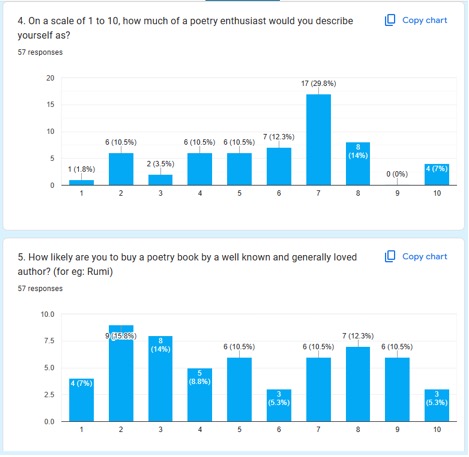
Doorway to learn how readers describe their preferences in their own words
Friends and peers would give you the exact terms used by people who only read occasionally i.e., everyday language, like:
- “I buy books when someone I trust recommends them.”
- “I prefer short reads because I don’t have time.”
- “I like books I can gift.”
-
“I save poetry for when I want to feel something specific.”
Take this information and use it to shape your book blurb/descriptions, marketing/positioning copy, and social media communication. You’d come across as an author who understands readers – not just shouts at them from a high horse.
How to survey
People tend to respond when surveys are low effort, friction-free and do not trample over their personal privacy. Keep confidentiality, ease, skippability at top of your priority. I like using Google Forms as it exports the result into Google sheets and gives results in clear charts.
Steps to create a Google Form survey:
- Start: Use a standard template or create a blank form on forms.google.com.
- Add content:
- Title and description: Click on “Untitled form” to give your survey a name and add a description for context (keep it conversational for building rapport).
- Add questions: Click the “+ ” button to add new questions, choosing types like Multiple choice, Paragraph, or Dropdown.
- Customize: Use the palette icon to change the theme, header image, and colors. (No worries if you keep it simple.)
- Configure settings:
- Required questions: Toggle the “Required” switch to make important questions mandatory. (Don’t keep too many of these; I’d suggest to not make open-ended questions mandatory, give people choices to select instead; aim to reduce friction.)
- Collect emails: Go to Settings to limit responses to one per person or collect email addresses. (It might deter people from giving you a response at all, so consider making this non-mandatory.)
- Collecting names: (People become conscious when they feel watched; consider making this non-mandatory or encourage anonymous naming.)
- Number of pages: Keep to a minimum. I suggest a crisp page. You never want to make a reader overwhelmed just filling your Google form.
- Send and analyze:
- Preview: Click the eye icon to see what respondents will experience.
- Share: Click the “Send” button at the top right to share via email, link, or embed the form.
- Review responses: View answers under the “Responses” tab, where you can see summary charts.
Takeaways for authors
When you are looking to break into the world of commercially successful publishing, it helps if you know how people, in general, talk about reading; and one way to understand this is by talking to the average reader.
A survey can break your assumptions, throw light on your potential blind spots and force you to face the squeamish feeling that comes when asking people to pay for your work (aka sales).
It also builds an ongoing conversation between you and potential readers – instead of you randomly showing up and asking people to buy a long form like a BOOK. Having a digital trail of process and thought does wonders for credibility and community.
Even if the survey responses do not directly shape any of your content, the gesture itself communicates respect. People appreciate being considered.
Finally, a survey is useful early content because it:
- helps the project feel real
- reduces uncertainty about the publishing landscape
- invites interaction (good for the algorithm)
- encourages people to participate
- signals seriousness of intent (for future work)
- builds early connection with readers
- creates curiosity (“what are they working on?”)
- creates momentum before launch
- creates a memory marker (“oh yes, this person has been working on something for a while”)
What authors should not take from this
Surveying, however, does not mean: write what people demand / follow trends blindly / optimize creativity into blandness. It simply means understand the landscape you are entering. Surveying your own circle does not give statistically perfect market data. What it does give is: direction, language, confidence, and awareness of reader behaviour.
Parting note
Take heart in the fact that reading enthusiasm ≠ reading frequency. People appreciate books, respect authors, enjoy literature, value thoughtful writing, but often read less than how much they’d like to. Your creation has merit, whether or not someone reads/ buys it.
But if you aim at generating money from your writing, you have to understand this basic fact: you are a seller. This is a marketplace. The readers are potential customers. The laws of business and commerce apply impersonally.
Bio: Rajvi Mittal is a multi-passionate author and artist from India. She has self-published a poetry chapbook titled “Reborn: Darkness is the Seed of Light” and writes a LinkedIn newsletter ‘SnowFlames Weekly’. Her writing has been published in McSweeney’s Internet Tendency, Entrepreneur Magazine and other online blogs. Her photography & artwork is forthcoming in Blood+Honey, and Flash Frog Lit Magazine. She made a career transition from a corporate consultant to support her health and is now a freelance artist. Her merch is available at her Etsy shop, Phoenix Rising Creations.
]]>Now through September 30, Indigo is seeking submissions for their first issue. Poets may submit up to three poems. Although they accept all types of poetry, the editors especially love “stark imagery and tactile, emotional experiences on the edge of the unsaid.” Authors of fiction and creative nonfiction may submit work of any length, though pieces 3,000 words or fewer are likely to be the best fit. The editors prefer fiction with a powerful sense of place; they also like introspective writing that embraces the surreal. For creative nonfiction, they like writing rooted in personal experience.
Indigo accepts submissions online using Google Forms, not via email or by post. They accept simultaneous submissions but ask that authors withdraw writing published elsewhere. They do not accept previously published work.
Indio only accepts submissions that follow the guidelines they’ve posted online. Please read these guidelines in full before submitting.
If you would like to learn more or submit to Indigo, please visit their website here.
Bio: Ella Peary is the pen name of an internationally published author and editor. After earning a Master of Fine Arts degree in poetry from Sarah Lawrence College, she lived as a monastic for five years. She now lives as a lay monastic, and teaches poetry, flash fiction, and literary publishing at the Authors Publish Writers Workshop. Her writing has been published in Room, The Apple Valley Review, Fourteen Hills, and elsewhere. And a number of full-length manuscripts she’s edited have received major international awards, including The Best Graphic Novel of the Year (Comics Finlandia), The Montaigne Medal, and The National Indie Excellence Awards. She’s also a long-time literary journal reviewer and editor at Authors Publish Magazine.
We try to make it as clear as possible who the publisher is seeking work from. Sometimes the focus of the press is limited, even though there are no limitations on who can submit. A few of the opportunities are also limited by geography, again, we try to make this clear. There are always additional submission details at the site we link to, but we try to cover the basics as best we can as part of this list.
If you belong to a limited demographic that is not listed here, this list might be helpful to you.
As long as a press/opportunity/journal is open to submissions we will continue to list it, so some of the content on the list is new, some overlaps with previous issues. This article is an ongoing collaborative effort by Emily Harstone and S. Kalekar. Please send us an email at support@authorspublish.com if you have any feedback or an opportunity/journal/publisher, to recommend.
Literary Journals/Magazines
Tasavvur
Tasavvur publishes submissions of South Asian speculative fiction of all kinds – fantasy, sci-fi, horror, magical realism, mythpunk, weird fiction, or anything genre-bending during their reading periods. They also accept non-fiction pitches and art on an ongoing basis. You can read the latest issue here and past issues here to get a sense of what they publish. They accept work from “Writers of South Asian origin or association (broadly defined — including diaspora, mixed heritage, or meaningful cultural affiliation)
Non–South Asian writers whose speculative fiction stories are deeply rooted in South Asian themes or settings”. They pay $0.05/words for stories of up to 5,000 words, and $100 for nonfiction. The deadline is 31 August 2026 for fiction submissions.
Usawa Literary Review
This is an India-based literary magazine and they accept submissions from all over the world. They want submissions for their Queer Unfiltered issue, and they have detailed guidelines. “We are primarily looking for entries from queer and transgender writers. But we welcome a few entries from allies that specifically and thoughtfully engage with queer and trans lives.” Submission is via a form. The deadline is 25th August 2026.
Tawahan
They only accept work from authors who identify as Arab or live in the Arab world (broadly defined), and accept submissions in Arabic and English. “This does not mean that the work must be in any way related to being Arab, Arab identity, or anything of that sort, merely that this magazine is made by Arabs, for Arabs.” “For Tawahan, Arts is not merely visual arts, poetry, or prose. We welcome experimentation, the novel, and the new.” They are accepting work on the ‘Ruins’ theme till 23rd August 2026. Submit here.
Reckoning
This magazine publishes fiction, creative non-fiction, critical essays, poetry, translations, book reviews, and art on environmental justice. “We are always seeking work from Indigenous writers and artists, racialized writers and artists, queer, trans and/or disabled writers and artists, and anyone, anywhere in the world, who has suffered the consequences, intended or otherwise, of dominant society’s systemic disconnect with and mistreatment of the natural world.” About fiction, they say, “The fiction we publish is mostly, but not exclusively, speculative. We appreciate surreal, literary, and experimental pieces as well as strong plotting, but prefer writing that doesn’t lean too far into pulp.” They have detailed guidelines. They are reading submissions for Issue 11. Send up to 15,000 words for fiction, up to 20,000 words for creative non-fiction, up to 10 pages for poetry; they pay $0.15/word for fiction and creative non-fiction, and S75/page for poetry. Submission is via their Moksha portal. The deadline is 31 August 2026; details here and here.
And, Reckoning is are also accepting novellas on environmental justice, of 17,500 – 40,000 words, for which pay starts at $0.02/word. Submit a synopsis initially via Moksha; see here.
Reckoning is also accepting flash fiction of 1,000 words or less on environmental themes for a special call – “Outside of flash, what we specifically want are weird stories, dark stories, horror stories . . . and yet stories with some bit of hope to them, even if that hope is simply, We will persist, we will exist, we will endure. You can’t make the world a better place, after all, if you aren’t there to do the work.” The deadline for this call is 31st October 2026. Details here.
Heartlines Spec
They will soon open for submissions. This Canadian magazine of speculative fiction and poetry wants work on long-term relationships; during each submission period, they have an exclusive reading period for equity-deserving groups which includes (but is not limited to): Racialized people, People with disabilities, LGBTQIA+ people, Indigenous people, Women, and Neurodivergent people.
Also, their goal us to publish at least 50% work from Canadian writers for each issue. “We’re looking for short fiction and poetry focused on long-term relationships: platonic, romantic, or familial. We don’t want the blaze of new love or the obsession of a new friend. We want pieces that show that comfort that develops when people know each other for years.
Give us deep space, dusty frontiers, or dreamy fantasy. We want stories and poetry with strong, confident relationships amid all the sci-fi/fantasy. While we are primarily looking for stories with happy endings (yeah, yeah), we also want endings that are earned. If things get a little teary or gory, that’s ok.
We are especially interested in stories featuring queer platonic relationships, ace/aro love stories, and polycules.” The early submission period for equity-deserving groups is August 24-31 2026 and they are reopening for general submissions September 1-30. Their submission portal will open during the reading period. Send 500-3,500 words for fiction; up to 5 poems. They pay CAD0.08/word for fiction; CAD60/poem. Details here (guidelines) and here (submission portal)
Translunar Travelers Lounge
They will open for submissions mid-September. They want fun speculative fiction; stories must have elements of science fiction or fantasy. “A fun story, at its core, is one that works on the premise that things aren’t all bad; that ultimately, good wins out. This doesn’t necessarily mean that your story has to be silly or lighthearted (though it certainly can be). Joy can be made all the more powerful when juxtaposed against tragedy. In the end, though, there should be hope, and we want stories that are truly fun for as many different kinds of people as possible.
Swashbuckling adventure, deadly intrigue, and gleeful romance are some of the most obvious examples of what we’re looking for, but we won’t say no to more subtle or complicated topics, as long as they fit under the wider “fun” umbrella.” They will reopen for submissions from 15th September to 15th October 2026; first week of submissions (15th to 21st September) is reserved for writers of color only. They pay $0.03/word for stories up to 5,000 words.
Room Magazine: Belonging
This Canadian magazine accepts work by persons of marginalized genders only, including but not limited to women (cisgender and transgender), transgender men, Two-Spirit and nonbinary people. “Send us your takes on belonging, not belonging, longing to belong, otherness, belonging on the fringe, belonging to the future, the past, the now. We welcome your imaginings, experiences, dreams, and fears of belonging in all their manifestations and intersections: poetry, fiction, and creative non-fiction as always, but we’re also eager to read your comics, hybrids, graphic essays, and other forms that resist and defy the boundaries of belonging in the art world.” They are only open for submissions from Canadian writers for all categories except art; international submissions are closed. Length guidelines are up to 3,500 words for prose, up to 5 poems. They pay CAD50-200 for writing. Submissions will close by category when they fill. They’re also open for a fiction contest, for which there is a submission fee. Details here and here.
Shō Poetry Journal
This Arizona-based biannual print journal was revived in 2023 after a twenty-year hibernation period. They offer free submissions through August 31st, 2026, to US-based Indigenous poets.
Apus雨燕
A literary journal that feature bilingual diasporic artwork and writing in Chinese and English. The print and digital publication welcomes poetry, fiction, nonfiction, essays, visual arts, and creative works that blend genres. They are open to submissions till August 31st on the theme of Suspension. This is what they say about the theme: “We invite works that dwell in states of suspension —emotional, bodily, political, spatial, linguistic, or otherwise. We welcome work that lingers in ambiguity, experiments with form, and resists easy resolution.” They pay a token amount. If you have not heard from them in 30 days, assume rejection.
The Masters Review
They are open to submissions from all authors, but have a special portal for BIPOC and other historically marginalized writers. Authors can submit through this portal for free to receive either a faster response to their submission, or few lines of feedback on it. They are also open to only “new voices” so authors that have published single-author novel-length work or under contract with a major press are ineligible. They publish fiction and narrative nonfiction.
East Jasmine Review
East Jasmine Review is an electronic literary magazine that publishes quality fiction, nonfiction, poetry, articles and reviews. They don’t have strict rules around who can submit but they state “Our first goal is to publish diverse voices that may not have mainstream access or traditional access to publishing. This includes but is not limited to LGBTQIA, ethnic minorities, women, lower socio-economic status, those who are older or younger, religious minorities, and non-American persons”.
Bipolar Poetry
This not-for-profit online publication publishes original poetry by people who have been diagnosed with bipolar affective disorder.
The B’K Magazine
This art and literature magazine prioritizes and pays traditionally marginalized creators, but they are open to submissions from all. They have very in-depth and detailed submission guidelines that everyone should read carefully before submitting.
CVNT
A new journal that declares they exist “for the solicitation, exhibition, advancement, & support of transfeminine writers”. Submissions are restricted to transfeminine people, binary trans women, & genderqueer folks. They accept submissions of poetry, fiction, & creative nonfiction on a rolling basis.
Gasp Magazine
I’m not linking to this publication in the title, because their website is not safe for work as they are a publisher of adult work. Please do not click on this link unless you are 18+/ They focus on sharing a multifaceted discussions on sexuality, eroticism, and queerness. They are interested in essays, interviews, research articles, creative writing, poetry, artistic illustrations, and photography (with additional rules) that reflect upon sex or the absence thereof in one way or another.
The Saartjie Journal
This new journal is only open to writing and visual art by Black women artists and writers. They accept submissions of previously unpublished original poems, short stories, and visual art.
Mande
This is a journal of bipolar talent. “Mande is always open to submissions from bipolar creatives on any topic. While I appreciate the long shadows bipolar throws, I’m particularly interested at the moment in its high points, in any joy or positive elements you find in bipolar. We also publish work by people familiar with bipolar, as long as it’s directly related to manic depression.” They pay for fiction, nonfiction, poetry, and art. They pay $50-250.
Cripple Punk Mag
This Substack publishes “essays, criticism, news and reviews, literary nonfiction, fiction, rants and raves, comics, and hybrid works on the subject of disability and live music, especially within the context of punk, alternative, and DIY music.” They also have an annual print anthology. Payment starts at $10 and is dependent on length and sliding scale based on need. Submissions are accepted on a rolling basis. Previously published work is allowed, and work should be between 300 and 1,000 words in length.
The West Trestle Review
This respected journal is only open to submissions poetry and art by creators around the globe who self-identify as women or as non-binary. They are always open to free submissions by BIPOC writers who self-identify as women or as non-binary, and you can see those guidelines here.
Decolonial Passage
According to their website they “publish writing from writers of all backgrounds regardless of race, origin, or gender while simultaneously centering African, African American, and Black Diaspora writing.” Their mission statement goes into more details about this. They are open on a rolling basis to essays, creative nonfiction, short stories, and flash fiction. They are open to poetry only during the months of February, June, and October; and for prose, only during April, May, August, and December.
Magnets and Ladders
They publish the work of disabled writers in two issues a year.
DisLit Youth Magazine
They only publish work by writers 14-22, and they primarily publish disabled writers.
AURORE
This publications tagline is “a curated collection of erotic stories written by and for women and LGBTQ+ based on their own experiences”. Because it is a NSFW site, the link to get to it is here, instead of the title, please only click on it if you are 18+ They publish nonfiction erotica and their website is NSFW, please do not visit it if you are under 18.
Heaven Magazine
They are interested in publishing fiction, creative non fiction, flash, and poetry by all underrepresented creators.
Sinister Wisdom
A multicultural lesbian literary & art journal. Founded in 1976, this literary journal is always open to submissions.
Saffron City Press
Saffron City Press is an online literary journal dedicated to amplifying the voices of Middle Eastern and Middle Eastern-American writers.
The Kalahari Review
A weekly African literary magazine interested in material exploring modern Africa and Africans in unique and avant-garde ways. They publish their work on Medium.
Transition
Born in Africa and bred in the diaspora, Transition is a publication of the Hutchins Center at Harvard University, published three times annually. Transition publishes writing by and about Africa and the African diaspora, with an eye towards a global perspective. They accept submissions year-round on a rolling basis, and generally respond to submissions within four months. They are reading submissions for a special folio, “Africa and Black Migrants in the Trump Era.” They are particularly interested in nonfiction, but accept other creative genres as well; the deadline is 1st September 2026.
Lavender Review
An international, biannual e-zine published in June and December, they are open to submissions of poetry and art by, about, and for lesbians. Submissions are open year round.
Ricepaper
This publication offers Asian Canadian context to ongoing arts and cultural issues, new perspectives on emerging and established Asian Canadian artists, and challenges mainstream media perspectives, little-known facts of interest, or critical stories that haven’t been told elsewhere. They are open to submissions from Asian writers around the globe as long as the editors can see a link between the content and some aspect of the Asian Canadian experience.
Raising Mothers
Raising Mothers celebrates and centers the experiences of Black, Indigenous, and Brown parents. Some sections have reading periods; columns are open year-round. Guidelines are here. See their call for 2026 here.
African Writer
They are open to all genres of literature from Africa and the African Diaspora. They do not allow simultaneous submissions.
Afritondo
According to their website, “Afritondo is a media and publishing platform that aims to connect with and tell the stories of Africans and black minority populations across the globe.” They accept a wide range of work, including manuscript-length work.
Brittle Paper
Brittle Paper is an online literary magazine for readers of African Literature. They accept the following: “fiction, poetry, creative non-fiction, book reviews, essays, literary commentaries, fun listicles, and any writing with a literary bent”.
Torch Literary Arts
Torch Literary Arts is a nonprofit organization. They publish and promote creative writing by Black women only; you can read more about them here. They publish contemporary writing by experienced and emerging writers. “We are interested in work that challenges and disrupts preconceived notions of what Black women’s contemporary writing should be.” General submissions are accepted for Friday Features only, in which they publish fiction, creative nonfiction, poetry, and drama (including that accompanied by video or dramatic audio). Send up to 3,500 for prose works, up to 10 pages for drama, or up to 5 poems. Pay is $150. Submissions are accepted on an ongoing basis; you can submit here.
Bi Women Quarterly
BWQ features the voices of women “with bi+ sexualities (i.e., bi, pan, fluid, and other non-binary sexualities)” and they see “woman” as a broad category and welcome contributions those who identify as trans, non-binary, cis, etc. They publish articles, creative writing, musings, and more. For their upcoming Winter issue, the theme is Body Image, and the deadline is 1 November 2026; see the submission form for details.
KOENING ZINE
They publish art, fiction, poetry, and creative nonfiction submissions primarily by Asians, but they are open to submissions from non-Asians. Their uniting theme is Asian Folklore. Submitters must be over 18.
POETRY SANGO-OTA
We only usually include journals currently open to submissions, but this list is always published on the third Thursday of a given month, and this journal is only open to submissions through the 1st to the 10th of each month, so we are listing it and encouraging you to set a calendar alert for when it reopens on the 1st of the next month. “We are interested in poems with a keen connection to a sense of place, nature, or otherworldly geographies.” They only publish African poets, and pay N2,500 per poem.
The Gay & Lesbian Review
The Gay & Lesbian Review is a bimonthly magazine of history, culture, and politics targeting an educated readership of LGBT people, and their allies that publishes themed features (2,000-4,000 words), reviews, interviews, and departments. They have announced a couple of themed calls, and they also invite suggestions for future themes.
- Going South: LGBT lives below the Mason-Dixon Line
- LGBT+Z: The Gen Z queer experience
Writers can send proposals or complete pieces. They pay for features ($250) and full-length book reviews ($100).
The Acentos Review
The Acentos Review publishes writing, art, music and multigenre work by Latinx writers. They are open to submissions all year long. Details here.
Craft
This respected literary journal is open to creative work from authors of all backgrounds, but they offer free submissions + fast response times to BIPOC and other mis- and underrepresented writers, here. Craft pays $100 for flash and $200 for short fiction and creative nonfiction.
The Lighthouse / Black Girl Times
The tagline of The Lighthouse is, “Cultivating spaces of solidarity and safety for southern Black girls to shine through focused programming and research.” They have an extensive guide for pitching articles, including “We … are always looking for thought-provoking stories and other content from marginalized communities, Black girls, (in particular, but not exclusively) and gender non-conforming people. In addition to story and long-form story pitches and op-eds, they accept photography and original artwork for their online blogging platform, The Black Girl Times, and their monthly newsletter, The Black Girl Times Redux. Also, “Each month, we have an editorial theme board (kind of like the mood boards interior designers use) we post on our social media accounts (@luvblkgrls). The theme board is intended to be an inspiration and provocation of thoughts, ideas and feelings. Your response(s) can be literal or abstract and loose. And again, it might not have anything to do with anything we’ve seen.” Pay is $0.25-$50/word. Pay for art (graphic design, cartoons and photo essays) can range up to $250.
Screen Door Review
They only publish work by individuals who are Southern and queer. You can learn more about how they define Southern here. They publish flash fiction and poetry.
Emergent Literary
An exciting literary journal that accepts a wide range of submissions from Black and Brown authors.
Presses/Anthologies
Blaft Publications: Women With Weapons Anthology
They want short fiction. Your story should prominently feature a woman wielding a weapon. “*Or many weapons. Or many women, wielding many weapons.
**Trans women are women.
***Non-binary weapon wielders are also welcome.
… Your story may be in any genre. It may be set in the past, present, or future. … This call is open to writers of all genders residing anywhere in the world. However, we are an Indian company, and will give preference to stories that will work for our primarily Indian audience. Nevertheless, don’t be shy to send in your Congolese swordswomen, medieval Vietnamese vampire slayers, or Belizean Mennonite harpoonists.”
One of the requirements is, “Your story must FAIL the REVERSE BECHDEL TEST . … To FAIL the reverse Bechdel test, … your story must feature
- a) at most one man
b) or, if it does feature more than one man, the men must not talk to each other
c) or, if the men do talk to each other, they must ONLY talk about the women; they are not allowed to discuss anything else.
(Exceptions may be considered if your story is extra genderspicy and you find all this binary logic constraining.)” They pay INR3,000 + INR3/word for stories of 1,000 – 8,000 words. The deadline is 15th September 2026.
Neon Hemlock Press: We’re Here – The Best of Queer Speculative Fiction 2026
They want fiction reprints only, of queer speculative fiction published published in 2026. “We’re Here 2026 will feature the best queer speculative short fiction published in 2026.
… Authors and editors both are welcome to read the submissions guidelines and submit queer speculative work from 2026.“ And, “We are looking for:
- The best speculative stories published in 2026 under 17,500 words that implicitly or explicitly explores queerness and/or transness.
- We refer to queerness that is inclusive of ace/aro stories, trans and nonbinary stories, and intersex stories.
- What we don’t want to see: Original/unpublished work, unqueer work, non-speculative work.”
They pay $0.01/word for works of 17,500 words. The deadline is 31 December 2026. Details here (scroll down), here and here.
DILIM Press: Sirena’s Song, An Anthology of Dark Fiction from the Philippine Diaspora (vol. 2)
This is a fiction and poetry anthology. “Sirena’s Song is DILIM’s second anthology of work by debut, emerging, and established global Filipino writers and poets.
DILIM’s goal is to provide a home for work in this anthology that focuses on themes important to women and non-binary authors.
Mermaids have traditionally been understood as sea-based creatures who navigate between the ocean and the land.
Many authors in the diaspora also navigate boundaries, submerge to the depths, and rise up with new ideas.
If these concepts spark your imagination, please help us build this collection.
The stories of the Sirena are about humanity’s needs, desires, imaginations, and intentions and are of and pertaining to the ocean, the sea, the islets and bays, the shores, and the rivers and waterfalls–here and in other worlds or other planets–where our kinfolk water-creatures might exist.” They also say, “We’re seeking your tales of thalassophobia, oceanic terror, underwater kingdoms, origins of the Yonaguni monument, creatures from Lemuria, musical echoes in the depths, or the dance of the stars in the heavens.
Share with us your fable about Amanikable, Amansinaya and Haik, WASP-34, or your imaginative stories of what fisher-folk or Navy sailors have seen in the night. Did the nuclear submarine ping a strange creature? Did unidentified submerged objects make an appearance? Share with us in your weird, wild fiction!” The submission deadline is 30 September 2026 or when they hit their submission cap, whichever is earlier. Details here and here.
Penguin UK: Merkey Books New Writers’ Prize
This is an annual prize, and is open to young (ages 18-35), underrepresented and unpublished writers from across the UK and Ireland. Writers also have to be unagented. It is for a work of literary and commercial fiction (for a completed manuscript or a manuscript in progress – see FAQ); send a synopsis of 200 words and an excerpt of 1,500 words. The winner receives a publishing contract with Merkey Books, an imprint of Penguin Random House UK, which also includes an advance. And, shortlisted writers will also be invited to their Writers’ Camp. The deadline is 24 August 2026. Submission is via a form (which also lists the genres they are accepting).
Academy of American Poets: Ambroggio Prize
This is an opportunity for US poets. They want a book-length poetry manuscript originally written in Spanish and with an English translation. Poets may translate their own work or collaborate with a translator who may or may not be a poet; the poet and translator must share the prize. The original manuscript in Spanish must be between 48 and 100 pages. Their website also says, established in 2017, the Ambroggio Prize is the only annual award of its kind in the United States that honors American poets whose first language is Spanish. The prize is $1,000 and publication; the deadline is 15 September 2026. Details here and here.
(The Academy of American Poets has other awards as well, both fee-free and fee-based – see their Submittable for all open calls.)
Speculative Literature Foundation: Working Class Writers Grant
They are open for various grants through the year for speculative literature, which “spans the breadth of fantastic writing, encompassing literature ranging from hard science fiction to epic fantasy, including ghost stories, horror, folk and fairy tales, slipstream, magical realism, and more. Any piece of literature containing a fabulist or speculative element would fall under our aegis.” One of their upcoming grants is the Working Class Writers Grant, an international grant for “speculative fiction writers who are working class, blue-collar, financially disadvantaged, or homeless, who have been historically underrepresented in speculative fiction due to financial barriers which make it hard to access the writing world. Such lack of access might include an inability to purchase a computer, books, and tuition, or to attend conventions or workshops. Often, these writers, many of whom work more than one job, have less time to write. … Unlike our other grants, you may choose to receive this grant anonymously or pseudonymously.” A cover letter and writing sample are part of the application requirement. The form will be available during the submission period. The grant is $1,000, and the application period is 1st to 30th September 2026; the application period will open during this period. You can see all the Speculative Literature Foundation grants here.
Generous Press
They are open to submissions from BIPOC authors only during their current reading period. Generous Press publishes “lush, high-caliber, and inclusive romance fiction: books so well written that every sentence is a delight to read aloud.” They close to submissions on September 1st.
Hear of Her
The new press Hear of Her is open to submissions for their first anthology, an erotic collection exploring female desire through the lens of darkness, in all its forms. You can learn more about what they are looking for here.
Thyme Travelers 2: An anthology of speculative fiction by Palestinian writers
Their website says, “Roseway, an imprint of Fernwood Publishing, will be publishing a sequel to the award-winning and acclaimed anthology Thyme Travellers featuring speculative fiction by Palestinian writers. … This anthology is open to writers who identify as Palestinian. This includes all Palestinians living anywhere in the world, and of any race. Authors from marginalized groups are encouraged to submit.” Payment is $0.08/word for stories up to 5,000 words. The deadline is 31 August 2026.
Rebel Satori Press
Rebel Satori Press is open to submissions for it’s LGBTQ+ speculative fiction imprint, Queer Space and Arabi Manor, it’s esoterica imprint. Queer Space only allows submissions from Queer authors and Arabi Manor is open to submissions from all authors but highly encourages submissions from Queer authors. You can read our full review here. Queer Space closes to submissions on October 14th, and Arabi Manor closes to submissions on October 31st.
Heyday Books: Berkeley Roundhouse program
Heyday is an established independent and nonprofit publisher that focuses on California and the American West. They publish nonfiction books that explore history, celebrate Native cultural renewal, fight injustice, and honor nature. They are open to submissions from Native voices in particular for their Roundhouse imprint, which you can learn more about here.
Palimpsest Press
They only publish Canadian authors. They are open to submissions from authors who identify as BIPOC, Deaf, or Disabled, all year round. They accept submissions from authors who do not identify as BIPOC, Deaf or Disabled from March 1st through March 31st. They publish poetry and other literary genres.
Adarna House
This established press based in the Philippines is committed to promoting culture and languages is support of Filipino artistry and talent. They are open to submissions from Filipinos 18 years or older, based anywhere in the world. There is no limit to the number of pitches one may submit. Submissions may be in Filipino or English or come with a Filipino or English translation.
Lantana
They are an award-winning children’s book publisher based in England, United Kingdom. They are looking for manuscripts and book dummies by authors and illustrators from underrepresented groups. They almost exclusively publish stories with child protagonists (including poetry, graphic novels and nonfiction) and are not looking for stories only featuring animal characters.
The University Of Arkansas Press
The University of Arkansas Press accepts unsolicited proposals for scholarly and trade books on topics related the African American history and culture. You can visit their website here to see the titles they’ve previously published.
aunt lute
A multicultural women’s press. Their priority is to publish work by women, both transgender and cisgender, particularly women of color. We have reviewed them here.
Little Puss Press
A feminist press run by trans women. They are open to general submissions of fiction and non-fiction manuscripts. They are also open to reprint proposals of literary/historical works of significance by transgender authors. They have good distribution, excellent press, and have already published work that has won a major award.
Arte Público Press
They focus on publishing literary work by “Hispanic writers”, and they publish work in both English and Spanish, but primarily focus on English work. They also have bilingual children’s and YA book imprint, Piñata Books.
The Black Lawrence Immigrant Writing Series
This opportunity, from Black Lawrence Press, is for immigrants living in the US – for manuscripts of fiction, nonfiction, poetry, and hybrid writing. “Poets and authors, at any stage of their careers, who identify as immigrants are welcome to submit a book manuscript of poetry or prose or a hybrid text for consideration. Submissions are accepted year-round. However, selections are made in June and November for a total of two books per year. In addition to publication, marketing, and a standard royalties contract from Black Lawrence Press, authors chosen for the Black Lawrence Immigrant Writing Series will receive a travel stipend of $500, which can be used for book tours or in any manner chosen by the authors.”
North Dakota State University Press: Contemporary Voices of Indigenous Peoples Series
The goal of this series to feature the authentic stories, poetry, and scholarly works of Native Americans, First Nations, Maori, Aborigines, Indians, and more to give voice to contemporary Indigenous peoples. NDSU Press considers book-length manuscripts of fiction, nonfiction, and poetry for publication in this series.
Monsoon Books
This respected press accepts unsolicited manuscripts with Asian, particularly Southeast Asian, themes.
Arsenal Pulp Press
A Canadian independent press that publishes a wide variety of work, prioritizes work by LGBTQ+ and BIPOC authors. We have reviewed them here.
Salaam Reads
They are an imprint of Simon & Schuster Books for Young Readers. They are actively seeking to publish books that center on positive and joyous portrayals of the Muslim experience across all genres for children. They say “Our goal is to highlight well-rounded portrayals of Muslim children and families in mainstream children’s media. We want to share stories that center Muslim characters without depicting their religious identity as a major source of conflict.” They are open to submissions aimed at readers starting at 4 years of age and going up to 18. They particularly encourage submissions of MG and YA novels.
Lily
A small poetry press that publishes work of varying length. Submitting shorter work is free for everyone, but submitting poetry manuscripts is free only for poets who identify as Black. They are always open to these submissions.
Angry Robot
A great science fiction publisher that only accepts direct submissions from Black authors.
Heartdrum
Heartdrum is an imprint of HarperCollins Children’s Books, which is edited by Cynthia Leitich Smith, and is in partnership with We Need Diverse Books. Native and First Nations writers and writer-illustrators are welcome to query her directly via a form on her website. Native and First Nations illustrators are also invited to reach out.
Opportunities/Support/Contests
Miles Morland Foundation Writing Scholarship
This is for published fiction and non-fiction writers who were born in Africa or whose parents were born in Africa (see ‘Do I need to prove my African birth place?’ in FAQ). The money is paid monthly over a course of a year. For non-fiction writers, additional funds can be made available, and given over a period of 18 months. A published writing sample is part of the application (see guidelines). One of the scholarship requirements is, writers have to submit 10,000 words of writing every month (see guidelines). They also say, “The Foundation will not review or comment on the monthly submissions as they come in. However, each Scholar will be offered the opportunity to be mentored by an established author or publisher. In most cases the mentorship will begin after the book has been finished and the Scholarship period has ended.” And, “Scholars are also asked to donate to the MMF 20% of whatever they subsequently receive from the book they write during the period of their Scholarship. … These funds will be used to support other promising writers. The 20% return obligation should be considered a debt of honour rather than a legally binding obligation.” They award £18,000 to fiction writers, possible additional funds for non-fiction writers. The deadline is 22 September 2026 (see ‘Important Dates’ in the entry requirements here.); see the application form here.
Harvard University: Radcliffe Institute Fellowships
This is an opportunity for published writers and journalists. These prestigious fellowships are for various disciplines, including creative arts – which include, but are not limited to, poetry, fiction, non-fiction, as well as journalism, and playwriting. “We welcome applications proposing innovative work that confronts pressing social, scientific, and policy issues and seeks to engage audiences beyond academia. Reflecting Radcliffe’s unique history and institutional legacy, we welcome—but do not limit eligibility to—proposals that focus on women, gender, and society or draw on the Schlesinger Library’s rich collections.
We also invite proposals relevant to the Institute’s multiyear focus area, which for 2024–2029 is academic freedom and connecting across difference.” Application is via their submission portal. The fellowship pays $78,000, and an additional $5,000 for project expenses; fellows also get an office at Harvard University, additional funds for moving expenses, childcare and housing, etc. The deadline for some disciplines, including creative arts, is 10th September 2026. See the eligible disciplines for this cycle here.
Horror Writers Association Grants
Their Diversity Grants, worth $500 each, are for “underrepresented, diverse people who have an interest in the horror writing genre, including, but not limited to writers, editors, reviewers, and library workers.” Apply here.
Their Mary Wollstonecraft Shelley Scholarship is for horror writers who identify as women; “Each Scholarship is worth $2500, which may be spent on approved writing education over the two years following the granting of the scholarship.” Apply here.
The application deadline for the above grants (via Submittable) is 2nd October 2026. They have other grants as well, some of which are open now.
Perugia Press Prize
This annual prize includes book publication and a $2,000 prize, as well as 20 author copies and an ongoing discount of 50% off of the cover price for additional copies. It is open only to women, inclusive of gender-expansive identities. There is a fee attached to this prize for general submissions, but BIPOC writers can submit for free. They close to submissions on November 15th. Please read their full guidelines carefully before submitting.
Princeton University Press: Global Equity Grants
These grants are for authors of underrepresented groups to support the preparation of works that is already under contract, in production, or published within the last 12 months. Grants range from $500 to $1,000. The grants can be used to cover a wide range of supports including parental/family care, and translation. More details at the source. Applications are considered on a rolling basis.
BIPOC scholarship for Emily Harstone’s classes at The Writer’s Workshop at Authors Publish
Each time Emily Harstone offers The Novel Writing Workshop (for manuscripts in progress), Submit, Publish, Repeat (for poems, short stories, and CNF publication in literary journals), and Manuscript Publishing for Novelists (for completed novel and memoir manuscripts) through the Writer’s Workshop at Authors Publish, there is now an opportunity for two writers who identify as BIPOC to take it for free. If you registered last year, please note that the form re-set in January, and you are encouraged to fill it out again.
Bio: S. Kalekar is the pseudonym of a regular contributor to this magazine. She can be reached here.
]]>Writing requires effort. When it becomes work, we reason that if we’re going to put in so much effort, we might as well get paid for it. While that doesn’t happen to everyone, it’s still a thought that’s present in the background. Writing just for fun suddenly isn’t possible, because it could be work instead. Or it’s just work, because after writing professionally all day, the brain’s too tired to do writing that’s unrelated, that’s just for our own joy.
Which is why writers need hobbies other than writing. When we switch to doing something different, something that demands different skills from us—or demands not much skill at all, such as coloring in drawings—we’re increasing our chances of finding creative solutions.
During writing or editing, our brain is focused, concentrating all its efforts on the task at hand. But just like other parts of the body, our brains need rest. The brain actually never stops working, but when we take a break to just take a walk or do something routine like folding laundry, it gets a breather. This is when it puts things on the back burner, where the problems we’re trying to tackle when focused—a plot hole, a tricky bit of dialogue, the best place to introduce our antagonist—simmer slowly, taking their time to come to a boil. In other words, it’s when we move away from a problem that we hit upon some solution.
And to do that we need something that we can do just for fun. Something that’s not attached to productivity, to capital. Which is what hobbies are all about.
Knitting, drawing, cycling, scrapbooking, playing the guitar—they’re not just hobbies, but also opportunities to observe the world anew (such as through collecting a variety of leaves by drawing them in detail), to develop discipline and learn field-specific knowledge (such as all the different types of knots and knits), to understand how those in other professions think or work (such as when trying to compose a new tune on your guitar).
And this variety in our learning, which comes not from reading and writing but from doing, from living, allows us to add more richness to our writing. The world reveals itself to us in new ways. We’re able to think from the perspectives of people—and, therefore, characters—who are not us. The more varied our knowledge, the greater the number of permutations and combinations of knowledge our brain can create to increase our creativity. By keeping ourselves limited to words, we limit the quality and depth of those words.
But even if our newfound love for say, crocheting or gardening doesn’t lead us to directly improve our writing by enabling us to create different characters and plots, hobbies are still worthwhile: they nurture our physical and mental well-being. We need to get up from our desks not just for the sake of our brains but also for our bodies. We need to stretch and bend and move and jump whenever (and however much) we can.
The subjects we write about can drain us, even if they were imaginary, such as fairy-elf border conflicts, and not just set in the real world, such as the huge losses caused by unseasonal rains for small farmers. Writing can be and is a form of service, but in order to serve well, we also need to take care of ourselves. And in a day when most of our time may be devoted to doing our work and providing care to our families, hobbies offer a chance to wind down (and this can be done collectively, too, such as through knitting clubs).
Most of all, though, we need hobbies because as loyal as we may be to the writing life, we also need something else to love. Otherwise, the work may lead us to falling out of love with writing. Effort will always be needed, and sometimes even long, painful, draining hours.
But if we’re always distant, always focused on productivity, and output, and numbers, be they word counts or payment-per-word, we may risk becoming averse to writing. The negative feelings of work that we have to push ourselves to do get associated with the thing that used to bring joy to us. When that happens, there might come a day when suddenly, we don’t want to write anymore. Or we’re saving every word, reluctant to throw anything away, worrying ourselves about getting everything right, perfect.
This can lead to perfectionism, to aversion, and even to quitting. Even if that quitting lasts months rather than a lifetime, that’s still a long time away from something that we usually cannot live without. I’ve been there and it was painful—returning to the page even more so. But I returned because I loved writing and I found that I could do it if I remembered that I was not just a writer. I was a person who writes, a person who loves writing, but also a person who loves practicing the guitar, knitting little projects, scrapbooking, cooking, and going on walks. When the writing feels difficult, I put down my pen and pick up the guitar or some needles. When I miss words, I go back to the page again.
But to come back to writing, I need to leave first—and I can do that because I’ve found other things to love.
Bio: Ratika Deshpande is a writer from India. Her work has appeared in Authors Publish, Reactor Magazine, the Brevity Blog, and other platforms.
]]>Haven Speculative
They publish speculative fiction and poetry. They also publish climate crisis focused Dry and Wet issues each year; scroll down on the guidelines page for details. “We like stories that are subtle in their telling and stick with us long after we’ve finished, and we’re more likely to buy stories that balance a sense of wonder with a bold plot and emotional depth. For our two issues focused on the climate crisis, we’re particularly interested in publishing stories from people displaced by or threatened by the climate emergency (see our themes below). For our other four issues, we’re open to a wide variety of stories across the SFF and weird spectra (e.g., science fiction, fantasy, speculative horror, and beyond).” They also accept translations. During each submission cycle, they have one month reserved for submissions from underrepresented writers, and one month, for all writers. In August, they’re reading submissions from all writers.
Deadline: 31 August 2026
Length: Up to 5,000 words for fiction, up to 5 poems
Pay: $0.08/word for fiction, $20/poem
Details here and here.
(– And Reckoning publishes mostly, but not exclusively, speculative fiction, creative nonfiction, critical essays, poetry, translations, book reviews, and art on environmental justice. Pay is $0.15/word for creative prose, and S75/page for poetry. They’re reading submissions for Issue 11; the deadline is 31 August 2026. Details here and here.
— Three-Lobed Burning Eye will open for submissions of speculative fiction – horror, dark fantasy, and science fiction during 1st to 15th September 2026; submission is via their Moksha portal. They also accept translations. Pay is $0.08/word for stories of 500-7,499 words; details here.)
The Ex-Puritan
They accept fiction, nonfiction, experimental/hybrid work, interviews, reviews, poetry, and poetry in translation. The deadline is 25 September, or when filled, for the next issue; they accept a limited number of fee-free submissions every month, and read year-round.
Deadline: 25 September 2026, or until filled
Length: Varies
Pay: CAD200 per essay; CAD150 for fiction; CAD100 per interview or review; CAD50 per poem, capped at CAD100; CAD50+ per experimental or hybrid work, at an increasing scale depending on the nature of the piece.
Details here and here.
(– Short Story, a Substack-based magazine, is also open; they want short stories of 6 words to 10,000 words, and they are open from the 1st to 31st of each month. They pay $100 + 50% of paid subscriber revenue. Details here and you can see their July statistics, including payout, here.
— The Cincinnati Review will reopen for print submissions on 1st September, and close when the submission cap is reached. They pay $25/page for prose and $30/page for poetry in the print journal, and $25 for miCRo posts or special features. Their submission portal will open during the reading period.)
Chestnut Review
Chestnut Review accepts fee-free submissions of flash prose, poetry, and art. They charge for submissions of longer prose of 1,000-5,000 words, while Black and Indigenous authors can also submit longer prose for free. They read throughout the year, with cut-off dates for issues.
Deadline: 30 September 2026 for the Winter issue
Length: Up to 1,000 words for flash prose, up to 3 poems
Pay: $120
Details here and here.
Lit Fox Poetry Series
“The Lit Fox Poetry Series is a publication featuring one exceptional poem per season. … the selected poem will be our top featured poem for three months.” Submissions are closed for poetry books.
Deadline: Open now
Length: Up to 5 poems
Pay: $150
Details here.
(Submissions are also open for The Lisbon Literary Review, a new literary magazine; they’ve issued a call for poetry. “The Lisbon Literary Review welcomes submissions of original poetry in Portuguese and English, and translations across those two languages.” And, “ Submissions are open internationally to authors writing primarily in Portuguese or English. The inclusion of other languages is welcome, provided the poem is predominantly written in one of these two languages.” Send up to 3 poems – see details in Submission Format in T&C; they pay €100; details here.)
Cōnfingō Magazine
Cōnfingō is a UK-based independent publisher. Regarding the magazine, their website says, “Twice a year we publish a collection of new short fiction, poetry and art from around the world in a beautifully produced, print-only magazine.” Stories may be in any style or genre. Submission is via a form on their website.
Deadline: Open now
Length: Up to 5,000 words for fiction, up to 3 poems (see guidelines)
Pay: £50
Details here.
Bio: S. Kalekar is the pseudonym of a regular contributor to this magazine. She can be reached here.
]]>Formerly The Minison Project, Wild Willow was launched in 2025. Since then they’ve published six issues with themes such as “Mums”, “Wintergreen”, and “Pomegranate”. Each downloadable issue contains writing from around 25 contributors, as well as visual art.
Wild Willow is published four times a year—in January, April, July, and October—and holds four corresponding submission periods. They are open from January 15 through March 15, April 15 through June 15, July 15 through September 15, and October 15 through December 15.
Poets may submit up to three poems. Authors of fiction and creative nonfiction may submit one piece, 2,500 words or fewer, or up to three flashes, 1,000 words or fewer each. Wild Willow accepts all forms and styles of writing.
Right now, Wild Willow’s “Minipress” is also seeking submissions for their “Mini Recipe Book” anthology. They are looking for recipes with corresponding writing or visual art that evoke memories through the senses. Authors may summit up to three recipes, and they will accept submissions until the anthology is full. You can read the complete guidelines here.
Wild Willow accepts submissions online using Google Forms, not via email or by post. They accept simultaneous submissions but ask that authors withdraw writing published elsewhere. They do not accept previously published work, and they do not accept writing generated by AI.
Wild Willow only accepts submissions that follow the guidelines they’ve posted online. Please read these guidelines in full before submitting.
If you would like to learn more or submit to Wild Willow, please visit their website here.
Bio: Ella Peary is the pen name of an internationally published author and editor. After earning a Master of Fine Arts degree in poetry from Sarah Lawrence College, she lived as a monastic for five years. She now lives as a lay monastic, and teaches poetry, flash fiction, and literary publishing at the Authors Publish Writers Workshop. Her writing has been published in Room, The Apple Valley Review, Fourteen Hills, and elsewhere. And a number of full-length manuscripts she’s edited have received major international awards, including The Best Graphic Novel of the Year (Comics Finlandia), The Montaigne Medal, and The National Indie Excellence Awards. She’s also a long-time literary journal reviewer and editor at Authors Publish Magazine.
]]>Those are usually the characters I trust.
Fiction has this weird historical addiction to emotional fluency. People in novels somehow produce perfectly shaped confessions while under immense psychological stress. Their trauma arrives alphabetized. Even their breakdowns have paragraph structure. Meanwhile real humans can’t explain why they’re upset without suddenly discussing sandwich bread from 2009.
Ask a real person why they’re angry and watch the brain blue-screen in real time.
“No, it’s fine.”
Pause.
“It’s just weird.”
Pause.
“I mean forget it.”
Longer pause.
“You always do this thing where—actually never mind.”
Then somebody laughs at the wrong moment because the body pulled the emergency brake too hard.
That’s dialogue. Or closer to it, anyway.
One of the fastest ways to flatten a character is making them emotionally literate beyond human capability. Especially during conflict. Especially during love scenes. People rarely identify their actual wound while bleeding from it. They circle it like raccoons around a trash can fire. They become historians of irrelevant details. They suddenly need water. They start discussing parking validation. Emotional avoidance is wildly creative.
And honestly kind of funny.
A guy can spend six pages complaining about a restaurant bill when the real issue is his wife almost left him three months ago.
Writers sometimes trim away this conversational mess because they think clarity equals quality. It doesn’t. Too much clarity starts sounding like therapy pamphlets wearing fake mustaches.
Real conversations leak sideways.
The most believable characters usually understand themselves incompletely. They revise mid-sentence. They contradict themselves within thirty seconds. They say “I don’t care” in the exact tone of somebody constructing a shrine in their basement.
That contradiction matters. Human beings are walking formatting errors.
One thing I love: characters who weaponize politeness instead of honesty. Absolute masters of emotional taxidermy. Somebody saying “Whatever works for you” with enough frostbite hidden inside the sentence to preserve mammoths.
Or the character who turns every serious conversation into stand-up comedy because sincerity feels like being skinned alive. They crack jokes right at the emotional cliff edge. Wrong timing. Weird energy. Everybody in the room quietly exhausted.
These people exist everywhere. Family dinners especially. Thanksgiving conversations have the structural integrity of collapsed mines.
I once watched a relative announce a divorce while buttering a dinner roll. Nobody reacted correctly. One person asked for more peas. Another started talking about highway construction. Somebody laughed because the silence got too loud. That’s the stuff fiction often misses: emotional events scrambling conversational gravity.
People glitch.
And those glitches create texture way more effectively than polished vulnerability speeches.
A character saying the wrong thing tells you more than a perfect confession ever could. Somebody apologizing for being late when they actually mean “please don’t abandon me.” Somebody obsessing over whether the window is open because panic needs a smaller object to wear like a coat.
Suppression changes sentence rhythm too. You can hear restraint inside syntax. Short answers. Abrupt pivots. Over-explaining tiny details while avoiding the actual emotional bomb duct-taped beneath the table.
“Did you eat?”
Translation: I was scared.
“You should probably get some sleep.”
Translation: I miss when you existed near me.
“Traffic was bad.”
Translation: I sat in the car for forty minutes trying not to cry before coming inside.
People hide inside language constantly. Fiction should let them.
The danger is making awkwardness feel manufactured. Some writers add stammering and ellipses everywhere like seasoning gone horribly wrong. Suddenly every character sounds like a haunted fax machine.
Awkward dialogue still needs pressure underneath it. The character must want something badly while failing to approach it directly. That friction creates electricity. Without desire underneath the verbal mess, scenes just wander around Target emotionally.
And there’s another thing. Silence counts as dialogue too. A character changing the subject is dialogue. A character suddenly becoming fascinated by refrigerator magnets during an argument is dialogue. People confess through avoidance all the time.
Honestly, some of the saddest scenes I’ve ever read involve characters discussing completely irrelevant objects because the real feeling sitting between them is too large to touch barehanded.
That’s emotional realism to me. Not elegant honesty. Not cinematic speeches in the rain. Just two damaged little mammals standing in a kitchen talking about batteries while their marriage quietly bleeds to death beside the toaster.
Messy. Indirect. Mortifying.
Human.
Bio: Sabyasachi Roy is an academic writer, poet, artist, and photographer. His poetry has appeared in The Broken Spine, Stand, Poetry Salzburg Review, Dicey Brown, The Potomac, and more. He contributes craft essays to Authors Publish and has a cover image in Sanctuary Asia. His oil paintings have been published in The Hooghly Review. You can follow his writing on Substack here.
]]>If one takes too realistic a look at the figures, then it can be argued that the number of authors who’ve been able to have such an impact on the world is quite small, especially when compared to the millions of books that are published across the world each year. So, statistically, we’re going to need huge odds in our favor to be in the company of authors like Carson or Perez. It might even convince us to give up any hope that writing can change things.
But the truth is that our writing has more power than we assume. It’s impossible to change the world—it’s just too big—but it’s not impossible to have no impact. We have some power in the immediate areas around us—our families, our friends, our neighborhoods and local communities are all places where our participation can make a difference. And if not even those, then we have power over ourselves. Over who we are and what we think.
When we write, with or without the expectation of making a difference with our words, there’s no guarantee that we will change others. But there is a guarantee that at least one person will be transformed by that writing—our own selves.
If we work with the pressure of using our words to bring about changes in the world around us, we may never get started. We will reject ideas that don’t, on the surface, seem “important.” You might want to write about a woman who steals stars from the night sky, but you might end up writing articles on the climate crisis. While both are valid and both are important to you personally—we’re multidimensional, passionate—you might think the latter are more important, more “necessary.”
But no form of writing is more important than the other. We need all kinds of writers (and artists, journalists, researchers, activists) to provide vision, alternatives, evidence so that our imaginations, be they rooted in science fiction or in data revealed through investigative journalism, can be nurtured, so that we can shape a better future.
On the surface, it’s difficult to predict what kind of writing will inspire people to take action, to innovate, experiment, legislate. It could be a poem, a short story, even a single sentence. The reaches of influence are random, unpredictable. By trying to control this process, by writing what might matter instead of writing what we feel compelled to write—through our love for a genre, or through responsibility towards a community—we lose our voice. Our words are the most potent when they have our voice behind them and that voice comes when we write from passion, honesty, care rather than when we approach writing from a cold, removed sense of obligation.
It’s important to note that we can be responsible, active citizens of the world or even of our communities without necessarily making writing the medium through which we create change—we can write for ourselves, then help others through our jobs, through volunteering, or through simply being good neighbors.
Clinging to the potential, unpredictable impact of our writing on others can be unhealthy, unhelpful. Instead, if we write from passion, if we write when we are compelled to, when the silence nags us, or when the pain demands channeling into the creation of a louder voice or a cozy retreat, we can bring out stuff from deep within ourselves. This internal matter is often honest and can be the very key that provides potential for connection with a reader—and through that connection, a change.
I’m not arguing that we should give up all efforts to use our writing for the greater good. Every voice, every imagination matters. The world is too complex to control, but that very feature of it is what increases the number of possibilities so much.
So what can we do, exactly? There’s no one specific answer, but several possibilities. Over the last few years, I’ve found that it matters who’s doing the writing. Underrepresented voices need to be heard more. So do underrepresented languages. The internet is perhaps one of the most effective ways to share our visions and ideas with as many people as possible, but a lot of it exists in a limited number of languages and so one way of making a difference is for multilingual writers to write in languages other than “global” languages like English—just think of what it would mean for a person who only speaks these other languages to come across words similar to those that have transformed you.
Consider also the things you know that many others don’t. Writing is also sharing knowledge. Shine a light on what’s ignored, what’s less known, or is unknown and needs to be searched.
But if you can’t do that, or if you’re interested in something else, celebrate it, as Ray Bradbury says. Joyful writing matters just as much and can also give people the ability to look at the world in a new light. As James Baldwin said, “[…] your aspirations and concern for a single man in fact do begin to change the world. The world changes according to the way people see it, and if you alter, even by a millimeter, the way a person looks or people look at reality, then you can change it.”
Bio: Ratika Deshpande is a writer from India. Her work has appeared in Authors Publish, Reactor Magazine, the Brevity Blog, and other platforms.
]]>