The Pig’s Back
This Ireland-based journal publishes fiction and nonfiction. They do not publish poetry.
Deadline: 15 October 2023
Length: 2,000-5,000 words
Pay: €300
Details here.
Uncanny Magazine
This award-winning speculative fiction magazine is only open for short fiction during this submission period – please do not submit works of other lengths or genres.
Deadline: 16 October 2023
Length: 750-10,000 words for short fiction
Pay: $0.10/word
Details here and here.
MetaStellar
They have opened their flash speculative fiction submission window during October – this is a paying opportunity. “We’re looking for your best enthralling, imaginative, or bone-chilling original fiction stories, as long as they’re 1,200 words or fewer.” They also welcome unpaid submissions and pitches all year round — in the form of reviews, essays, excerpts, and reprints.
Deadline: 31 October 2023 for flash fiction
Length: Up to 1,200 words
Pay: $0.08/word
Details here, here, and here.
Baltimore Review
They publish fiction, nonfiction, and poetry. Some editor preferences are in the bios on their Staff page.
Deadline: 30 November 2023
Length: Up to 5,000 words for prose, up to 3 poems
Pay: $50 (via a gift certificate or PayPal, if preferred)
Details here and here.
The Paris Review
They are open for poetry and poetry translation submissions in October. Their Submittable will close when the cap is reached, but they will still accept mailed submissions through October.
Deadline: Until filled for submissions via Submittable; postmarked till
31 October 2023 for mailed submissions
Length: Up to 6 poems
Pay: Unspecified
Details here.
Bio: S. Kalekar is the pseudonym of a regular contributor to this magazine. She can be reached here.
]]>Love Inspired Suspense is an imprint of Harlequin that focuses on publishing work where romance and suspense are both major elements. They describe the work they publish as “Edge-of-the-seat, contemporary romantic suspense tales of intrigue and romance featuring Christian characters facing challenges to their faith…and to their lives”. You can see the catalogue for this imprint here.
You can read our review of Harlequin, and their digital imprint Carina, if you want to learn more about the company as a whole, but this article very much focuses on these two related imprints. I don’t usually group two imprints together and I don’t often review imprints if the publisher as a whole mostly publishes one genre. However, these imprints are clearly linked by their name and their focus on the Christian market, which also sets them a part from the Harlequin catalogue as a whole.
Like all Harlequin imprints you submit your work through Submittable. Both imprints are seeking complete manuscripts that are 55,000 words in length, along with 3-5 page synopsis of the book. Both imprints want the book to reflect a Christian worldview and contain wholesome values. Both imprints are seeking books featuring “relationships that emphasize emotional intimacy rather than sexual desire.”
There are lots of other details about the specifics the imprints are seeking, the editors involved and their promotional plans. You just have to go to Harlequin’s submittable account and scroll down to the end of their imprint list to get details about both publishers. Follow the submission guidelines carefully before submitting.
]]>
Long River Review was established in 1997. The journal is published annually in print and online, and each edition features writing from around 20 contributors. The journal also features a large amount of artwork, also from around 20 contributors.
Long River Review accepts a wide range of writing: poetry, fiction, creative nonfiction, translations, dramas, hybrid pieces, and “any otherwise uncategorized creative works.” Authors submitting English translations should include the original text.
Right now, Long River Review is open to submissions through December 15. Poets may submit up to five poems. Authors of prose (fiction and nonfiction), dramas, and multimedia pieces may submit up to 6,000 words.
Long River Review also accepts all mediums of visual artwork, including photographs, illustrations, prints, paintings, comics, drawings, and mixed media pieces.
Contributors to Long River Review receive two print copies of the journal.
Long River Review accepts submissions online via Submittable, not by email or post. They accept simultaneous submissions but ask that authors withdraw writing (and artwork) published elsewhere. They do not accept previously published work.
Long River Review only accepts submissions that follow the guidelines they’ve posted online. Please read these guidelines in full before submitting.
If you would like to learn more or submit to Long River Review, please visit their website here.
Bio: Ella Peary is the pen name for an author, editor, creative writing mentor, and submission consultant. Over the past five years, she’s written hundreds of articles for Authors Publish, and she’s also served as a copywriter and copy editor for a wide range of organizations and individuals. She is the author of The Quick Start Guide to Flash Fiction. She occasionally teaches a course on flash fiction. You can contact her at ellapeary@gmail.com.
]]>Are you writing a memoir? A story about your life or someone else’s life? Have you considered your theme? Or your plot? Remember, every life has a story to share and that story needs, no, in fact, it has both a theme and a plot. So, don’t randomly launch into the story of a person’s life, even if it’s your own life, without first considering the theme and the plot. And, in order to best develop the plot, you need a theme. Remember, life doesn’t just happen, even though there are times when we all feel like it does, and not always for the better. Plotting a memoir and giving it a theme is not so different from the short story or the novel. Life doesn’t ramble and neither should your story about this life.
Here are some tips to keep your plot and theme engaging and meaningful, just like the life you’re writing about. First of all, it always helps to make a list. I’m a passionate list writer. I’d be lost without my lists. But, seriously, without a list to lead you forward, your memoir is doomed to be a random collection of stories. From personal experience, I started writing my memoir by writing memory stories as I thought of them. The result was a mishmash of stories with no identifiable connection. I had to return to the drawing board, so to speak, and make a list. At the very least, it would sort out my ideas and memories into some sort of reasonable order.
What do you need on this list? The bare facts for one thing. Start by answering these questions:
- Who are you writing about?
- What are their life dates?
- Where were they born? Where did they live?
- Why do you want to write this story? What contributions did they make to the world around them?
- What is so important about this story?
- Are you exploring a dramatic life-changing event, like a battle won against a dreaded disease? Or an escape from a horrific situation?
- Why is their life so important? Now this is a tricky question. I was interviewed by a national broadcasting station and was asked this very question. My answer? Every life is important. We just need someone to believe enough in that life to make it important enough to write about. When I was submitting my grandmother’s story, years ago, I frequently received rejection letters from big-name publishers telling me that they would only consider a biography of a famous person. My argument since then has been, how many books do we really need about famous people, when there are so many un-famous, more than ordinary, extra-ordinary, beyond the ordinary lives whose stories should be, need to be told. These are the stories that make our world, that define our world and our lives; these are the stories that describe who we are. Extraordinary people – we are all extraordinary, we all have a story to tell, our story.
- Do you want your story to be a gift to the next generation? So that they can appreciate and understand their ancestors?
I’m sure you can think of more questions to add to your list, but these certainly will get you started. Fueled with these thoughts and a beginning list of questions, you are ready to launch into your memoir.
What next? Perhaps you should make a plot map, like you would for a work of fiction. The ‘what happened when’ is always a good place to start, and a good way to organize your thoughts, but be careful to keep the what happened when stories from sounding like another list of this happened when. How? Add descriptive narrative to set the scene. Add some dialogue between the characters involved in the story. Make your story come alive.
So, what is the theme of your memoir? Themes are the same for memoirs as they are for any story. Don’t confuse theme with the plot. Basically, plot is what the characters do, while theme is the lesson or moral underlying the plot. Theme is the message describing an opinion about life, human nature or elements of society. Themes include:
- Human conflict with nature
- Human conflict with society
- Good versus evil – crime doesn’t pay
- Overcoming adversity within or without – triumphing over life’s struggles
- The power and the sacrifice of friendship – “Those who seek a friend without a fault remain without one.”
- The power and the sacrifice of family
- Love – romantic, situational, family, general sense of caring for another living creature
- The cycle of life and the intricate connection between life and death
There are several themes in the above list that you will connect with right away. Life is full of these themes. However, it is helpful to maintain consistency in your storytelling art to choose one that fits best and stick to it. Be mindful of both your plot and your theme throughout the storytelling process. Keep referring to your lists and reflect on various turning point moments, special times that have changed the person you are writing about. Ask yourself more questions:
- What kind of special moments became turning points?
- Are there some moments of great joy and happiness, or moments of fear, sadness and inconsolable grief you wish to include to strengthen the theme and move the plot forward?
A memoir may seem like a compilation of complications, both nonsensical and often irrational. Life, quite simply, is full of chaos. So, how can you possibly sort through the chaos to create a sustainable plot? Well, your timeline and your lists should help you with that. And, of course, your theme. Remember that life is more than a series of ‘this happened when’ type of events. There is a reason for everything in life and there is a reason why you, as the writer, chose specific events to write about.
Emily-Jane Hills Orford is a country writer, living just outside the tiny community of North Gower, Ontario, near the nation’s capital. With degrees in art history, music and Canadian studies, the retired music teacher enjoys the quiet nature of her country home and the inspiration of working at her antique Jane Austen-style spinet desk, feeling quite complete as she writes and stares out the large picture window at the birds and the forest. She writes in several genres, including creative nonfiction, memoir, fantasy, and historical fiction. http://emilyjanebooks.ca
]]>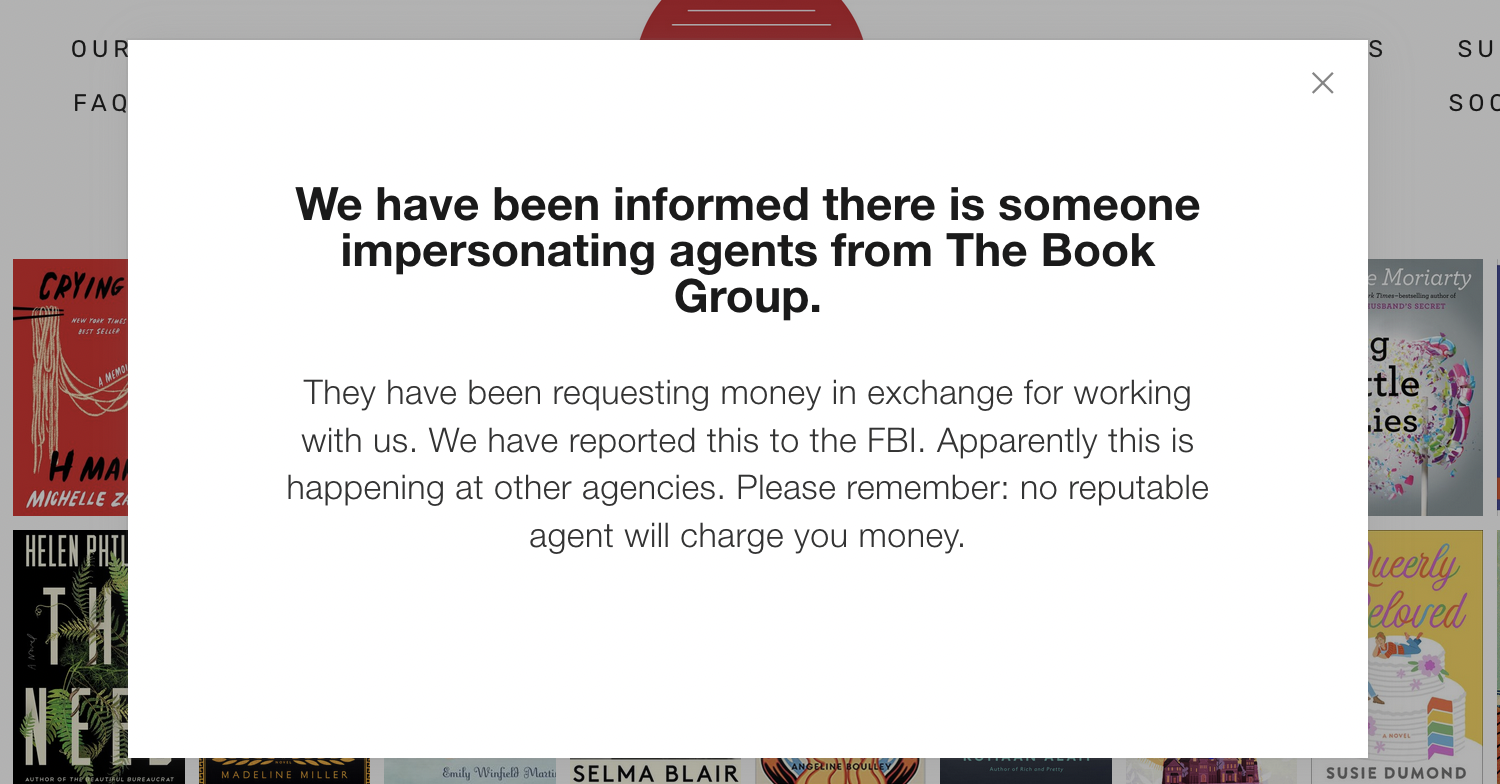
The Book Group website, screenshot taken October 2nd, 2023.
In the past there has always been an issue with fake literary agents charging money (you can read more about that here), but the newer version of the scam which has become increasingly prevalent has been scammers impersonating established agents and agencies, and cheating the writer out of thousands of dollars.
In July of 2022, Writer Beware wrote a thoughtful post on the subject. Since then the issue has only increased, as evidenced by all the agents who now have pop-ups on their landing pages like this one:

The Knight Agency website, screenshot taken September 26th, 2023.
or notes on their agents page like this one:
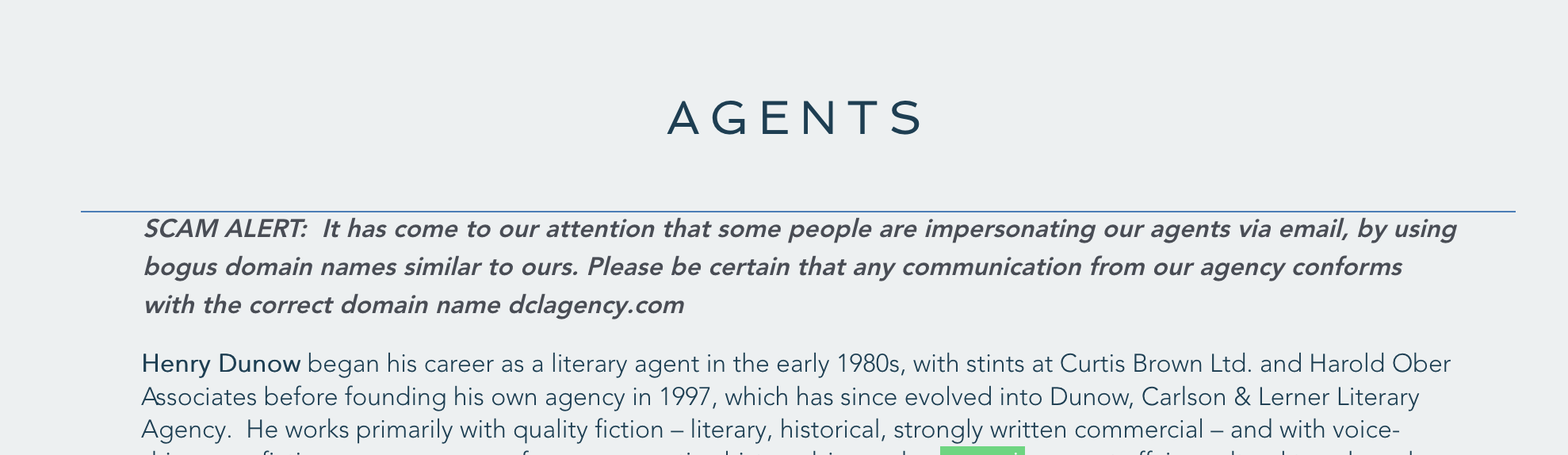
Dunlow, Carlson & Lerner Literary Agency website, screenshot taken September 27th, 2023.
We’ve also received increasingly urgent letters from subscribers on this matter, having lost money from these scams.
A legitimate literary agent will never charge you money to represent your book, and this knowledge should help prevent future scams. A legitimate literary agent will always be paid a percentage of the advance and royalties you receive from a publisher once one is found for your book.
The more one knows about how actual literary agents and agencies operate, the less successful scam artists will be.
Here are two other helpful resources in terms of literary agents, that should help you steer clear of scams:
Literary Agents (a helpful and regularly updated webpage by Writer Beware)
How to Find the Right Literary Agent for Your Book
Emily Harstone is the author of many popular books, including The Authors Publish Guide to Manuscript Submissions, Submit, Publish, Repeat, and The 2023 Guide to Manuscript Publishers. She regularly teaches three acclaimed courses on writing and publishing at The Writer’s Workshop at Authors Publish. You can follow her on Facebook here.
]]>